
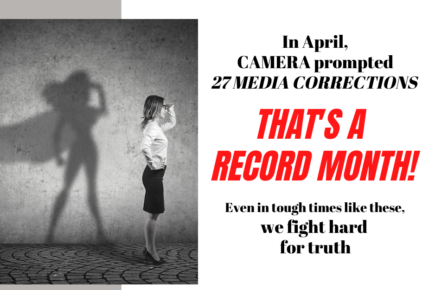
Amid Pandemic, CAMERA Prompts Unprecedented Number of News Corrections
In April, with the global battle to contain the spread of Covid-19 in full swing, CAMERA elicited a record 27 corrections in a variety of news outlets: from major media including The New York Times, Associated Press and NBC, to non-Western and alternative news sources.
 Iranian Hezbollah has warned two of the country's former presidents against undermining the country's Supreme Leader Ali Khamenei. Yet, print media shouldn't mistake divisions as a sign of "moderation."
  CAMERA staff prompt a Financial Times correction making clear that there are no curfews in eastern Jerusalem and no air strikes in Ramallah. The misinformation apparently originated with Thomas Hill of Save the Children.
  The Financial Times' story about Thomas Hill, an expat living in the West Bank is a poorly researched bit of propaganda that portrays Israel in an unfair and inaccurate light.
  What's the difference -- in news media coverage -- between Kashmir and the West Bank? It seems to be that, for the press, the former is "disputed" territory but the latter is "occupied." Yet sovereignty over the West Bank most definitely is unresolved and disputed.
  The Financial Times' David Gardner, led the way in presenting biased, incendiary coverage of the newly-launched Israeli-Palestinian talks. Name-calling, smears and propaganda trumped facts, context and objectivity.