
In PBS’ quest to give viewers “both sides,” it showed its audience that it deemed a terrorist leader worthy of more respect and civility than an Israeli diplomat.
Wafiq Safa is a founding member of Hezbollah and the brother-in-law and close confidante of since-assassinated Hezbollah chief Hassan Nasrallah. Simona Foltyn interviewed the top Hezbollah leader on Apr. 21, 2026. As she sat with Safa in an undisclosed location in the suburbs of Beirut, her questions to him were soft-spoken, open-ended, and he was never interrupted.
Upon introducing the interview, co-host of PBS NewsHour, Amna Nawaz, described Hezbollah as simply a “Lebanese militant group.” (Hezbollah is a proxy for Iran and an international narco-terrorist organization responsible for the death of thousands, including hundreds of Americans. It has been designated a terrorist organization since 1997 by the U.S.)
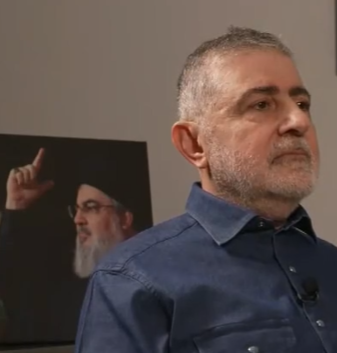
During the interview, Foltyn missed multiple opportunities for hard-hitting questions. She did not query Safa about Hezbollah’s twenty-year-old requirement to disarm pursuant to U.N. Security Resolution 1701 or ask about the group’s ongoing violations of the November 2024 ceasefire with Israel.
When Safa sidestepped a question, often Foltyn did not follow up. The most stunning part of the interview was Foltyn’s lack of pushback to Safa’s outrageous lie that Hezbollah’s “ethics and religion prohibit it from killing civilians.” Without challenge, Safa claimed that any Israeli civilian deaths were just collateral damage when Hezbollah fired at soldiers, ignoring the 12,400 indiscriminate rockets and other projectiles fired at Israel from Lebanon between Oct. 7, 2023, and November 2024, and another approximately 3,500 projectiles fired at Israel since March 1, 2026.
Other times, Foltyn asked a question that did some of Safa’s work for him. One example was when she asked why Hezbollah attacked first if it presupposed that Israel would deliver a “disproportionate response that would claim many civilian lives.” Safa’s answer was that the Israelis don’t need a pretext – something Foltyn did not argue with.
The calm exchange between Foltyn and a founder of a terrorist organization stood in stark contrast to a hostile, disrespectful interview conducted days later between PBS NewsHour co-host Geoff Bennett and Israeli Ambassador to the United Nations, Danny Danon.
Bennett’s Apr. 23, 2026, interview of Danon was aggressive. Bennett’s prosecutorial tone featured prominently, while context, transparency and basic phonetic research did not. Bennett both grilled and rudely interrupted Danon, but only after mispronouncing his name like a brand of yogurt, which stripped the interview of both fairness and professional courtesy. (It’s pronounced Dah-nohn.)
To Bennett’s credit, he acknowledged Hezbollah embeds itself in civilian areas. But he quickly pivoted and aggressively asked Danon, “[H]ow many civilian deaths per Hezbollah target is acceptable? Is it five? Is it 10? Is it 300? Or is there no ceiling at all?” Bennett appeared uninterested in answers, however, as he repeatedly cut off Danon’s replies. Unfair, hostile questions, containing built-in, unestablished assumptions were replete throughout the interview. The PBS host might as well have asked Danon when he stopped beating his wife.
Danon never said civilian deaths were “acceptable.” He told Bennett Israel had given evacuation notices to many communities in Southern Lebanon and does its best to minimize civilian casualties. He explained that Hezbollah, like Hamas, uses civilians as human shields and that the IDF does not just attack thoughtlessly, but engages in a process that includes legal advice before each attack. Danon also made clear that Israel wants peace with the Lebanese people, but that Hezbollah stands in the way.
Bennett’s aggression only grew. He raised the recent death of Lebanese journalist Amal Khalil and quoted Lebanon’s prime minister as saying that Israel’s targeting of journalists was becoming “an established approach.” Omitted, however, was Khalil’s affiliation with Hezbollah and the two other Hezbollah operatives killed alongside her.
Bennett cited an organization that has been platformed on the NewsHour program before, the Committee to Protect Journalists (CPJ). Bennett said CPJ “documented a pattern of journalists killed by Israeli strikes.” PBS has never revealed to its viewers that CPJ is an organization that maintains propaganda on its website and eulogizes card-carrying terrorists as “journalists.”
Before allowing Danon to speak, Bennett posed another fallacious question: “What military objective is served by killing reporters?”
Danon pushed back and called this a blood libel. He said Israel does not target reporters, something he reiterated on social media in the days to follow.
I did not allow the PBS anchor to spread lies. Israel is not “killing” journalists in Lebanon – we are killing terrorists. pic.twitter.com/7f5FxnJqs4
— Danny Danon 🇮🇱 דני דנון (@dannydanon) April 26, 2026
He implored Bennett to ask why some reporters were so close to Hezbollah operatives (likely referring to Khalil). Bennett interrupted him several times during this exchange, at which time Bennett again referenced CPJ’s “documented” allegation that 15 journalists and media workers have been killed in Lebanon since Oct. 7, 2023.
Bennett dismissed Danon (and Israel’s) representations that Israel does not target journalists. In a final dig, he asked, “At what number of dead journalists does that answer become one that the international community can no longer accept?”
Bennett’s line of questioning indicated a lack of understanding of Hezbollah, and how it operates by integrating its civilian infrastructure with its military infrastructure. Many Hezbollah operatives also work in civilian professions, including media. Though this is well-documented, it seems to elude many Western journalists, including Bennett. A terrorist doesn’t get immunity just because he moonlights as a shoe cobbler.
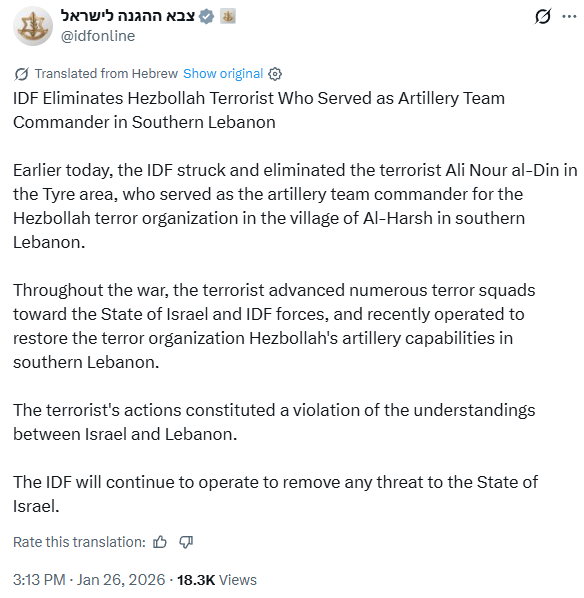
For example, Ali Nour al-Din was a TV presenter for Al-Manar network and a Hezbollah artillery operative and commander. According to the IDF, he “advanced numerous terror squads toward the State of Israel and IDF forces, and recently operated to restore the artillery capabilities of the Hezbollah terror organization in southern Lebanon.” He also operated in Syria during the civil war.
Ali Shoeib was another Al-Manar journalist who also served as an intelligence asset and operative for Hezbollah.
Ali Shoeib, a correspondent for Hezbollah’s TV channel Al-Manar who was eliminated on March 28, was not a “journalist” — but an intelligence asset and operative for Hezbollah in its preparations for an invasion of the Galilee and during the current war.
For years, he operated as… pic.twitter.com/0DzHFUMuA9
— Israel-Alma (@Israel_Alma_org) March 31, 2026
Over three years ago, when Bennett first joined PBS, he gave an interview to Salon. In it he talked about how context, transparency and thoughtful framing were important for “NewsHour.” He valued giving “viewers the clearest, most accurate distillation of the facts and the news of the day.” Bennett did not follow his own stated principles when interviewing Danon.
Challenging, tough questions are welcome – but that’s not what Bennett posed. Instead, he hurled conclusions and accusations masked as questions. His cross-examination of Danon lacked facts, context and transparency, and failed to allow Danon to give complete answers.
Viewers could speculate that PBS journalists have different standards for interviewing leaders of terrorist organizations versus diplomats. But, both a February 2026 News Hour interview of EU Ambassador to the United States Jovita Neliupšienė and a December 2025 interview of Ukrainian Ambassador to the United States Olga Stefanishyna were civil and respectful. (Their last names were also pronounced correctly.)
Maybe the hostility is only reserved for diplomats from one specific country.