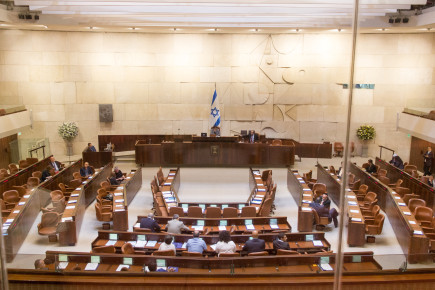
Media outlets falsely report that Prime Minister Benjamin Netanyahu shut Israel's courts, citing him as a prime example of an "authoritarian" national leader engaging in a "coronavirus coup." In fact, Justice Minister Amir Ohana, a Netanyahu ally, curtailed court activity without closing the institutions, a move backed by Supreme Court justice Esther Hayut.
Unsurprisingly, a newspaper that calls Benjamin Netanyahu a scold for trying to protect seniors is unable to report fairly on Israeli hesitations about the Joint List political alliance.
New York Times journalists continue to distort and revise history to maintain a phony but consistent narrative about who is to blame in the ongoing conflict.
The New York Times doesn't have a policy to avoid using the word "terrorist." So why did it scrub that word from coverage of Israel's strike on senior Islamic Jihad leader Baha Abu Al Ata?
When J Street convinces students to reject Israel's right to exist, David Halbfinger casts the group as truth-tellers who are literally beyond reproach — not a word of skepticism or criticism of the organization can be found in the article.
A story in today’s New York Times refers to Hamas rocket fire into Israel and its imprisonment of two Israelis. But reporter David Halbfinger avoids telling readers that these are both violations of international law.
New York Times Jerusalem bureau chief David Halbfinger authored two interviews in five days that underscore the newspaper’s continuing anti-Israel bias and shoddy attention to accuracy, context and clarity.
Why does the New York Times want its readers to wrongly believe that Palestinian gunmen and bombers struck down while engaged in combat were killed while merely "demonstrating"?