The New York Times won't correct an error it has corrected twice before, and won't defend its incorrect claim. But it is simply false to claim, as does David Halbfinger and Michael Crowley, that there had been until recently a “longstanding American policy treating the settlements as illegal.”
CAMERA prompts correction after CNN erroneously reported that "dozens" of bipartisan U.S. lawmakers signed letters to Secretary of State Mike Pompeo expressing their opposition to a potential International Criminal Court investigation of Israel. In fact, more than 300 members of the House and Senate signed.
CAMERA prompts correction of an AFP article republished at the Times of Israel which had erroneously reported that the Trump administration had recognized Israeli settlements. Last November, the administration stated that the settlements are not per se contrary to international law; it did not "recognize" them.
Among other misrepresentations, The New York Post misleads with the categorical claim that the AIPAC Policy Conference "has been boycotted by Democrats in recent years."
It has become common to hear that the U.S. government has always had an unwavering “pro-Israel bias.” But as CAMERA noted in The Jerusalem Post, history is never as simple, or as neat, as common narratives suppose.
There is no better illustration of the prevailing political advocacy journalism than the recent coverage of U.S. Secretary of State Mike Pompeo’s announcement about the current administration’s position on Israeli settlements.
A Wicked Local editorial falsely claims the Trump administration's anti-Islamic sentiment and support for Israel is the reason the United States Department of Education warned Duke University's Middle East Program that it was in danger of losing federal funding.
The Los Angeles Times falsely declares that the recognition of Jerusalem as Israel's capital, the relocation of the U.S. embassy from Tel Aviv to Jerusalem and the U.S. recognition of Israeli sovereignty in the Golan Heights all contravene international law.
In an article on the J Street conference, The Times twice reports that presidential hopeful Amy Klobuchar declined to answer a question about U.S. aid to Israel. The "Paper of Record" concealed from readers that at one point in the interview the senator expressed strong support for continued aid: "I am so wedded right now to making sure we continue the aid."
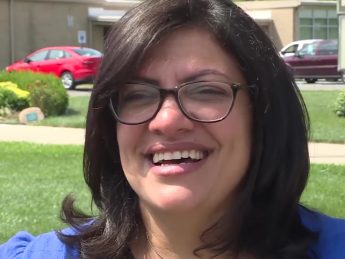
More than policy itself, it is the reaction and discussion of Benjamin Netanyahu's decision to bar two anti-Israel Congresswomen that has the potential to weaken traditionally strong American support for Israel.