
Context matters in journalism. Inverting the cause and effect of the subject in a story, or omitting the cause of an effect altogether, can have serious implications in the story’s presented conclusions. In PBS News’s September 7 story, titled “Inside southern Lebanon’s villages where Israeli occupation has upended daily life,” Special Correspondent Simona Foltyn and Videographer Adrian Hartick decontextualize the cause of the Israeli military presence and resulting damage in southern Lebanese villages. What is this cause? The Lebanese, Iran-backed Shia terrorist organization Hezbollah.
While PBS provides extensive coverage to the damage caused by fighting between Israel and Hezbollah throughout southern Lebanon, the outlet gives comparatively little attention to detailing the Hezbollah military infrastructure and ongoing presence in several villages in the region that prompted the Israel Defense Forces’ (IDF) operations in the first place.
While interviewing a family in the southern Lebanon Christian town of Marjayoun, Foltyn states,
Beyond their fence lies a stern warning. The Shia village of Dibbin has been largely destroyed, in what many here see as collective punishment of the Shia community who support Hezbollah.
To be fair, Askwak Dabaghi, one of the women Foltyn interviews, does not attempt to mask the region’s sympathy to Hezbollah, stating, “Even if them with Hezbollah, nobody deserves to lose her house, her family, her dreams.” The report, also to its credit, notes, “Most villages in this border region [with Israel] … are Shia Muslim and have historically supported Hezbollah…”
But this is where the coverage deviates away from explaining the cause of the damage in southern Lebanon. There was plenty more context to add, instead of acting as if Israel was arbitrarily operating in southern Lebanese villages with no good military reason. Consider Dibbin and Khiyam, two southern Lebanese villages referenced in the report.
The village of Dibbin was labeled in a Hezbollah document, seized during the 2006 war with Israel, as an “infantry center” where anti-tank mines were stored for sabotage operations against Israeli forces. Dibbin has been the subject of IDF strikes since 2024, after Hezbollah joined Hamas’s war against Israel on October 8, 2023.
More recently, in June 2026, the IDF carried out targeted operations against what Israel said was a “significant Hezbollah terrorist stronghold” in the area of Dibbin. Footage and photographs from the operations documented the elimination of several Hezbollah terrorists from the air, as well as large caches of Hezbollah weapons in the village. Also in June, Israel stated that Hezbollah had launched mortar shells which struck a United Nations Interim Force in Lebanon (UNIFIL) position in Dibbin, killing a U.N. worker.
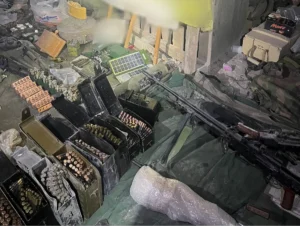
IDF-uncovered weapons cache in the Lebanese village of Dibbin, IDF Spokesperson
Dibbin is not merely some civilian village caught in the crossfire, it is a well-documented Hezbollah stronghold used to launch and plan attacks against residents of northern Israel and IDF troops along the southern Lebanese border. PBS chose to show the consequences of fighting in Dibbin while omitting the causes.
The other village, Khiyam, presents an even clearer case. Foltyn interviews two residents of the village, lamenting that the women have “helplessly watched the destruction of their community on their phones,” while observing that “only piles of rubble are visible” in Khiyam. Foltyn then moves on, once again omitting key context about significant Hezbollah presence in Khiyam while portraying it as just another arbitrary civilian landscape decimated by Israel.
Shortly after U.S. and Israeli strikes against Iran in February 2026, the Islamic Republic’s proxy in Lebanon, Hezbollah, opted to rejoin the fight against the Jewish State. On March 5, Reuters documented Lebanese sources stating that members of Hezbollah’s elite Radwan Force had “received orders to join the battle and block advances by Israeli tanks … citing the town of Khiyam.” Hezbollah’s Secretary General, Naim Qassem, stated that the terrorist organization would confront Israel’s “occupation and expansion” in Lebanon, a direct call to arms.
Days later, clashes broke out between Hezbollah and the IDF in and around Khiyam, according to local Lebanese sources. Hezbollah itself even released a statement on March 10 claiming to have “repelled an advance attempt by enemy forces on the southern outskirts of Khiyam.” Later in March, the IDF said that it had found a “large cache of weapons” hidden in a school in the area of Khiyam. The IDF also stated around the same time that it had found weapons located near a church in the village. In April 2026, Israeli forces located a 25-meter-deep Hezbollah command tunnel under a civilian clothing store in Khiyam.
With both Lebanese and Israeli sources confirming Hezbollah’s operations in Khiyam, there simply can be no ambiguity around the terrorist organization’s military capacity in the village.
In both cases, PBS failed to adequately explain to viewers the true extent to which Hezbollah was entrenched in southern Lebanese villages. The outlet fixated on the effects while ignoring the cause, leaving viewers with the impression that the IDF was striking these villages simply for the sake of it. PBS has an obligation to report the true extent to which terrorists have hijacked southern Lebanon and provide viewers with this context.