
From Feb. 6 to Feb. 11, PBS NewsHour made a series of serious journalistic faux pas in its Middle East reporting, including pushing one-sided narratives, erasing Oct. 7’s American victims, and failing to challenge a repressive regime.
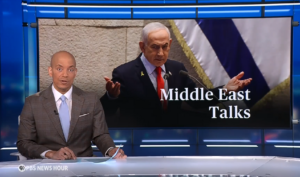
Screenshot of PBS News Hour segment “Netanyahu Visits Trump as US Restarts Iran Nuclear Talks,” Feb. 11, 2026.
“Aggressive” Israelis pushing Palestinian dispossession
Most recently, in its Feb. 11 segment, “Netanyahu visits Trump as U.S. restarts Iran nuclear talks,” reporters Geoff Bennett and Stephanie Sy framed newly approved Israeli Security Cabinet measures as tools of Palestinian dispossession, without explaining what the policies are.
According to a Feb. 9 announcement by Ministers Bezalel Smotrich and Israel Katz, these policies would largely remove longstanding legal and bureaucratic barriers to Jewish settlement in the West Bank, rooted in laws established while the territory was under Jordanian control between 1948 and 1967.
Shortly after Jordan illegally annexed the territory and wiped out all Jewish presence following the 1947-49 war, it enacted a law banning the sale of land to non-nationals, with an exception (article 4, section 2 of the law) for some non-citizens of Arab origin.
When Israel captured the territory in the 1967 Six-Day War, it voluntarily applied Geneva Convention provisions requiring an “occupying power” to maintain existing “penal laws,” despite not considering itself an occupier. As a result, a patchwork of Jordanian, British, and even Ottoman laws remained in force, including the Jordanian ban that effectively prevented Jews from legally purchasing land.
This Cabinet decision reversed this discriminatory restriction and removed additional bureaucratic hurdles by reopening sealed land registries to increase transparency and eliminating special permits and licensing requirements so that land transactions follow standard legal criteria, according to the announcement.
Sy said that the new measures would make it easier for “Jewish settlers to force Palestinians to give up land,” yet none of the measures listed in the announcement inherently involve coercion or forced dispossession. In making this argument, Sy assigns malicious intent to all Jews living in the West Bank, without evidence.
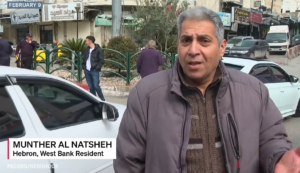
Screenshot of PBS News Hour segment “Netanyahu Visits Trump as US Restarts Iran Nuclear Talks,” Feb. 11, 2026.
Sy quoted the office of the U.N. secretary-general condemning the actions and a Hebron resident who claimed that Israel’s “fascist” government seeks to displace all Palestinian people, further implicating Israelis as “aggressive,” while portraying Palestinians as passive victims. This dichotomy, however, is not reality.
In the case of Hebron, its Jewish community maintained a presence for centuries, until Aug.1929, when it was massacred by the local Arab population, and subsequently evacuated by the British.
Hebron’s current mayor, Tayseer Abu Sneineh, is a convicted terrorist, one of four responsible for the 1980 Hebron attack in which six students were murdered. He was released in a 1983 prisoner swap and was elected as mayor in 2017.
Israeli forces arrested him again during a raid at his home on Sept. 2, 2025 for alleged involvement in terror activities, indicating he never reformed. Over the years, several other Palestinian politicians have also been arrested for terrorist activities.
By pushing a single narrative of a complex conflict on their audiences, the network merely acts as a conduit for activism, not journalism.
Did PBS forget there were American hostages in Gaza?
In a Feb. 6 segment, “Mike Huckabee on what’s next for Gaza and the Middle East,” PBS NewsHour’s Bennett interviewed U.S. Ambassador to Israel, Mike Huckabee, asking, as a final question, what understanding is lost about Israeli society and values when the country is viewed almost exclusively through the lens of war.
Huckabee sidestepped the thoughtful question, instead defending Israel’s actions in Gaza by asking whether Americans would stand idle if their own sons or daughters were being held hostage, raped, and tortured in tunnels, or whether they would do whatever it took to bring them home.
Sadly, the Ambassador seemed to forget that there were;11 American citizens taken hostage on Oct. 7 and 45 who were killed. Yet there was no mass American movement demanding the release of the hostages or justice for the families of those murdered.
The American citizens kidnapped that day were Edan Alexander, 19 at the time; Itay Chen, 19; Sagui Dekel-Chen, 36; Hersh Goldberg-Polin, 23; Gadi Haggai, 73; Judith Weinstein Haggai, 70; Omer Neutra, 21; Keith Siegel, 65; Judith Raanan, 59; Natalie Raanan, 17; and Abigail Edan, 3.
Goldberg-Polin was killed while in captivity, and the remains of Chen, Haggai, Weinstein-Haggai, and Neutra were taken to Gaza after they were all murdered on Oct. 7.
PBS prides itself on giving its viewers the facts, so why is PBS so willingly apathetic to this one? The least a publicly funded American network can do for the American victims of such unimaginable cruelty is remember them.
Softball questions for a hardline regime
In the Feb. 10 segment “‘No one wants war’: Iran spokesman discusses diplomatic path with U.S. after Oman talks,” interviewer Reza Sayah treated Iran’s Foreign Ministry spokesperson, Esmaeil Baghaei, as though the dispute with the U.S. were a playground quarrel, posing hardly any substantive or challenging questions.
The title alone frames the Islamic Republic of Iran as a peace-loving nation, despite its designation by the US as being the top state sponsor of terrorism due to its worldwide funding of terror proxies, its production of ballistic missiles and nuclear weapons and its cruelty to its own citizens.
For a representative of a regime whose security forces recently killed thousands of demonstrators, maintains one of the world’s worst human rights records, and has openly vowed the destruction of Israel, the United States, and Western values, any reporter would be expected to push back.
Instead, Sayah’s questions were soft and superficial: he asked whether Iran feared a looming war, whether Iranian Foreign Minister Sayed Abbas Araghchi and U.S. envoy Steve Witkoff had cordial exchanges in Oman, and what Iran might be willing to negotiate.
When the conversation turned to the death toll in recent protests, Sayah neither challenged Baghaei nor followed up despite Baghaei’s obviously false claims that Iran respects peaceful protest.
Sayah could have asked any of the following questions of Baghaei:
If Iran does not want war, why does it continue to fund proxies like Hamas, Hezbollah, and the Houthis that all started wars with Israel by attacking it in Oct. 2023? Why do Ayatollah Ali Khamenei and its MPs chant death to America?
Why was Iran enriching uranium to nuclear weapons grade levels? Why does it continue to build its ballistic missile arsenal? Why would the U.S. trust Iran as a partner for peace amid these ongoing activities?
If the nuclear program is for peaceful use, why are the facilities buried so deep underground?
Why, if Iran tolerates peaceful assembly, did authorities crack down on the Women, Life, Freedom protests of 2022, killing at least 551?
The segment treated a dangerous regime as if it were a polite interlocutor, giving viewers little insight into the consequences or dangers of Iran’s actions and intentions.
These approaches to reporting in the week-long period misled viewers, distorted complex geopolitical realities, and substituted rigorous journalism with activism.
If PBS aims to fulfill its public-service mission of informing audiences, it must provide full context and hold all parties accountable, rather than advancing predetermined storylines.