
Like Neville Chamberlain’s “quarrel in a far-away country between people of whom we know nothing,” Euan Ward’s July 4 New York Times article, “What to Know About Ayatollah Ali Khamenei as Funeral Services Begin,” leads his readers to believe Ali Khamanei and the Islamic Republic of Iran (Iran) under his totalitarian theocracy were faraway problems that had no relevance to the United States.
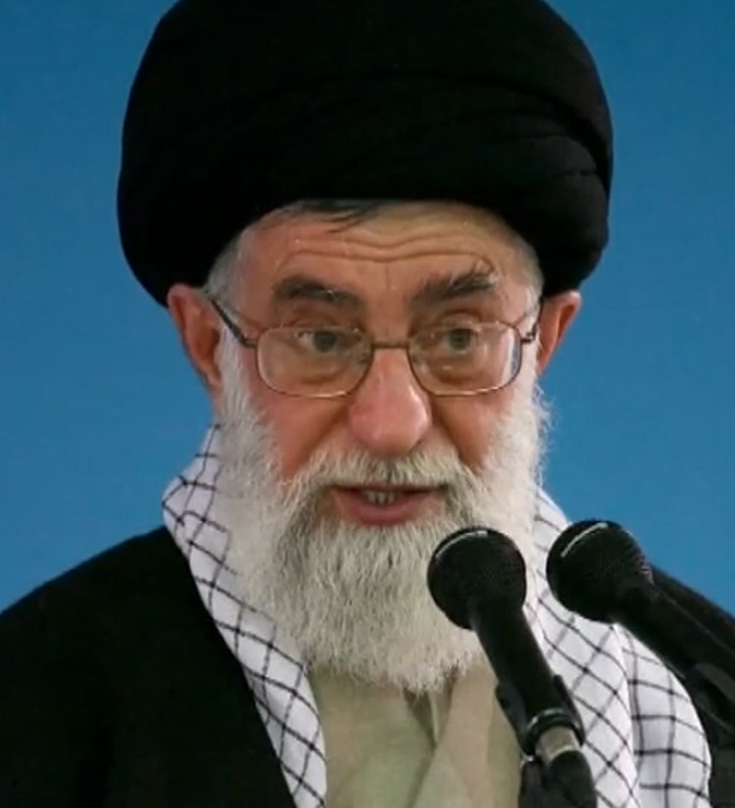 When describing Khamenei and his attitude towards the United States, The Times used relatively bland language, quoting an American diplomat from 2012 who said Khamenei lacked charisma, had a “singular, hostile focus on the United States” and that he was “consumed with, and identified by, enmity toward Washington.” But more critically, the author masked the size, dangerousness and ethos of the groups in Khamenei’s “network,” writing:
That hostility became a defining feature of Iran’s strategy abroad. Ayatollah Khamenei made support for foreign armed groups a central instrument of Iranian power. Working largely through the powerful Islamic Revolutionary Guards Corps, he financed and armed Hezbollah in Lebanon, Palestinian groups including Hamas, Shiite militias in Iraq and the Houthis in Yemen.
The network — known as the “axis of resistance” — allowed Tehran to project power, confront Israel and challenge American influence, usually without engaging its rivals directly. But it also drew Iran into a widening confrontation that, by the end of his life, had reached Iran itself.
Not only is Ward’s description of these groups woefully deficient, but his characterization of the relationship between the Islamic Republic of Iran and its “network” is sanitized to an extreme. It’s about as accurate as calling a mafia boss a venture capitalist who provides seed funding to local street gangs to help them increase market share.
The Islamic Revolutionary Guard Corps (IRGC) operated under Supreme Leader Ali Khamanei’s unchecked command. According to its charter, the IRGC’s mandate is to protect the 1979 Islamic Revolution at home and to promote it abroad; the literal translation of the army is the Guardian Corps of the Islamic Revolution. It is an internationally recognized terrorist organization that is inspired theologically by martyrdom and politically by Leninist Vanguardism. It funds, supports, and at times, manages other terror organizations.
A charitable interpretation would be that The Times erred journalistically and assumed its audience had a great deal of background knowledge, as it did not explain what Hezbollah is or what was meant by financing and arming it. The IRGC created Hezbollah. Based in southern Lebanon, it is a billion-dollar, internationally recognized narco-terrorist organization and has been a source of worldwide terrorism, including killing hundreds of Americans.
It is estimated that Iran sends nearly $1 billion to Hezbollah annually (though in 2025, Iran sent double). Before Oct. 7, 2023, Israel estimated that Hezbollah had amassed approximately 150,000 rockets, more than most European militaries. As described by the Council on Foreign Relations, Hezbollah “was considered the most powerful non-state armed group in the Middle East” and functions as a “state within a [the Lebanese] state.” Iran’s influence over Hezbollah continues growing. The IRGC sent representatives to Lebanon to take over its leadership and change its structure following Israel’s assassination of Hezbollah leader Hassan Nasrallah in September 2024.
Ward said Iran’s network of groups allowed it to “confront Israel.” But “confront” is used for a challenge moving toward someone, implying that Israel initiated the conflict. It is an interesting word choice, given Hezbollah’s and Hamas’ calls for Israel’s destruction in their charters, attacks on their fellow Lebanese citizens and Gaza residents, and Hamas’ orgy of violence on Oct. 7, 2023, as well as its promise to repeat Oct. 7 “a second, a third, a fourth time” on “Oct. 7, Oct. 10, October one million.” In addition, the Houthis’ slogan is “God is the greatest (allahu akbar), death to America, death to Israel, curse to the Jews, and victory for Islam.”
Ward also omitted Iran’s support for former Syrian leader Bashar al-Assad and did not acknowledge Hezbollah’s participation in butchering Syrians.
Iran has been supporting Hamas for over three decades. Its annual contributions to Palestinian Islamic Jihad and Hamas range from tens of millions to $200 million. Both are internationally recognized terror organizations, which Ward reduced to “groups.” Palestinian Islamic Jihad participated in the deadly, Hamas-led attacks on Israel on Oct. 7, joining the killing, raping, kidnapping (even children) and hostage-taking of dead bodies—including Americans.
Iran began supporting the Houthis militarily sometime between 2009 and 2014. Iran is considered the internationally designated terrorist organization’s primary benefactor. The Houthis receive training, intelligence and weapons support from both Hezbollah and the IRGC. The Houthis have disrupted international trade by terrorizing commercial ships in the Red Sea and fired approximately 130 missiles at Israel in the last three years, killing one civilian and injuring more. They also commit atrocities against their own people, including but not limited to hijacking aid when millions are suffering from acute food insecurity, repressing women, sentencing gays to death, and recruiting child soldiers.
Mistaking ‘Heroic Flexibility’ for Reasonableness
Ward then described Khamenei as “tactically flexible,” leading readers to believe Khameini could be reasonable, instead of devious and dangerous. Ward wrote:
Ayatollah Khamenei could nevertheless be tactically flexible when he believed the system’s interests required it.
As nuclear negotiations with the United States and other powers gathered pace in 2013, he endorsed what he called “heroic flexibility,” likening diplomacy to the actions of a wrestler who bends without losing sight of his opponent or objective. The approach helped clear the way for the 2015 nuclear agreement with the Obama administration, a deal that was abandoned by President Trump during his first term.
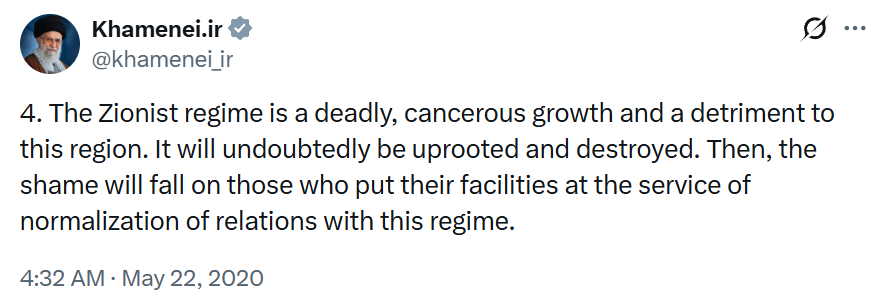
Wald neither fully nor accurately explained the concept of “heroic flexibility,” derived from a book Khamenei translated from Arabic to Farsi before becoming Supreme Leader. The historically dubious book was about a 661 C.E. peace treaty between the second Shi’ite imam and the caliph, signed allegedly to prevent the total annihilation of a community. Khamenei engaged in “heroic flexibility” in 2013 when he authorized the President Rouhani’s administration to negotiate the Joint Comprehensive Plan of Action (JCPOA) with the United States and others because his state was desperate for cash under sanctions. Khamenei opted for “heroic flexibility” in 2023 because he was trying to suppress domestic dissent. This time, he was more honest by acknowledging contemporaneously he was going to use the tactic of taqiyya (the Shi’ite concept of concealing one’s true beliefs to achieve an Islamic goal) to do so.
While The Times acknowledged Khamenei’s cruelty to his own people and touched on how he sowed discord in the region, it did not explain to readers how the leader of the largest state-sponsor of terror in the world bears responsibility for terror attacks spanning six of seven continents—the only exception being Antarctica. By making Khamenei out to be a local troublemaker who could sometimes be reasonable, Ward kept The Times readers uninformed and with the impression that neither Khamanei nor Iran was something the United States needed to concern itself with.