
The Islamic Republic is at war not only with the United States and Israel, but also with “much of [its] own population,” according to Iran expert Karim Sadjadpour of the Carnegie Endowment for International Peace in a Mar. 11, 2026, CNN interview. Yet this internal conflict has been largely absent from American media coverage, which often frames the war as beginning with U.S. and Israeli strikes on Feb. 28.
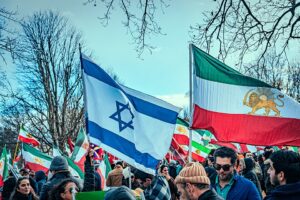
Demonstrators wave Israeli and Iranian flags at demonstration against the Islamic Republic of Iran, January 11, 2026. (credit: Ted Eytan from Washington, DC, USA, CC BY-SA 4.0, via Wikimedia Commons)
The regime’s conflict with its own citizens intensified during the December 2025-January 2026 anti-regime protests. In mid-January, Justice Minister Amin-Hossein Rahimi said that anyone who had been protesting since Jan. 8 would be treated as a criminal, according to official news agencies.
Even before this announcement, authorities were using extreme force. During a state-imposed internet blackout, more than 7,000 individuals were confirmed killed, with some estimates exceeding 30,000. The Human Rights Activist News Agency documented at least 18,000 arrests and at least 26 protesters were sentenced to death. Reports also describe hospital raids, denial of medical care, concealment of bodies, and “final shots,” in which wounded protesters were deliberately killed at close range.
Despite this, much of the war coverage has downplayed or ignored the regime’s actions against its own people. Reports often focus on damage caused by the U.S. and Israel, while internal repression is mentioned only briefly or not at all. For example, a Mar. 19 CNN article detailed the roots of civilian suffering but did not mention government repression, including the January crackdown.
There are exceptions. A Mar. 24 NPR report featured interviews conducted from the Turkish border of Iran. Correspondent Emily Feng found that many Iranians expressed support for the war, citing years of government brutality. Some described the January crackdown as a turning point. One interviewee said the repression caused the kind of pain that could make someone “wish death on their own government.” Still, such perspectives are rare.
Other reporting acknowledges repression but buries it.
A Mar. 9 The New York Times article describing the impact of the war on Iranians mostly featured criticism of the U.S. and Israel. It noted several paragraphs down that an Iranian armed forces branch was patrolling the streets of Tehran to squash regime dissent. One of the report’s authors was Farnaz Fassihi, The Times’ Iranian-American Tehran regime-linked bureau chief. She was once caught telling her colleagues not to interview “crazies” like women’s rights activist journalist Masih Alinejad, a frequent regime target for assassination.
Farnaz Fassihi from the New York Times @nytimes was overheard in a Clubhouse room instructing Leili “Make sure Emma doesn’t interview the crazy Masih @AlinejadMasih.” This isn’t the first instance of her urging reporters & journalists to boycott Alinejad. It’s time for Fassihi to… pic.twitter.com/qADl4pJTT6
— Mooniter (@Mooniter) May 20, 2024
One resident in the article described warnings that further “outbursts” would result in raids after neighbors celebrated the death of Ali Khamenei. The Wall Street Journal reported, citing state-run media, that 11 suspected regime opponents were killed while resisting police. The same report said Iran’s police commander claimed that at least 500 people had been arrested since Feb. 28 for sharing information with foreign media or opponents.
The Times article included only one line noting that the U.S. Central Command accused Iranian forces of using civilian areas to shield military activity. It was the only American outlet to report this, and it still doubted the truthfulness of the claim. Kurdistan Human Rights Network director Rebin Rahmani told CAMERA on Mar. 10 that this practice has increased civilian casualties.
Even widely covered stories have lacked context. Reports on Iran’s women’s soccer players who sought asylum after refusing to sing the national anthem – and were later forced to withdraw their claims – rarely explained the risks they or their families face at home.
Even when CNN’s Frederik Pleitgen reported from within Iran, he did not interview any anti-regime voices. Instead, he spoke with anti-war businessmen and one woman who said on camera: “We are not scared of bombs and missiles. We are ready to sacrifice our blood, our life, and our children for our beliefs. We will support our Leader to the end!” The NPR report suggests that this support for martyrdom is a minority position and that most Iranians do support the fall of the regime.
As a result, Iran is portrayed as a victim of Western aggression, rather than as the top state sponsor of terror that has long oppressed its own people. According to Rahmani, Iranians inside the country have criticized international media for “whitewashing” the regime’s violence. He said that during the 2022 Woman, Life, Freedom protests, outlets like The Times and The Wall Street Journal contacted his organization, but they did not do so after the Jan. 2026 protests.
Islamic Republic’s war against its citizens
The Islamic Republic is a totalitarian theocracy that restricts speech, press, religion petition, and assembly. It is among the world’s leading executioners. In 1988, under Supreme Leader Ruhollah Khomeini, the regime executed thousands of political prisoners in just two months. Many in the international community consider this a crime against humanity. Khomeini ordered the rape of teenage girls and women before their executions based on his belief that virgins go to heaven. Arbitrary detention is widespread, often following sham trials and coerced confessions. As of early 2026, at least six Americans and hundreds of other foreign nationals remain imprisoned. The regime has continued executions and torturing those they suspect of conducting espionage during the war.
After alleged forced confessions and a disputed case tied to the January 2026 Tehran protests, political prisoners Mohammadamin Biglari and Shahin Vahedparast were executed today in Ghezel Hesar Prison. Fears now grow for two co-defendants.
More in HRANA’s report here… pic.twitter.com/vD8MsvnXLo— HRANA English (@HRANA_English) April 5, 2026
Women face systemic, state-sanction discrimination with second-class status enshrined in the law. Rules requiring the hijab punish women who appear in public without head coverings, exposing them to fines, prison, and other penalties. Speaking out against these laws can result in charges that carry the death penalty. The legal system also gives men greater rights in areas such as court testimony, inheritance, divorce, and control over their wives’ movement.
Domestic violence is legal and girls can be married at 13, or younger with court approval. Each year, tens of thousands of underage marriages take place. In many cases, child brides whose family members kill their abusive husbands face the death penalty alongside their relative.
During the 2022 uprising against these laws, about 16,000 people were arrested and security forces killed at least 551 protesters. In the two years after the protests were crushed, more than 1,400 people were executed on bogus charges.
Ethnic and religious minorities also face discrimination. Kurdish and Baloch communities are targeted more often for arrests and executions and suffer from long-term underdevelopment, especially in education and healthcare. Religious minorities, especially the Baha’is, are denied basic rights, including access to higher education and employment.
By leaving out the regime’s long history of repression and its ongoing crackdown, much of the American media presents an incomplete and misleading picture of both the war and Iranian society.
While American news outlets obsess over bashing the American and Israeli administrations for striking Iran as well as their conduct during the war, they have failed to capture the pulse of the many Iranians, who unwillingly live under a brutal theocratic dictatorship that tightly controls every aspect of their lives, and support efforts to challenge it.