
“There can be no higher law in journalism than to tell the truth and to shame the devil,” Pulitzer Prize–winning journalist Walter Lippmann wrote in Liberty and the News (1920).
By that measure, CNN’s Frederik Pleitgen’s Feb. 1 interview with Iranian Foreign Minister Sayed Abbas Araghchi would have Lippmann rolling in his grave.
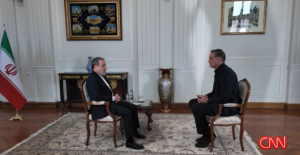
Screenshot of CNN’s Frederik Pleitgen interviewing Iranian Foreign Minister Sayed Abbas Araghchi, Feb. 1, 2026.
The Islamic Republic of Iran is run by an authoritarian religious theocracy that does not allow free and fair elections, freedom of religion, press, academia, speech, or assembly. Homosexuality is illegal, and in 2024, Iran ranked 143 out of 146 on the World Economic Forum’s Global Gender Gap Index. Freedom House, which measures the democracy, political freedom, and human rights of countries across the globe, gave Iran a score of 11 out of 100.
Prior to his diplomatic positions, Araghchi was a member of the Islamic Revolutionary Guard Corps (IRGC), a branch of the Iranian Armed Forces, during the Iran-Iraq War. He maintains pride in this background, despite the organization’s designation as a foreign terrorist organization (FTO) by the U.S., Canada, the European Union, and others.
Since the anti-regime protests in Iran – which initially began due to economic frustration – reached a peak in early January 2026, Araghchi has conducted a press tour, attempting to repair Tehran’s damaged reputation after news outlets shared harrowing reports of demonstrators being brutally murdered by government forces, with an estimated death toll reaching tens of thousands.
While The Wall Street Journal published an editorial rebutting Araghchi’s published op-ed and Fox News’s Brett Baier challenged many of his claims, Pleitgen offered no meaningful pushback at all. The exchange played out less like an interview and more like a cordial chat between friends in a lavish setting.
Araghchi’s conspiratorial claim
In his WSJ op-ed and on Fox and CNN, Araghchi promoted a conspiratorial argument that terrorist elements from outside, led by the Mossad (Israel’s spy agency), hijacked the peaceful protests in order to boost the death toll, so as to trigger U.S. military intervention to bring down the regime.
Baier refuted this claim, stressing that this is not what appears in videos, and not what the press hears when they can speak to people on the ground.
While the WSJ editorial did not address this claim, the newspaper published a letter to the editor that stated that “logic, testimony of survivors, and available footage” debunks his argument. The terrorists Araghchi referred to, the letter states, “were members of the security forces of the brutal regime of which Mr. Araghchi himself is a servant.”
As for Pleitgen? He did not pushback against this conspiratorial claim that absolves the Islamic Republic of guilt for the murder of thousands. He moved on to other topics. What happened to speaking truth to power?
The Obama-era Iran deal
In Pleitgen’s interview, Araghchi said the U.S. must regain Iran’s trust after leaving the Obama-era Iran deal and siding with Israel in the June war for Tehran to return to the negotiating table. He stressed that Iran has a right to use nuclear technology for peaceful purposes and that Iran hopes for sanctions relief as a deal outcome. Since Pleitgen did not ask any questions in response, here are some questions he could have asked.
Why should the U.S. trust Iran as it has continued enriching uranium past 60%, producing ballistic missiles, and funding proxies throughout the region that intend to destroy Israel and the U.S.?
Why would the U.S. enter another deal with Iran that would ensnare one tentacle of Tehran’s war machine while nourishing the others?
Even while the deal was in effect, there was immense secrecy surrounding its implementation, and the IAEA’s reporting on Iran’s nuclear program decreased in quantity and quality over time. Why was that?
From 2016 to 2018, after U.S. sanctions were lifted, Tehran increased defense spending by more than 30 percent. When sanctions were reimposed in 2018, Iran cut its military budget by nearly 25 percent the following year. If Iran’s intent was to channel sanctions relief into economic growth, it raises a question: why was military spending the sector most directly affected?
Furthermore, Pleitgen could have asked why this round of negotiations would be different from other rounds, considering Iran’s track record for using negotiations as a tactic “to play for time as it rebuilds.” As the WSJ editorial pointed out, “If the regime wanted peace, it could have negotiated a deal after the destruction of its nuclear sites in June. Instead, it has refused to compromise even on uranium enrichment, which has no purpose other than to build a bomb.”
Unlike Pleitgen, when Araghchi told Baier that Iran only wants to use its nuclear program for peaceful purposes, Baier rightfully immediately bit back: “Legitimate peaceful purposes for a nuclear program usually are not buried a mile down deep, and that is where the concern was.”
Praising the IRGC and making thinly veiled threats
Towards the end of Pleitgen’s interview, Araghchi praised the IRGC for defending safe passage and freedom of navigation in the Persian Gulf, the Sea of Oman and the Strait of Hormuz.
Islamic Republic of Iran flags in a row, June 11, 2011. (credit: Alborzagros, CC BY-SA 3.0, via Wikimedia Commons)
Moreover, CNN viewers watching this broadcast were not told about the IRGC’s designation as a FTO.
The IRGC, often operating through its special operations and intelligence wing, the Quds Force, conducts attacks abroad ranging from assassination and abduction to bombings and surveillance, relying on operatives under diplomatic cover, dual nationals, proxy organizations, or hired criminals to maintain deniability. Such attacks are typically preceded by extensive surveillance and carried out using explosives or small arms, with cyber tools playing an increasing role.
Over the past several decades, many Western courts have convicted IRGC affiliates for attacks targeting Iranian dissidents abroad, Jews, diplomats, and western interests or institutions.
Most recently, in Aug. 2025, Australia’s intelligence agency found the Iranian regime funded local criminals who set fire to Melbourne and Sydney synagogues. Australia’s prime minister expelled Tehran’s ambassador from the country because of this revelation.
Yet, as Araghchi praised this terrorist organization, Pleitgen said nothing.
Even when Araghchi warned that a war between Iran and the U.S. would inevitably draw in “many parts of the region” because U.S. bases are spread throughout it, Pleitgen allowed the thinly veiled threat to go unchallenged on air, offering no interruption or comment.
It is not as if Pleitgen could not prepare for the claims Araghchi made in this interview, as the foreign minister has repeatedly recycled the same allegations, including in the Baier interview just two weeks earlier. Given Araghchi’s position in Iran’s government and his affiliation with a FTO, Pleitgen, as an experienced journalist, knew it was his responsibility to hold Araghchi to account.
Instead, CNN’s host acted as an agent of Iranian state-sponsored media, giving the foreign minister a platform to spread his propaganda, this time, across American airwaves, without pause.