
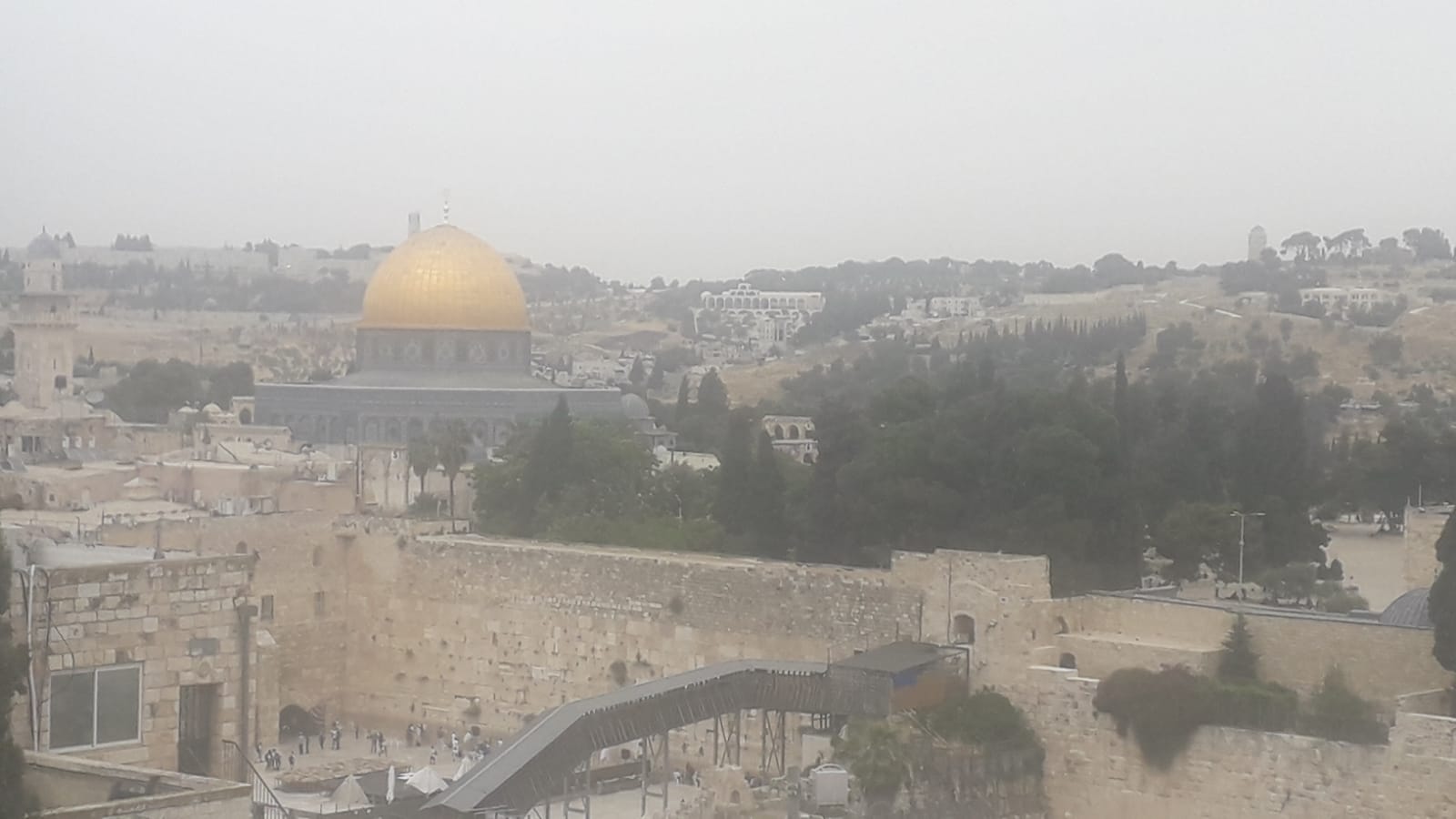
A view of the Temple Mount on a stormy day in May 2021 (Photo by Akiva Sternthal)
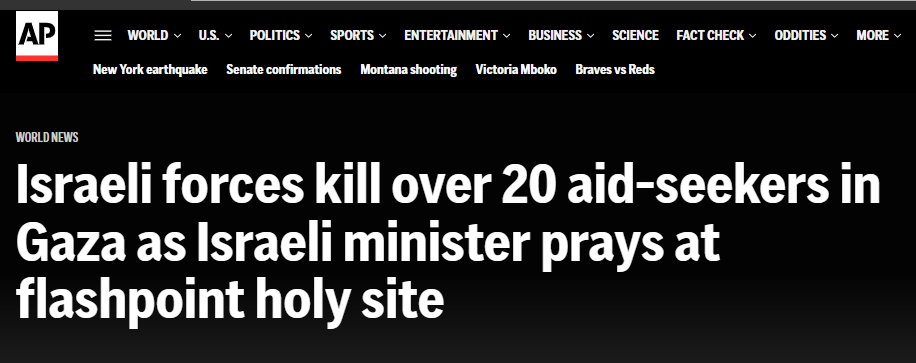
From Jerusalem to the Gaza Strip, the Associated Press yesterday implemented multiple substantive improvements on a story originally entitled (“Israeli forces kill over 20 aid seekers in Gaza, witnesses and health officials say,” retrieved yesterday from Lexis-Nexis news database). An updated digital version of the same Aug. 3 is available here, and was originally headlined (“Israeli forces kill over 20 aid-seekers in Gaza as Israeli minister prays at flashpoint holy site,” screenshot follows).
 Published on Tisha B’Av, the Jewish day of mourning commemorating the destruction of Jerusalem’s First and Second Temples along with a host of other Jewish tragedies which fell on this day, the wire service story had originally obscured the fact that the Temple Mount is Judaism’s most sacred site. Initially, AP writers Wafaa Shurafa, Sam Metz and Samy Magdy incompletely described the Temple Mount, the site where the First and Second Temples had stood, as “the hilltop compound in the Old City revered by Jews and Muslims.” Later, the article referred to “Tisha B’av, a day in which Jews mourn the destruction of two Jewish temples at the site.”
But at no point did the article note that the Temple Mount is the most sacred site in Judaism. Following CAMERA’s communication with AP, the wire service commendably updated the article at 11 am ET, adding near the top of the article:
The area, which Jews call the Temple Mount, is the holiest site in Judaism and was home to the ancient biblical temples. Muslims call the site the Noble Sanctuary. Today it is home to the Al-Aqsa Mosque, the third-holiest site in Islam.
 Beyond the Jerusalem misreporting, CAMERA contacted the AP about three additional shortcomings in the article’s coverage of events in the Gaza Strip. AP editors subsequently amended two of the three Gaza-related points. First, regarding the United Nations’ own information regarding the theft of humanitarian aid into the Gaza Strip, the article had originally reported (screenshot at left):
The GHF launched in May as Israel sought an alternative to the U.N.-run system, which had safely delivered aid for much of the war but was accused by Israel of allowing Hamas, which guarded convoys early in the war, to siphon supplies.
Israel has not offered evidence of widespread theft. The U.N. has denied it. [Emphasis added.]
 But, according to the U.N.’s own data (screenshot at left), 85 percent — or 23,353 tons out of a total 27,434 collected tons from May 19 to Aug. 3, 2025 — was intercepted “Either peacefully by hungry people or forcefully by armed actors, during transit in Gaza.”
Perhaps a U.N. official at some point denied widespread theft either to an AP reporter or elsewhere. But on what basis did the AP completely disregard the U.N.’s own published data? Following CAMERA’s query to the news service on this point, editors removed the reference to the U.N.’s denial of widespread theft, along, unfortunately, with reporting about the accusations of theft.
Separately, in its communication with editors, CAMERA noted that the digital version of the headline for this article stated as fact, and without attribution, that Israeli forces are responsible for shooting dead more than 20 aid seekers (“Israeli forces kill over 20 aid-seekers in Gaza as Israeli minister prays at flashpoint holy site“). Again, while the original print headline (available on Lexis-Nexis) attributed the claim that the IDF killed over 20 aid-seekers to witnesses and [Hamas] health officials, AP’s website upgraded the unverified claim to fact.
 Following CAMERA’s communication on this point, AP editors commendably amended the headline, deleting reference to the Israeli military as the culprit and adding attribution for the updated and unverified fatality figure: “Israeli minister prays at flashpoint today as officials say 27 aid-seekers killed in Gaza” (Emphasis added, screenshot at left).
Separately, concerning the reporting of total alleged fatality figures for the Gaza Strip, CAMERA flagged AP’s failure to note that Gaza Health Ministry is Hamas-run, a fact which should be noted for the sake of transparency and complete sourcing, especially since the figures have come under considerable criticism. AP’s selective reporting on the credibility of Hamas-supplied fatality figures conceals:
The [Gaza health] ministry, which doesn’t distinguish between civilians and combatants in its count, is staffed by medical professionals. The United Nations and other independent experts view its figures as the most reliable count of casualties. Israel has disputed its figures, but hasn’t provided its own account of casualties.
Despite CAMERA’s request to note that the Health Ministry in the Gaza Strip is controlled by Hamas, AP did not rectify this point. As recently as July 29, the same AP reporters rightly cited “[t]he Health Ministry, part of the Hamas-run government.”
See also, “On Tisha B’Av, Many Methods for Distancing Jews From Their Holiest Site“