
In a March 15 weekend panel discussion on MS NOW, Parkland, Florida school shooting survivor Cameron Kasky said he finds it “disgusting” that Israeli soldiers who kill innocent children are perceived as “brave and heroic warriors.”
The horror my classmates in Parkland experienced on 2/14/2018 is all the children in Palestine have ever known.
Millions of people marched in the streets for us.
In America, the mass murders of brown, Muslim children are written off as negligible if even addressed at all. pic.twitter.com/5UwdvgA7CB
— Cameron Kasky (@camkasky) March 16, 2026
In making this claim, Kasky portrayed Israeli soldiers as child killers rather than soldiers tasked with protecting Israeli civilians while operating in complex urban combat environments.
Kasky made the comment while arguing that while the U.S. treats school shootings as tragedies and prosecutes perpetrators, Americans wrongly show far less outrage when Palestinian and Lebanese children are killed by Israeli forces because they are “brown and Muslim.” The topic was introduced by disgraced MS NOW reporter Ayman Mohyeldin in the context of a likely U.S. strike on a school in southern Iran that reportedly resulted in the deaths of over 100 schoolchildren.
This comparison ignores basic facts. In school shootings, perpetrators intentionally target students. By contrast, children in Gaza and Lebanon are killed in the context of urban warfare, where civilians are placed in harm’s way by armed groups operating among them and in largescale tunnel networks below.
The killing of children is always tragic. However, drawing a direct parallel between school shootings and military operations in war zones is misleading, particularly on a news program where factual accuracy should be paramount. Unlike school shooters, the Israeli military does not deliberately target children in Iran, Gaza, or Lebanon.
Armed groups, state actors embed military infrastructure in population centers
In Iran, Lebanon, and Gaza, terrorist groups and state actors, including the Islamic Republic, Hezbollah, and Hamas, have placed military infrastructure within densely populated civilian areas, embedding military assets among civilian populations.
In the case of the likely U.S. strike in Minab, Iran, the intended target was an Islamic Revolutionary Guard Corps base, but outdated intelligence appears to have misidentified a nearby school – mere meters away – as part of the military site.
In Gaza, Israeli soldiers have found terror tunnel entryways in children’s rooms, and rockets under children’s beds. Even the U.N. has admitted finding Hamas weapons and tunnels within UNRWA schools and U.N. facilities.
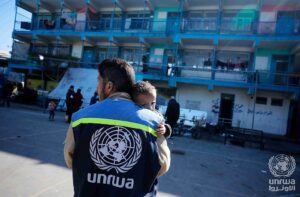
UNRWA staff member comforts a distressed child at a school shelter in Nuseirat camp, Gaza Strip, March 12, 2025. (credit: Ashraf Amra, CC BY-SA 3.0 IGO, via Wikimedia Commons)
Hamas also runs youth programs and summer camps that indoctrinate their youth and train them for participation in armed conflict. Outrageously, Hamas has been known to use child combatants in its wars as well.
Hezbollah’s entrenchment in civilian areas is also widely documented. The Beirut suburb of Dahiyeh, for example, is a densely populated residential district that functions as a major Hezbollah stronghold and hosts many of the group’s leadership structures.
Under international law, civilian infrastructure used for military purposes may become legitimate military targets.
Israel’s efforts to safeguard civilian populations
At the same time, the Israel Defense Forces (IDF) mandates rules of engagement that require precautions to minimize civilian harm during military operations. Israeli soldiers undergo training intended to reduce civilian casualties and the IDF employs legal advisors to provide operational legal advice during combat. Over the years, numerous military experts have commended Israel for its efforts in reducing civilian harm.
There have been recent cases where soldiers have been found in violation of these rules. One widely reported example occurred in April 2024, when seven aid workers from World Central Kitchen were killed in an Israeli drone strike. The IDF admitted to a “serious failure,” dismissed a colonel and a major, and censured three others. Notably, Hamas has been caught on camera exploiting World Central Kitchen vehicles to target IDF soldiers in Gaza.
Additionally, whereas Israel has mandated communal bomb shelters in homes built after 1969 and safe rooms in homes built after 1993 and operates a nationwide missile warning siren system and mobile alert applications designed to warn civilians of incoming attacks, neither the Islamic Republic nor Hamas has taken such steps to protect their own civilians. The Lebanese government, which has been heavily infiltrated by Hezbollah, has also taken no such steps.
While the MS NOW commentators criticized U.S. lawmakers for only offering “thoughts and prayers” after school shootings, these actions demonstrate how Israel has taken numerous steps to protect its children. Notably, there was criticism leveled at Hamas, Hezbollah or the Islamic Republic for putting their own citizens in harm’s way.
Kasky ignores impact of war on Israeli children
War is always horrific, and like the children of Gaza, Lebanon, and Iran, Israeli children are unfortunately also deeply familiar with its consequences.
Even though Kasky purported to care for all children who are victims of violence, Israeli children were absent from his monologue.
Since the October 7, 2023, Hamas-led attack on Israel, studies have reported significant psychological trauma among Israeli children. One clinical assessment found that 69 percent of preschool-aged children and 49.2 percent of school-aged children showed symptoms consistent with post-traumatic stress disorder. During the massacre itself, 53 children under 18 were murdered and 36 were taken hostage by Palestinian terrorists. More than 150 children had a close relative taken hostage, and hundreds have lost parents in the conflict.
Children in Israeli territories have also been killed in subsequent attacks. In July 2024, for example, 12 Druze children were killed by a Hezbollah missile while playing soccer in the town of Majdal Shams. Recently, three children were killed in Beit Shemesh by an Iranian ballistic missile.
In communities along Israel’s border with Gaza, such as Sderot, playgrounds are built with brightly colored bomb shelters so children will enter them quickly and without panic during rocket attacks. Parents have taught their children race to the bomb shelter when sirens sound, like a game. Many children fear kites and balloons, which Hamas has used to carry explosives into Israel.
Throughout Israel’s north, tens of thousands of families were forced to evacuate due to Hezbollah’s rocket and missile fire. Towns such as Kiryat Shmona and Metula were razed in such attacks.
In central cities such as Tel Aviv and Jerusalem, children know the sound of incoming missile warnings and have spent nights in bomb shelters during attacks from Hamas, Hezbollah, the Houthis, and Iran.
MS NOW commentators show ignorance to realities of war

Screenshot of Cameron Kasky on MS NOW, March 15, 2026.
Later in the segment, MS NOW reporter Antonia Hylton asked Kasky what it has been like to understand war, given his own experience and his generation’s exposure to violence through social media.
While surviving a school shooting is undoubtedly traumatic, it does not confer an understanding of war.
War is not a single event. It unfolds over days, weeks, months, or years. Observing war through social media or news coverage does not replicate the experience of living through it.
Hylton’s assumption that Kasky knows the reality of war from his New York City apartment is laughable. Instead of humbly rejecting her question, as he should have, he continued with the comparison.
War is brutal for civilians, especially children, who are always among its greatest victims. If the goal is to protect children from violence, the conversation must move beyond inflammatory rhetoric and toward a more honest understanding of how these wars waged against Israel actually unfold.