
In the last few months, NPR has been hard at work in its Lebanon narrative crafting. The media organization has reported frequently about the property damage and destruction in southern Lebanon by focusing almost exclusively on Israeli actions. In doing so, NPR has excised Hezbollah from any role or responsibility in the conflict, inadvertently (or not) advancing the U.S.-designated terror organization‘s propaganda goals.
In its stories about property destruction in Lebanon, NPR leads its audience to ask questions designed to draw nefarious conclusions. Why are people’s homes being destroyed if the Israel Defense Forces (IDF) says it is attacking Hezbollah infrastructure? Why would Israel conduct military operations in a town (Bint Jbeil) that a previous NPR guest described simply as a “beautiful, quaint little village?”
These are excellent questions that curious journalists should be asking and investigating. But NPR does not do that, at least not in Lebanon. In continuing to avoid acknowledging Hezbollah’s use of human shields and civilian infrastructure, it offered its audience a new reinforcement to the narrative: wealthy expatriates would never hide weapons in their expensively built homes in beautiful villages.
Despite the program’s name, a recent All Things Considered segment did not consider all the things and did not answer these questions. Had NPR scratched below the surface, or more concretely, drilled a hole through the floor of a home or a shop in southern Lebanon, it would very likely have found Hezbollah tunnels and weapons (or maybe found such items without even digging). It would have had to tell its listeners that Bint Jbeil is both beautiful and a Hezbollah stronghold.
For decades the world has known Hezbollah built underground tunnels, both for fighting and weapons stores, in the villages south of the Litani River (where both Bint Jbeil and Yaroun are located). In 2018, Israel found and destroyed six major cross-border tunnels which would have allowed thousands of Hezbollah fighters to infiltrate Israel.
While the story was about destruction to homes, NPR ignores Hezbollah’s abuse of civilian infrastructure generally, including schools and places of worship (recently, firing from inside a church). In a recent photo story, NPR stated the IDF made claims of Hezbollah using ambulances and hospitals “without evidence.” This was false, though, as the IDF had published proof. (CAMERA asked NPR to correct the statement, but it did not respond.)
Every time you see the scale of destruction in South Lebanon, remember this footage of Hezbollah’s rocket launcher hiding inside civilians houses and buildings. pic.twitter.com/qdJ9omwm82
— Hussain Abdul-Hussain (@hahussain) May 25, 2026
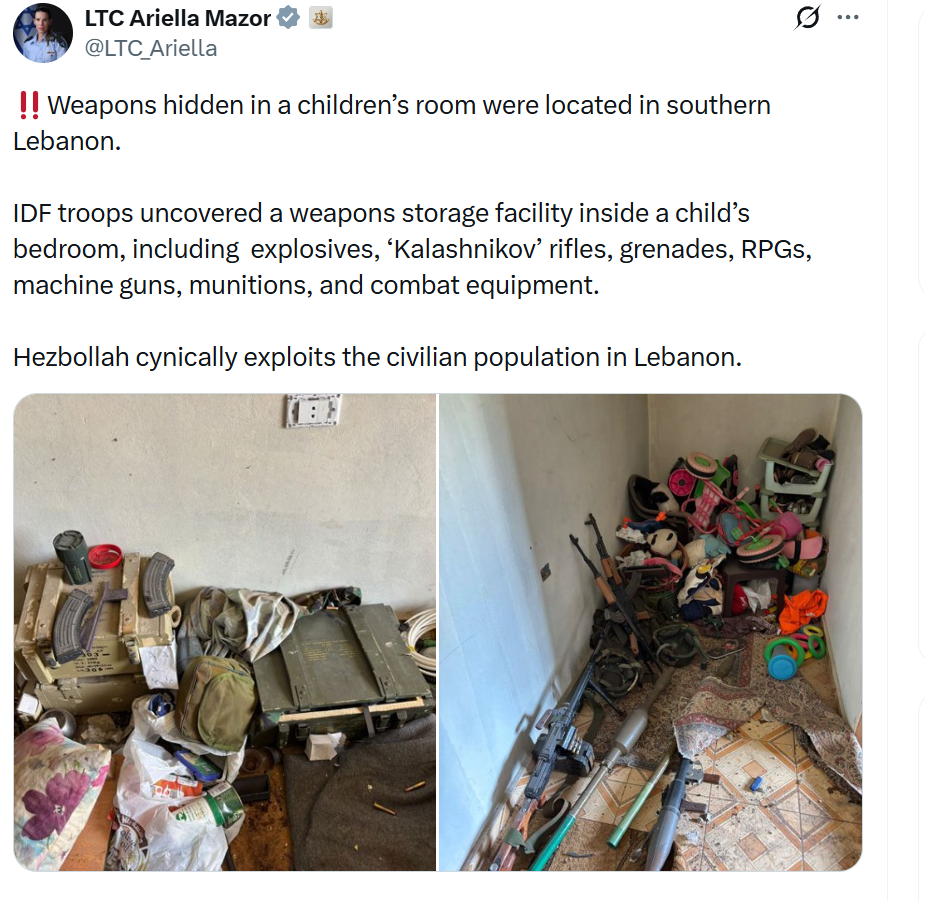
As to Hezbollah’s use of homes, the IDF has found rockets, missiles, and rocket launchers in homes and garages, as well as weapons in a child’s bedroom. When asked to quantify in how many southern Lebanon homes an IDF brigade found weapons, the commander answered, “it’s not just one or two houses, it’s all of the village. These are villages that are strongly identified with Hezbollah. In almost every home there are weapons and signs of identification with the organization.”
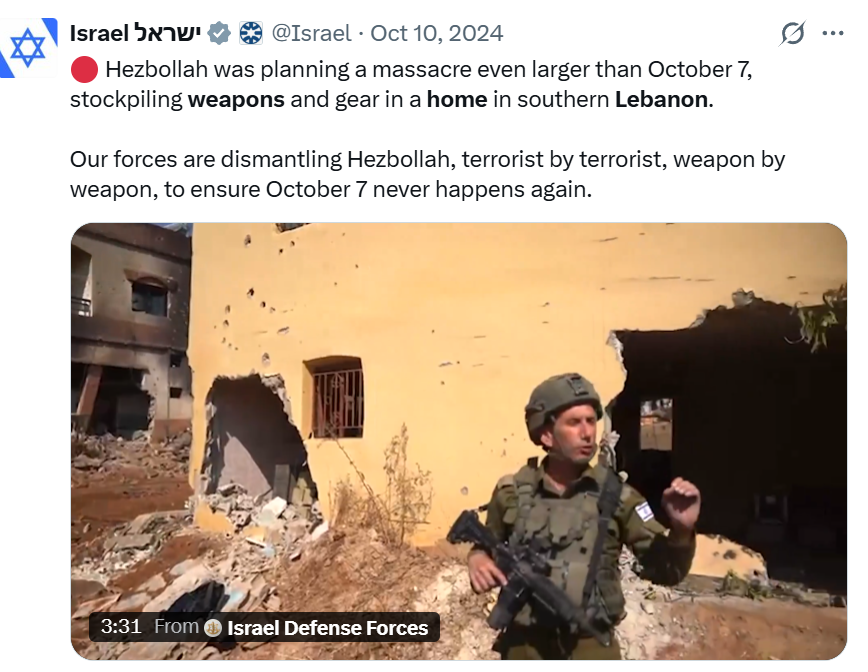
Not just weapons, either. In 2024, the IDF discovered an 800-meter Radwan Force (Hezbollah’s commando unit) tunnel. Its opening was found in the living room of a private home in a southern Lebanon village and it led to a large Radwan Force headquarters underneath a neighborhood. NPR provided no information on Hezbollah’s use of homes – or any other civilian structures – to its audience. Instead, Jane Arraf and Jawad Rizkallah took listeners back to Bint Jbeil and to another Hezbollah stronghold, Yaroun, to survey more damage inflicted by the IDF on homes.
To counter the Israeli narrative – that the IDF was bulldozing Hezbollah infrastructure – NPR presented two men. The first, Mazen Farah, told NPR he had security cameras constantly running around his father’s now-destroyed house in Yaroun and “never saw fighters.” The idea that Hezbollah operated in tunnels under the home was never floated as a possibility.
Farah’s protestations also echo more famous claims of having seen nothing: those of the UN Interim Force in Lebanon (UNIFIL) spokespeople stating UNIFIL troops did not observe Hezbollah activity or rearming, despite the IDF showing videos of tunnels and the presence of a Hezbollah training center approximately 200 meters from a UNIFIL post.
Avoiding Hezbollah’s use of civilian structures, including tunnel shafts and storing weapons in or beneath homes, serves Hezbollah’s narrative of reporting on Israeli-inflicted damage to Lebanon while leaving out Hezbollah’s role.
TBN’s Mati Shoshani, who filmed a Hezbollah tunnel under a clothing shop in Lebanon, explained that Hezbollah did not build tunnels and infrastructure inside villages to protect Lebanon or its civilians. “It did it because it knows that on the day Israel strikes, the world will first see the destroyed house, and only later, ask what was hidden inside or under it.”
The second man NPR featured was Hanna Hanna, whose Lebanese-American brother had already spent close to $500,000 building a house in Yaroun that had been destroyed by the IDF. (Arraf and Rizkallah also referenced another Lebanese expat who made a fortune in Panama and spent more than $10 million on a 12-bedroom Bint Jbeil home, with swimming pool, cinema, and gyms, that was also destroyed.) Hanna assured NPR’s audience that “no one spends money on their dream home and then uses it to store weapons,” an argument just slightly better than, “Trust me, bro.”
Given what the IDF has already found in homes in southern Lebanon, is NPR trying to advance the narrative that weapons would only be placed in homes that were not nice? Such a ridiculous notion has been disproven in Lebanon and elsewhere, as weapons stores have been found in mansions or villas located in Mexico, Spain, Panama and Los Angeles.
When contemplating why NPR gave a microphone to such flimsy, unconvincing arguments without even a hint of push back, one recalls how recently an NPR journalist reported on property destruction in southern Lebanon while standing next to her Hezbollah operative escort.
Perhaps NPR cannot report on this conflict neutrally or accurately because it has dug itself into a hole in Lebanon. It remains to be seen if it can come out on the other side.