
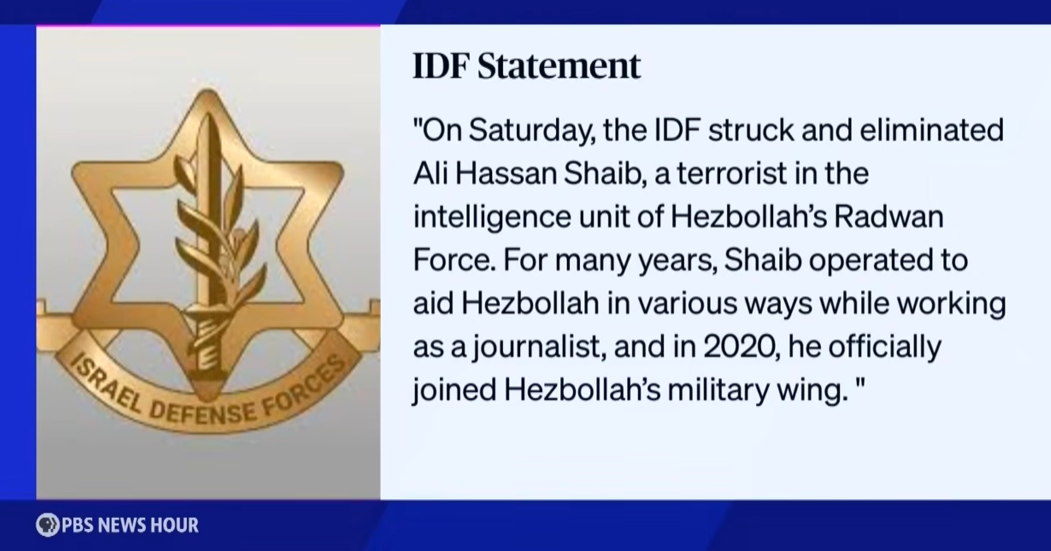
On March 29, 2026, the Israel Defense Forces (IDF) revealed that Ali Hassan Shaib, killed by the IDF on March 28, was a journalist for Hezbollah-owned and affiliated network al-Manab – and a terrorist. On March 30, PBS interviewed Sara Qudah, Regional Director for the Committee to Protect Journalists (CPJ). In the interview, Qudah alleged – without any challenge by PBS’ Nick Shifrin – that the IDF had a pattern of targeting journalists. She did this while wholly ignoring the documented practice of Iranian proxy and other terror group operatives doubling as journalists, doctors, and more.
Shifrin reported that one of the three journalists killed in southern Lebanon was Ali Hassan Shaib. He acknowledged the Israeli military’s statement about Shaib’s terrorist ties and then asked Qudah to talk about Shaib and the company he worked for.
Qudah acknowledged that Al-Manar TV is owned by and affiliated with Hezbollah but argued that working for it does not make a journalist a terrorist. CAMERA wrote about Al-Manar 20 years ago, and how its stated mission was to wage “psychological warfare against the Zionist enemy.”
The three journalists were “still civilians,” said Qudah, and the “IDF did not provide any kind of evidence that Ali or the other two journalists are participating in any military action.”
She then said:
There is a key principle under international military law. Journalists are considered civilians, and therefore they are protected from any kind of attacks unless they were in any way participating in conflict with an army.
But, until now, IDF did not provide any kind of evidence that Ali Shaib is part of Hezbollah or he has been part of the military. This is a pattern. It’s not an isolated incident, and it became a playbook by Israeli authorities and the IDF.
We saw it in Gaza since 2023, where they were killing journalists, and after they killed them, they smeared them saying that they are terrorists and they were part of Hamas or participating in military actions.
There is much to unpack in Qudah’s provocative comments.
Many journalists killed in Gaza, though not all, were members or affiliates of terror groups. One analysis of Palestinian journalist casualties from late 2025, by the Meir Amit Intelligence and Terrorism Information Center, found approximately 60% of media workers killed since Oct. 2023 were tied to Hamas or Islamic Jihad.
In a Feb. 26, 2026, Washington Post article about a CPJ report on journalists’ deaths, Qudah was quoted as saying, “Israel is able to target and kill journalists with full impunity, with no investigation and no accountability.”
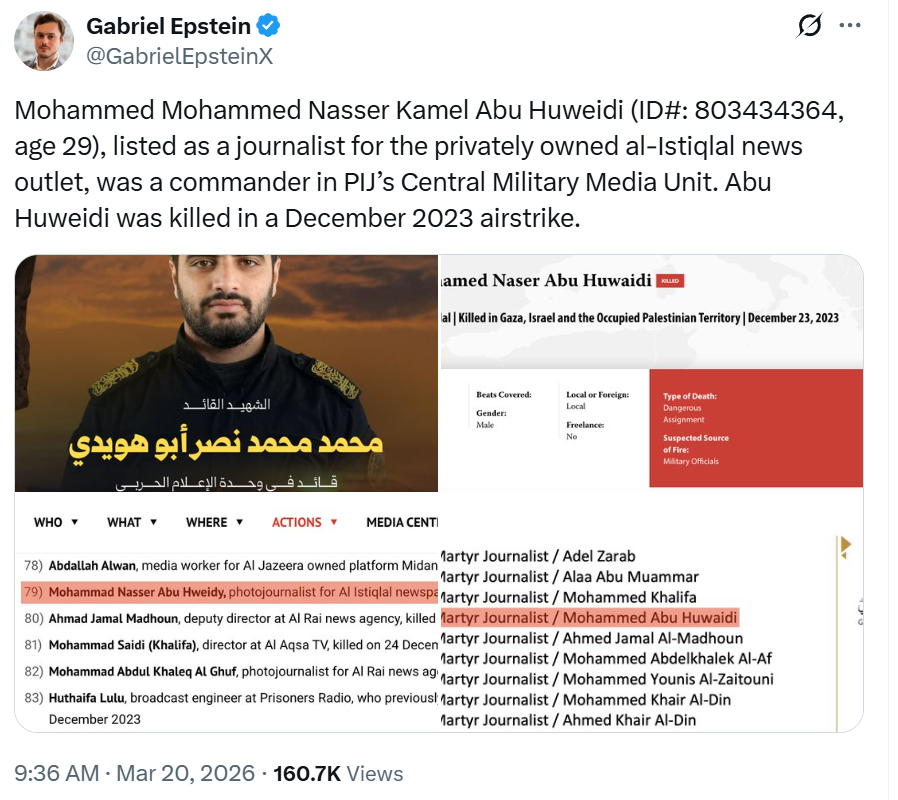
One month later, CAMERA wrote about Palestinian Islamic Jihad’s acknowledgment that several journalists killed by the IDF during the Israel-Hamas war were their members. CPJ issued no statements related to the revelations. It made no update to its entry on, for example, Mohammed Nasser Abu Haweidi, and did not acknowledge the evidence proving he was an Islamic Jihad operative.
To the contrary, CPJ’s website currently maintains outright propaganda and shields terrorists. One example is an entry from July 2025 entitled: “CPJ calls for Anas al-Sharif’s protection in face of Israeli smears.” CPJ said al-Sharif was “being targeted by an Israeli military smear campaign, which he believes is a precursor to his assassination.” It cited IDF Arabic spokesperson Avichay Adraee, who was “falsely alleging” al-Sharif was a “Hamas terrorist.”
In August 2025, the IDF did kill al-Sharif. The IDF had evidence he was the head of a Hamas terrorist cell responsible for coordinating rocket attacks against Israel – including personnel rosters, lists of terrorist training courses, phone directories, and salary documents, as recorded by CAMERA.
So while Qudah complained on PBS that the IDF did not provide advance evidence that Shaib was part of Hezbollah, when the IDF did make allegations in advance, CPJ called them a smear campaign and called for protection. It seems there is no “right” time, in Qudah’s opinion, for the IDF to release information about a journalist’s terror affiliation. Judging by CPJ’s failure to update any of the information about the journalists written about on its website, it seems no amount of proof by the IDF would suffice, either.
Finally, Qudah invoked the Law of Armed Conflict with regard to protecting journalists (though she called it “international military law.”) On top of a legal imperative, the protection of journalists is also morally important. What Qudah fails to consider is the difference between a civilian journalist and a militant one. For reference, all militaries, including the U.S. armed forces, have journalists in their ranks, but they are not protected under the law. Shaib was a journalist, but his membership in Hezbollah exempted him from legal protections.
Qudah did not explicitly define what she meant when she said journalists are protected unless they were “in any way participating in conflict with the army.” To have integrity, she would have to admit to the need – at a minimum – for a fact-specific analysis. A close look would be required to determine whether a journalist (like Shaib) who performed media work that was integrated into military operations would count as having a direct part in hostilities. Qudah’s declaration – that Shaib’s work for a Hezbollah-owned television network is insufficient to make him a target – is meaningless.
The truth is that Qudah has no idea what Shaib was or was not doing for Hezbollah.
For an organization dedicated to protecting those whose job it is to ask questions and get to the bottom of thorny issues, CPJ’s failure to acknowledge the existence of terror operatives doubling as journalists undermines both its credibility and its mission.
PBS left viewers without important context, airing Qudah’s claims without challenge. Shifrin’s failure to confront Qudah with evidence that some journalists killed had links to terror groups skewed the coverage dramatically and left PBS viewers uninformed.