
Famously, the slogan “All the News That’s Fit to Print” graces the front page of every New York Times edition. The slogan was coined at the end of the 19th century by the paper’s publisher, Adolph Ochs. Of course, in today’s hyper-globalized world, the slogan is wishful thinking. No paper could realistically cover all the important news stories of the day. Still, it would be hard to argue that outlets like The New York Times, the Washington Post, CNN, and others adequately cover even those stories they do print. They often devote precious space to emotive or opinionated claims, while omitting highly material and relevant information that sheds important new light. Provided below are two important, but underreported, stories from the week bearing on Israel and the Middle East that media consumers should know.
Israelis in the North live under constant fire
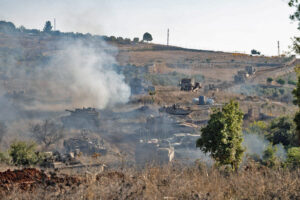
The IDF operating in Lebanon during the 2023-2024 war, November 2024. (credit: IDF Spokesperson’s Unit via Wikimedia Commons)
Almost entirely absent from much of the U.S. and European news outlets has been the impact of the war with Hezbollah and Iran on Israel’s northern residents. These communities often have no more than 10 seconds to seek shelter from Hezbollah’s fire, and usually even less.
While foreign correspondents based in central cities like Tel Aviv and Jerusalem have reported on Israelis repeatedly running to shelters, residents in the north – who face more frequent and immediate fire from Hezbollah, in addition to Iran – receive far less attention. At the same time, correspondents in Lebanon interview people from the southern part of the country through Beirut to report on how the war has impacted the Lebanese throughout the country.
Even when central Israel is covered, reporting is often shallow, with only brief Israeli voices, if any. The two articles, in which Israelis in the north were interviewed, also made sure balance their accounts with references to Lebanese suffering. By contrast, reports focused on Lebanon rarely mention Israeli hardship.
CAMERA asked two Israelis who live on the Lebanese border to describe their daily realities. Both Isabelle and Raz, residents of Kiryat Shmona and Kibbutz Metzuva, spoke of instability, sleeplessness, and the constant need for resilience.
“So how do you describe life in the north, on the border with Lebanon? Sitting at home watching TV while hearing nonstop firing and learning to tell what’s ours and what’s the enemy’s,” Isabelle wrote, continuing:
It’s going to the supermarket, hearing an interception and then a siren, and realizing there’s no point running to a shelter anymore, so you just keep shopping as usual.
Every time you leave the house, you plan your route near shelters “just in case,” or you ask yourself whether it’s even necessary to go out at all. You get a message from work saying tomorrow is business as usual, then at midnight, after a heavy barrage on the communities, another message comes saying work is canceled.
In general, we try to maintain a normal routine, because we know how beautiful our north is and how important it is to preserve it. We’ve already built-up resilience – no matter what, the enemy does not break us, and we keep going because we have no choice.
Interceptions have already become like a fireworks show, and drones turn into a kind of cat-and-mouse game with the helicopter chasing them, triggering endless sirens until you finally hear the boom and know it was intercepted.
You’d expect to see empty towns with only soldiers – but no, people keep living here, even without sleep, managing to carry on with daily life.
Raz and her family were evacuated along with her entire kibbutz after Hezbollah began firing missiles into Israel on Oct. 8, 2023. Since then, they have returned.
Now, she writes:
Our reality has become more complex and has set us back. After finally returning home – after more than a year of being evacuated – we hoped the quiet would return and that we could begin rebuilding a normal routine. But instead, the chaos came back: nonstop sirens, and the house feels like a war zone. Planes overhead, military vehicles on the roads, and constant explosions.
These feelings are with us every moment. It’s truly hard to relax or plan ahead when we don’t know what’s coming next.
Some northern residents also serve in the Israeli military along the Lebanese border, living under constant threat at home while also carrying the heavy emotional burden of being responsible for the defense of their own communities.
Israeli media coverage of the north also paints a picture of exhaustion, trauma, and determination.
A Mar. 17 Ynet article, titled “My daughter sank into depression and refused to take her medicine. It’s a war within a war,” describes the toll on children receiving psychiatric care. Doctors and parents report that hospitals near the Lebanese border have moved wards into protected areas and sharply reduced capacity, forcing many vulnerable patients into remote treatment.
As a result, the conditions of patients have regressed. Clinicians describe regression among children, including renewed bed-wetting, separation anxiety, obsessive behaviors, and increased reliance on medication. Mental health professionals warn that the situation may deteriorate further once the war ends, when the temporary resilience of wartime gives way to delayed psychological fallout.
A Mar. 16 Channel 13 report, titled, “Life on the Edge: The Residents Who Continue to Work Under Fire on the Northern Border,” shows how close many communities are to danger, just hundreds of meters from Hezbollah positions.
Farmers, business owners, and winery workers describe a cycle of recovery repeatedly cut short by renewed fighting.
Shlomi Yakuti, standing in a chicken coop, in Moshav Dovev, that has been hit three times, said he will not leave: “Even though the chicken coop was destroyed and we rebuilt it during the war, [leaving] won’t help. We’re staying. This is our country.”
He added that the current escalation echoes December 2023, “which was a catastrophe here. Constant fire, non-stop.”
At the Galil Mountain Winery in Kibbutz Yiron, workers expressed the same resolve. Manager Keshet Razili Michaeli said, “If we abandon the vineyards and the winery, we won’t have a future here.”
Another employee, Ram Daodi, described the work as a mission: “To rebuild the north and not give up. We have to stay and show our presence.”
At least an additional five wineries in northern Israel have remained open despite non-stop rocket fire, according to Calcalist.
Int’l Quds Day Draws Tens of Thousands to Rallies Supporting Terror
Outside of Israel, and across the world, International Quds Day drew tens of thousands of demonstrators, rallying in support of designated terrorist organizations such as the Islamic Revolutionary Guards Corp, Hamas, Hezbollah, and the Houthis.
At the rallies, held on Mar. 13 and Mar. 15, 2026, chants of death to America and death to Israel were widespread. Speakers and attendees honored slain terrorist leaders such as Yahya Sinwar and Hassan Nasrallah. In New York City, rally-goers called on Iran to strike Tel Aviv and for Hezbollah to destroy it, and chanted “We support Hezbollah here” and “We support Hamas here!”
🚨 BREAKING RIGHT NOW in Manhattan: Crowds at the Al-Quds March kicking off from Times Square are openly chanting “We Support Hezbollah Here, we support Hamas here!”
Deport these domestic terrorists.
pic.twitter.com/gHfYshnnOx— Gunther Eagleman™ (@GuntherEagleman) March 13, 2026
In Chicago, speakers led crowds in chants such as “there is only one solution: Intifada, revolution!” and “IRGC, make us proud! Bomb these genocidal clowns!”
In New York, Toronto, and London, counter protesters rallied in support of Israel, the U.S. and against the Islamic Republic of Iran. These protesters carried Israeli, American, and monarchical Iran flags.
In London, police arrested 12 people for showing support for a designated terrorist organization and for threatening or abusive behavior. The Metropolitan Police said it was investigating chants of “death, death to the IDF” led by Bobby Vylan, who has led the same chant in the past. Shortly after the home secretary, Shabana Mahmood, had granted a police request to ban al-Quds protesters from marching, the Metropolitan Police said that the rally could take place as a static protest only.
International Quds Day, held on the last Friday of Ramadan, was established by Ayatollah Ruhollah Khomeini shortly after the 1979 Islamic Revolution, proclaiming it as an annual day of solidarity against the “usurper Israel,” in support of the “Palestinian struggle,” and for “victory of the Muslims over the infidels.”
Chants of death to America and Israel have been common over the decades among celebrators, as well as the burning of these respective flags. By hosting Quds Day celebrations globally, Iran seeks to frame the Palestinian struggle as a pan-Islamist cause and as part of its mission to spread the Islamic Revolution internationally.
These rallies in Europe and America, though relatively small, are significant because they show the Islamic Republic’s footprint even in the West. Among American news outlets, just Fox News published a report limited to the demonstrations in New York City.