
Over the weekend, MS NOW’s Rachel Maddow used her 15-minute monologue to push a striking allegation that the U.S. is at war with Iran, not because of Tehran’s conduct, but because Arab Gulf states effectively bribed the president into launching it.
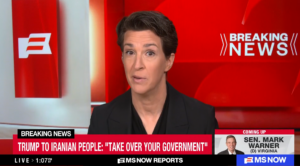
Screenshot of MS NOW’s Rachel Maddow in the segment titled “Who benefits from Trump’s war in Iran? The answer is disturbingly clear,” aired on Feb. 28.
In “Who benefits from Trump’s war in Iran? The answer is disturbingly clear” (Feb. 28) she cited several high-profile financial connections, including Qatar’s $400 million gift of a luxury Boeing 747 for President Donald Trump’s use as Air Force One; the United Arab Emirates-linked investment firm acquiring nearly half of the Trump family’s cryptocurrency company; and the sovereign wealth fund controlled by Saudi Arabia’s Prince Mohammed bin Salman investing $2 billion to Trump’s son-in-law Jared Kushner’s private equity firm.
This conspiratorial reporting contradicts several other articles that explained a far more plausible scenario.
The Associated Press and the Wall Street Journal reported that the strikes followed months of diplomatic efforts to constrain Iran’s nuclear and missile programs. During these talks, according to AP, the U.S. had offered Iran several ways it could have a peaceful nuclear program, including offering free nuclear fuel “in perpetuity.”
According to the WSJ, “one of [the US’s] latest proposals would have left Iran with thousands of advanced centrifuges and permitted Iran to enrich uranium as much as 20 percent,” far more than the cap imposed under the 2015 nuclear deal.
As Iran declined all offers, Trump publicly warned the regime several times that if it did not agree to a nuclear deal, the U.S. would attack.
The exact timing of the attack was impacted by intelligence that identified a rare moment when Ayatollah Ali Khamenei would meet with other top Iranian officials in locations where they could be hit effectively in coordinated strikes, according to The Jerusalem Post and the WSJ.
Reuters portrayed U.S. rationale in terms of neutralizing a pervasive threat posed by Iran’s nuclear ambitions and missile capabilities, which have grown over the years, and as part of a broader strategy to protect U.S. personnel and regional allies. This threat was repeatedly denied by Maddow who relied on statements made by notoriously unreliable Iranian regime officials denying their pursuit of nuclear weaponry.
Maddow claims Iran posed no immediate threat to America
Maddow claimed the U.S. had no reason to strike Iran other than serving the Arab Gulf state interests, insisting Tehran posed no immediate threat to America, discrediting statements by Trump, Secretary of State Marco Rubio, and Middle East envoy Steve Witkoff.
Notably, Maddow seemed to forget that Israel struck Iran with the U.S., indicating that Trump is not the sole leader with a vested interested in taking down the Islamic Republic outside these Arab Gulf states.
Upon the strike, NATO allies to the U.S. expressed opposition to further escalation of the conflict into a wider regional war, while mainly pressuring Iran to engage in good faith negotiations to end its nuclear and ballistic missiles program, illustrating that NATO also sees Iran’s activities as an increasing threat to the world.
NATO member states, in the past decade, have sanctioned hundreds of Iranian and Iran-linked entities and individuals engaged in destabilizing behavior, and one by one, have designated the Iranian Revolutionary Guards Corp (IRGC), a branch of the Iranian Armed Forces, as a terrorist organization.
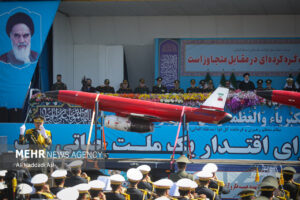
Islamic Republic of Iran Army Day parade in Tehran, April 18, 2023. (credit: Mehr News Agency, CC BY 4.0, via Wikimedia Commons)
Many Western courts have convicted IRGC affiliates for attacks targeting Iranian dissidents abroad, Jews, diplomats, and western interests or institutions.
Although Iran does not currently have intercontinental ballistic missiles, as Maddow pointed out, many America’s allies and assets are within range of Iran’s capabilities.
Iran and its proxies have targeted U.S. interests in the region in the past. Most infamous was the Oct. 1983 bombing carried out by Hezbollah against U.S. Marine barracks and a nearby French military facility in Beirut, Lebanon, killing 241 American service members, 58 French soldiers, and six civilians.
Other major attacks include the Nov. 1979 seizure of 66 Americans at the U.S. Embassy in Tehran by Islamic Republic–backed students; the June 1996 Khobar Towers bombing in Saudi Arabia, which killed 19 U.S. Air Force personnel and wounded roughly 500; the killing of at least 603 U.S. troops by Iranian-backed militias in Iraq between 2003 and 2011; and the Oct. 7, 2023 massacre in southern Israel, when Hamas killed at least 48 Americans and kidnapped 11 as part of its broader assault that left 1,200 people dead.
It seems that only Maddow cannot see the risk the Iranian regime poses to the U.S. and the western world.
Maddow’s dubious understanding of the conflict
Maddow opened a window into her dubious understanding of this issue with a backyard analogy in which one neighbor, representing Iran, builds a fence over the property line, only for the “cops,” representing Trump and Netanyahu, to respond with wildly disproportionate force and hand the property over to the bribing neighbor.
Never mind Iranian leadership chanting death to America or its actual “fence” of proxy organizations, dubbed its “ring of fire,” surrounding Israel which are armed, funded, and directed by Tehran and often threaten Saudi Arabia as well.
The U.S. and Israel are the hostile actors in this scenario, according to Maddow.
Maddow mused “who benefits” from striking Iran, implying only Trump and the Arab Gulf states that pushed him into this war do. She overlooked the Iranians and Israelis who welcomed the blows against the regime responsible for decades of regional aggression and human rights abuses galore.
This question of who benefits ignores the most obvious answer: governments and civilians threatened by a consistently emboldened and legitimized regime whose nuclear ambitions and proxy violence have destabilized the region for decades.
Framing the U.S.– Israel strikes as a favor to Gulf states ignores decades of Tehran’s wrongdoing, resulting in a narrative that inverts aggressor and victim while dismissing the real security threats America and its allies face.