
For those expecting sharp and edifying analysis of legal issues, law blogs are often a great go-to source. But at Opinio Juris, readers have instead been given a factually challenged, highly misleading analysis by Professor Patrick Brian Smith’s July 2, 2026, article, “Upstream Harms: OSI, AI Militarism, Big Tech, and Gaza.”
Smith’s article, which reads fundamentally as an advocacy piece, seeks to cut off Israel from “big tech” by alleging wrongs by the former while accusing the latter of “culpability.” It’s a classic tool in the kit for BDS Movement activists who seek to isolate the Jewish state. In this case, Smith is trying to tie artificial intelligence (AI) technologies to alleged Israeli wrongs, demanding “accountability” for “every actor, institution, and infrastructure” involved, including companies involved in AI data centers in Israel.
But ironically, Smith – who claims expertise on “open-source investigations” – either can’t or won’t get the basic facts right. Instead, he masks his leaps in logic and dearth of factual support with material omissions and a heavy dose of emotive, anti-imperialist jargon.
Consider three examples:
The “Plausible Genocide” Lie
The first is a simple one.
In just the second paragraph, Smith works to manufacture credibility for his assertion of Israeli wrongs. He claims that “the International Court of Justice has ruled as a plausible genocide” the “ongoing killing and destruction in Gaza.”
This is flatly false and easily disprovable. In April 2024, the then-president of the court, Joan Donoghue, clarified this herself on BBC News, stating: “I’m correcting what’s often said in the media – it didn’t decide that the claim of genocide was plausible.”
If a writer at a legal blog can’t even get the basics of a court ruling right, what else is he wrong about?
A lot, as it turns out.
The Gas Fields Lie
The main thrust of Smith’s complaints has to do with “six massive, resource-hungry corporate data centers,” which, he says, rely on “resource extraction from… the Palestinian territories” that is “likely to be central to [their] maintenance.” The two main resources Smith identifies are natural gas and water.
Let’s examine each in turn. According to Smith:
…Israel is operating as an engine of wider technologies of imperialist expansion in Western Asia and the Mediterranean that require the effective integration of territories as either engines of—or extractive zones for—energy security in an unstable geopolitical milieu. Widely reported gas reserves off the coast of Gaza, as well as aforementioned water and land resources utilised towards data centres to support the Israeli state and its securing of interests in the region, are all embedded in a political ecology of empire within which the electricity requirements of large-scale computing are increasingly central.
Smith implies that Israel is stealing gas from Palestinians for the purposes of “imperialist expansion.” The Marxist gobbledygook, featured throughout the 2,200-word article, is as illogical and factually challenged as it is uttered with confidence.
His claims are belied by open-source information that the open-source investigative expert omits.
The only significant gas field off the coast of Gaza for which there is any real estimate is the Gaza Marine Field with approximately 32 billion cubic meters of natural gas. That’s less than three percent of Israel’s own estimated total recoverable reserves of 1,087 billion cubic meters. Put another way, Israel is extracting nearly a Gaza Marine Field’s worth of natural gas every single year. Israel doesn’t need Gaza’s gas.
But not only is Israel not extracting from the Gaza Marine Field – it gave the Palestinian Authority (PA) the green light to develop the gas field itself.
Even Israel’s use of its own natural gas reserves contradicts Smith’s “imperialist expansionism” narrative. Nearly half of Israel’s natural gas production is being exported to Israel’s neighbors, including Jordan and Egypt, helping fuel their economies.
The Water Lie
Smith takes a similarly dishonest approach toward water.
Smith’s argument purports that all three data centers “are approximately 5km from the border with the occupied West Bank.” He continues that “[t]here is evidence that both the Shoham industrial zone and Har Tuv A industrial zone,” where two of the centers are located, are:
located near wellfields (Rosh Ha’ayin/Yarkon and Kfar Uriya and Eshtaol) that pump from the Yarkon-Taninim (Western Mountain) Aquifer. The Western Aquifer’s recharge is predominantly on the West Bank highlands (about ~73% of recharge occurs there), flowing west to Israeli pumping centers. Thus, there is strong evidence that two of the three areas where these data centers are located tap a transboundary aquifer that is recharged largely in the West Bank. Access to water becomes a “potent state-controlled weapon” to maintain and extend the Occupation.
The argument is facially absurd. Smith is suggesting that it is somehow wrong for Israel to use an aquifer inside its own borders simply because the aquifer, like aquifers everywhere, is replenished by water flowing into it from elsewhere.
Israel’s critics are seemingly continuing their war against geography and geology.
The argument gets worse. The Yarkon-Taninim Aquifer is already subject to an internationally supported water sharing agreement mutually arrived at between Israel and the Palestinian Authority: the Oslo II agreement. Under its terms, both Israel and the PA are allocated a certain annual extraction rate from the aquifer. The rate for Palestinians has historically been exceeded.
The author’s argument also relies on several rhetorical tricks doing some heavy lifting. His “strong evidence” that these data centers are using the supposedly Palestinian water is that they are “located near wellfields” connected to the aquifer.
But had Smith done basic open-source investigation, he would’ve understood that proximity is irrelevant. The data centers might as well have been in the middle of the Negev Desert, and it wouldn’t change anything.
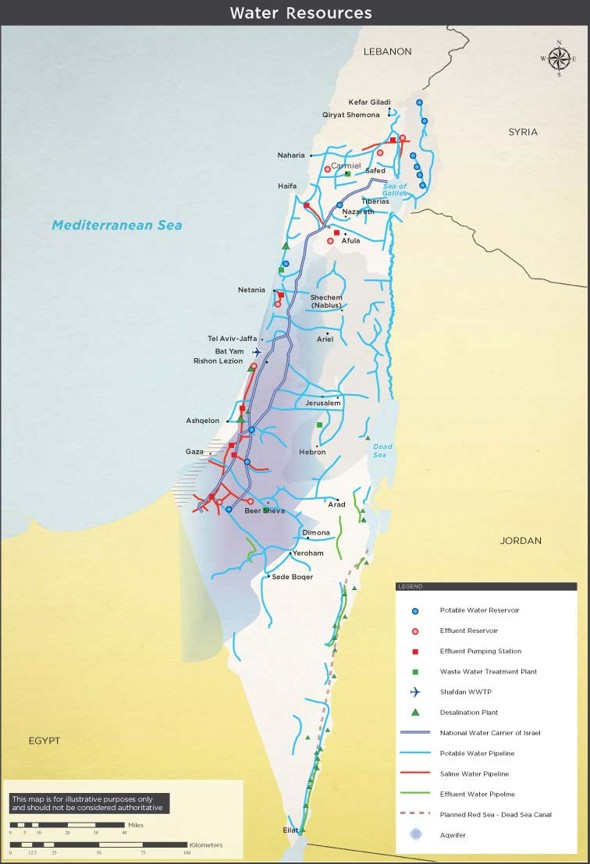
A map of Israel’s national water system.
That’s because Israel operates a highly integrated national water grid, into which the Yarkon-Taninim Aquifer feeds. In fact, one of the wellfields identified by Smith, the Rosh Ha’ayin/Yarkon wellfield, is where Israel’s national water carrier connects multiple major water lines, including the Yarkon-Negev lines, creating a continuous system from the Sea of Galilee in the north to Mitzpe Ramon in the south.
The water for the data centers may just as well have come from any other source connected to the national water grid. Approximately 660 mcm/yr, or about twice the typical volume extracted from the Yarkon-Taninim Aquifer, is supplied by Israel’s desalination facilities. Wastewater reclamation plants alone provide a comparable amount, at 400 mcm/yr.
Once again contradicting Smith’s “imperialism” narrative, Israel – a world leader in water management – is sharing water with its neighbors. For decades, Israel has shared fresh water with Jordan, even doubling the amount supplied from 2021-2025. Even after Hamas’s massacre of Oct. 7, 2023, Israel repaired the water pipelines that were damaged during the war to supply Gazans with fresh water.
Opinio Juris’s Standards
Far from using natural resources to fuel conflict and imperialism, Israel has used natural resources to build relationships with its neighbors. Smith’s narrative, which asserts the opposite, relies on cherry-picked facts, divorced from their context, and blatant misrepresentations.
The dishonesty belongs to Opinio Juris, too. Despite CAMERA’s correction request noting the false description of the ICJ ruling, the blog has refused to correct.
This is perhaps unsurprising given the blog is a collaborative project with the organization, International Commission of Jurists, which has long pursued anti-Israel lawfare. One of its commissioners, Shawan Jabarin, is even affiliated with the internationally designated terrorist organization, Popular Front for the Liberation of Palestine. Another “honorary” commissioner, Raji Sourani, is also a convicted member of the same terrorist organization and was even banned from entering the United States in 2012.
Opinio Juris claims to be dedicated to “informed discussion” of international law. But if the law is as “informed” as the “facts” are in Smith’s piece, then perhaps international law isn’t real law, after all.