
This article by CAMERA Español’s Marcelo Wio first appeared in Spanish Sept. 18 in The Objective, an independent digital news outlet in Spain.
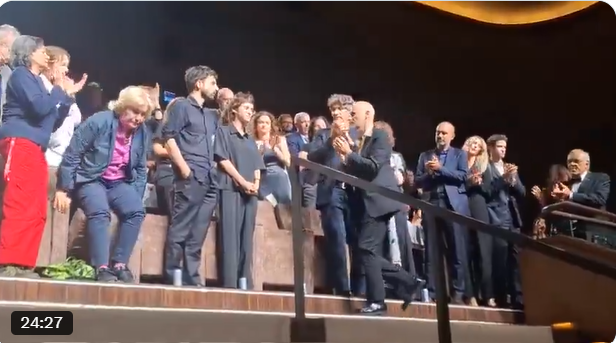
The socially engineered extended applause at the Venice Film Festival, September 2026 (Screen capture from footage shared on @mssophiste X post)
What exactly was the audience applauding when the screening of “Naza“ ended at the Venice Film Festival? What was it? The war? The addition of yet more false material intended to constrain Israel’s ability to defend itself? The sorry spectacle of two Jews debasing themselves as an offering to prejudice? The ease with which that particular prejudice can now be aired in public?
Let me add another theory—or another question. Or perhaps simply another ingredient.
They were applauding out of fear. Fear of ostracism, of cancellation, of the social, artistic, and moral gulag.
Alexander Solzhenitsyn tells an illuminating story in The Gulag Archipelago. It goes like this:
At the conclusion of [a] conference, a tribute to Comrade Stalin was called for. Of course, everyone stood up …
The small hall echoed with “stormy applause, rising to an ovation.” For three minutes, four minutes, five minutes, the “stormy applause, rising to an ovation,” continued. But palms were getting sore and raised arms were already aching. And the older people were panting from exhaustion. It was becoming insufferably silly even to those who really adored Stalin. However, who would dare be the first to stop? … The director of the local paper factory, an independent man of strong character, stood with the presidium. Aware of all the falsity and all the impossibility of the situation, he still kept on applauding! Nine minutes! Ten! … Insanity! To the last man! With make-believe enthusiasm on their faces, looking at each other with faint hope … Then, after eleven minutes, the director of the paper factory assumed a businesslike expression and sat down … To a man, everyone else stopped dead and sat down. They had been saved! The squirrel had been smart enough to jump off his revolving wheel …
That, however, was how they discovered who the independent people were. And that was how they went about eliminating them. That same night, the factory director was arrested … after he had signed Form 206, the final document of his interrogation, his interrogator reminded him:
“Don’t ever be the first to stop applauding!”
In this account, applause is a measure of loyalty or allegiance.
Izabella Tabarovsky made precisely this point about the audience in Venice: the crowd kept applauding because not to do so would have meant appearing to support the alleged genocide. What they truly feared, she argued, was social death, inevitably followed by professional death—one of the harshest punishments a modern Western society can impose on people who have committed no crime but crossed a social boundary.
“In Venice, they were terrified of rumor, suggestion, an Instagram post; the public shaming, the denunciations, the cancellation of contracts and everything else that might follow should there be the slightest suspicion that they didn’t fully and wholeheartedly support the message of the film. No state agents were needed to enforce the clapping. Each was an enforcer for the others,” she wrote. [Emphasis added.]
Tabarovsky stressed that the circumstances of those applauding Stalin and those applauding at the Venice Film Festival were, of course, radically different. But, she argued, “the terror—that cold, sticky fear of punishment for falling out of line, for standing apart from the crowd—would have been entirely the same.”
There was, however, one crucial difference: “The first audience could be forgiven for having had the misfortune to live at a time when the state was executing its own citizens by the thousands and destroying the lives of millions more. The second helped build this social-terror bubble of its own free will.”
In Venice, every member of the audience knew when the applause was supposed to begin. There was even a kind of conductor and timekeeper for the clapping. By bringing one palm against the other, over and over again, they simply created a social fact.
But they were not applauding “Naza.” Not really.
They were staging a consensus, an ideology; displaying their deference to the “moral commissars” of cancel culture. The audience, before it was an audience, was a constituency of activism and obedience. Each person was another number added to the chorus of political performance. The applause itself was part of the performance: the noisy glue binding together a public display of allegiance.
And that applause echoed another round of applause at Venice: the acclaim once given to Leni Riefenstahl and her innovative, skillfully made Nazi propaganda at the same festival in the 1930s.
It echoed, in other words, the indulgence of a hatred that no longer needs to be named; the euphoria of impunity; the bond among “sensitive, cultured souls” forged through shameless contempt.