
Famously, the slogan “All the News That’s Fit to Print” graces the front page of every New York Times edition. The slogan was coined at the end of the 19th century by the paper’s publisher, Adolph Ochs. Of course, in today’s hyper-globalized world, the slogan is wishful thinking. No paper could realistically cover all the important news stories of the day.
Still, it would be hard to argue that outlets like The New York Times, The Washington Post, CNN and others adequately cover even those stories they do print. They often devote precious space to emotive or opinionated claims, while omitting highly material and relevant information that sheds important new light.
Provided below are three important, but underreported, stories bearing on Israel and the Middle East that media consumers should know this week.
Jerusalem court orders ex-ICC prosecutor Khan to pay NIS 25 million to former hostages and families
Several Israeli media outlets reported that Jerusalem’s District Court ordered this week that former chief prosecutor of the International Criminal Court Karim Khan must pay former Israeli hostage families some $7.7 million dollars in civil damages. Additionally, the court ordered Khan to pay some $773,000 in legal fees.
Shurat HaDin, the organizations representing Israeli hostage Eitan Mor, along with the families of hostages Avinatan Or and Omri Miran, filed the suit in August 2025. It accuses Khan of selectively targeting Israeli leaders, while failing to issue warrants for leaders of the Palestinian Islamic Jihad, and equating Israeli leaders with Hamas’ leaders by including them together in the same order.

Karim Khan, retrieved with creative commons usage rights.
Khan failed to respond when given notice of the suit, so the District Court’s judge Eran Shiloh approved the civil damages to be levied against him. It’s to be noted that Khan was facing at the time the removal from his position within the ICC over sexual misconduct allegations.
The ICC issued arrest warrants in November 2024 for Israeli Prime Minister Benjamin Netanyahu and Defense Secretary Yoav Gallant, including in the same announcement warrants for Mohammad Deif, who was already dead by the time due to an Israeli airstrike several months before the announcement. The court had also issued postmortem arrest warrants for Ismail Haniyeh and Yahya Sinwar.
Italy Adopts the IHRA Working Definition of Antisemitism
The Italian parliament officially voted this week to adopt the International Holocaust Remembrance Alliance (IHRA) working definition of antisemitism. The definition was included in a new bill with the goal of combatting antisemitism in Italy. For reference, Italy saw a record number of antisemitic incidents in 2025, with some 963 incidents logged by Rome’s Center of Contemporary Jewish Documentation. The legislation passed by 147 votes in favor to 93 against.
The vote was met with fury from leftist members of Italy’s parliament, who claim that Prime Minister Giorgia Meloni’s ruling bloc was “exploiting the antisemitism bill to stifle criticism.” The opposing Democratic Party abstained from the vote, angering other left-wing allied parties like the Five Star Movement and the Green-Left Alliance, who urged a unified vote against the bill.
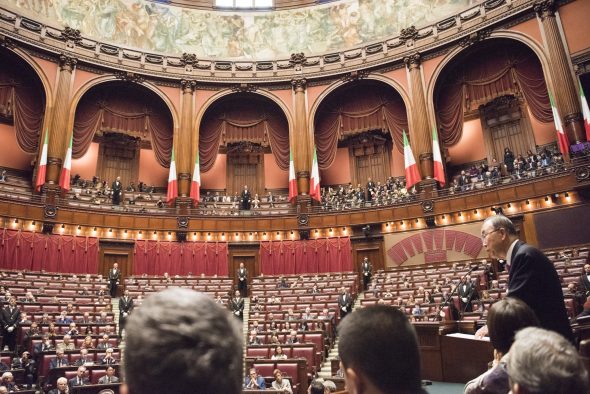
Italian Parliament, retrieved from Flickr with creative commons usage rights.
Similar criticisms against the IHRA definition are often raised by anti-Israel activists in the wake of similar adoptions by various governing bodies. But, as the American Jewish Committee (AJC) points out, “the IHRA definition does not prohibit anyone from exercising their First Amendment rights. The definition is a tool to identify and address antisemitism—nothing more. In fact, the IHRA definition expressly recognizes that criticism of Israel’s policies and politics, like criticism leveled at other countries’ policies, cannot be regarded as antisemitic.”
Italy becomes the latest country to adopt the IHRA definition. The U.S. State Department adopted the working definition in 2016, when the U.S. joined dozens of other IHRA member states.
Iraq’s Government Moves on Kataib Hezbollah Stronghold
Iraq’s government is seeking to end an Iran-backed Shia militia’s hold over a key province, from which the group has reportedly been smuggling oil from for several years. Iraqi Prime Minister Ali al-Zaidi said on Nov. 17 that his government had created a comprehensive strategy to combat the large-scale theft of oil by Iran-back Kataib Hezbollah in the Jurf al-Sakhar region of Babil province.
After an investigative committee found alleged oil theft and pipeline tampering in the area, Baghdad ordered the replacement of forces holding the area, demanding that the current Kataib Hezbollah units holding Jurf al-Sakhar be stood down. The move on Kataib Hezbollah came after al-Zaidi dismissed some nine senior security, intelligence, and oil officials, including the director of the Oil Pipelines Company over their role in the smuggling operations. Satellite imagery dated between 2021 and 2026 allegedly showed illegal oil extraction near Jurf al-Sakhar’s pipelines, leading to the investigative committee discovering further evidence of the smuggling upon visiting.
Al-Zaidi officially set Friday, Nov. 20, at 8 pm local time as the deadline for Kataib Hezbollah to withdraw from the area. Iraqi officials did not, however, indicate whether that meant military operations against the group were imminent.
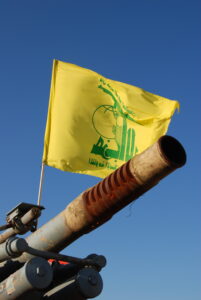
Hezbollah flag over an artillery piece, retrieved via Wikimedia Commons.
Separately, other Iran-backed terrorist groups faced similar hot water. Two weeks ago, the Lebanese government charged more than a dozen Hezbollah terrorists over the seizing of a half-ton shipment of explosives by Lebanese authorities stashed in a vehicle moving toward Beirut, bound for Hezbollah.
Only two men are currently in Lebanese custody over the plot, charged with endangering state security, defying government decisions, membership in Hezbollah, and possessing firearms and explosives. Hezbollah has demanded the release of the two men, and the return of the explosive.
Hezbollah’s threats to escalate the situation further is not the first time the group has levied threats of civil unrest or even civil war against Lebanon. In 2008, Hezbollah stated that the Lebanese government had declared war against it by operating against its communication network in Lebanon, vowing to “cut off the hand” that was trying to dismantle the terrorist group. After domestic protests against political corruption in Lebanon, Hezbollah stoked the already heightened tensions, with then Secretary General of the organization Hassan Nasrallah saying that a power vacuum would lead to civil war.
And, following the Lebanese government’s pledge to impose a state monopoly on weapons in the country, Secretary General of Hezbollah Naim Qassem warned that there would be “no life in Lebanon” if the government followed through on its mandate. Across the region, Iran’s proxy groups continue to threaten sovereign states, utilizing threats of violence to strongarm governments into not acting with the best interests of their citizens in mind.