
ABC’s recent video on the Israeli election outcomes, “How US midterms and Israel’s election could shape future of Middle East policy,” portrayed Arab-Israeli member of Knesset (MK) Ahmad Tibi, head of the Ta’al party in the Joint List, as an underdog minority kingmaker as Jerusalem’s parliamentarians seek to form a government.
What did ABC leave out though? All of the reasons Tibi won’t be kingmaker, particularly his consistent rhetorical flirtations with terrorism.
ABC anchor Britt Clennett sat down for what could only be described as a gentle interview with Tibi for her segment. “Tibi, a key face of Israel’s new political reality, says the election results are a staunch rejection of Netanyahu and his allies.” Clennett repeatedly fed Tibi softball questions, such as asking him if he is “fearing for [his] community,” to which Tibi affirmed. Arab citizens of Israel enjoy the right to vote, sit in the Knesset, and live in the only Middle Eastern state rated as “Free” by Freedom House, which judges countries’ civil rights as part of its “Freedom of the World” tracker. For reference, Kuwait and Lebanon are rated as “Partly Free.”
A few notable omissions left Clennett’s audience ignorant of Tibi’s character.
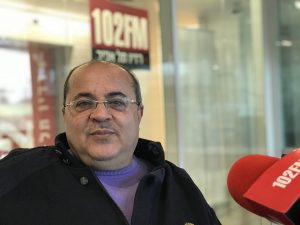
Ahmad Tibi, retrieved via Wikimedia Commons
For one, Tibi refuses to label Hamas as a terrorist organization, notwithstanding its targeting of Israeli civilians as a matter of policy. Speaking in October to Israel’s Kan Reshet Bet, Tibi, when asked “Is Hamas a terrorist organization that must be destroyed?” responded “I don’t want to answer these questions.” Similarly, the Joint List to this day refuses to call the group a terrorist organization, justifying the decision by claiming doing so would lend support to Israel’s campaign in Gaza following the Hamas-led Oct. 7, 2023 atrocities.
ABC paints a picture that Tibi and other members of Knesset in the Joint List could “figure out how to replace the right-wing government,” and that Netanyahu rival Gadi Eisenkot “must decide whether to work with the Arab parties” to form a government. But Eisenkot already set his conditions for potential coalition partners, stating that parties wishing to join a government under him would need to formally label Hamas a terrorist group. The Joint List has not signaled that it will take this step. ABC does not mention Eisenkot’s conditional statement — one which any responsible journalist would recognize as highly relevant context that the audience should know.
Then there’s the fact that prior to his tenure in the Knesset, Tibi served as the political adviser on Israeli affairs to Yasser Arafat from 1993 to 1999. Arafat led the Palestine Liberation Organization (PLO) terrorist organization from 1969-2004. In the years following its founding in 1964 (notably three years before Israel took control of the West Bank and Gaza) the group was responsible for the deaths of hundreds of civilians. One 1978 study showed that between 1967 and 1977, the PLO and its “partners in terror” killed, wounded, or maimed 2,471 people, and held a further 2,755 hostages.
The Israeli Knesset itself has also reprimanded Tibi for glorifying terrorism. A translation of Tibi’s speech at a 2011 Martyrs’ Day event reads:
“There is no value more exalted than Shahada (Death for Allah)… those whom the occupation would want to be referred to as terrorists, but we say that there is nothing more exalted than those who have died for the sake of the homeland.”
The Knesset Ethics Committee reprimanded him in March 2012, noting correctly that the word “shaheed,” or “martyr,” had been widely used by terrorist groups praising and mourning their suicide bombers and slain terrorists killed while carrying out their attacks. Tibi attempted to explain away his comments by stating, “A martyr is not a terrorist, but a victim who died for his land. That is who I praised.” Though it shouldn’t need to be said, the legally and morally defining feature of terrorism is the conduct, not the worthiness (or lack thereof) of the cause.
Tibi has also made controversial remarks about Israel’s terrorist neighbors to the north, the Iran-backed Hezbollah. He seemingly excused both Hezbollah’s and Palestinian terrorism on television in 2008, emphasizing that “resisting the [Israeli] occupation is possible, permissible, and furthermore, it is one of the rights of the occupied people, as Hizballah did and was victorious in its resistance.” ABC did not bring up this comment either.
Without any context into Tibi’s controversial past, ABC portrayed the MK as simply a minority leader ready to challenge the status quo and bring representation for Israel’s Arab population to bear in the Knesset. But by leaving out the reasons as to just why so many Israeli parliamentarians refuse to sit with Tibi, ABC paints him as kingmaker when the reality reflects a different story.