
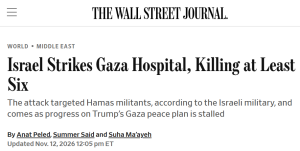
Screenshot of headline and byline of the Wall Street Journal Nov. 12, 2026, article, “Israel Strikes Hospital, Killing at Least Six”.
The Wall Street Journal attempted to falsely frame Israel in its Nov. 12, 2026, article, “Israel Strikes Gaza Hospital, Killing at Least Six,” for not issuing an evacuation warning before it targeted Hamas terrorists in the Nasser Hospital in Khan Yunis.
The article stated: “The strike came without an evacuation warning, according to the military.”
The military did not say that. The Israel Defense Forces issued three statements on the strike. The second explicitly stated: “Prior to the strike, advance warnings were issued to the population & precision-guided munitions and aerial surveillance assets were employed to minimize the risk of harm to civilians.” [Emphasis added]
The first stated: “Prior to and during the strike, steps were taken to mitigate harm to civilians, including the use of precision munitions and aerial surveillance.”
Neither statement said the IDF had issued no evacuation warning. Although the second statement did not specify whether those warnings called for evacuation, it does not support the Journal’s attribution of a lack of evacuation warning to the military.
CAMERA sent the newspaper a request for correction.
The WSJ included information from the IDF’s second statement in the paragraph immediately before the erroneous sentence. It reported that the strike targeted Muhammad Abu Ismail, commander of Hamas’s Khan Yunis Brigade, and that he operated from the hospital—details that did not appear in the first statement. The second statement also said that the IDF had issued advance warnings to the population. Other outlets reported the same targeting details around the time the IDF issued its statements. Yet the Journal attributed to the military a claim neither statement made: that the strike came without an evacuation warning.
The IDF shared that targeting information only in the second statement, not the first. Even if the WSJ published before the second statement appeared, the first statement did not say the IDF had issued no evacuation warning; it simply did not list a warning among the steps the IDF took to mitigate harm.
In the third statement, the IDF said that among the precautions it took, it directed the strike at “the room from which the brigade commander and the other terrorists were conducting military activities,” and that prior to the strike, “the IDF warned and demanded on several occasions, including recently, that the military activity at the hospital be halted. Despite the warnings, the military activity at the hospital did not cease.”
Furthermore, even if the Israeli military did not issue an evacuation warning, that would not necessarily violate the Law of Armed Conflict (LOAC) or the IDF’s own norms.
What the Law of Armed Conflict Says About Evacuation Warnings
LOAC protects hospitals as civilian infrastructure unless someone uses one outside of its humanitarian function to commit an “act harmful to the enemy.” The International Committee of the Red Cross (ICRC) gives several examples:
“If a hospital is used as a base from which to launch an attack; as an observation post to transmit information of military value; as a weapons depot; as a center for liaison with fighting troops; or as a shelter for able-bodied combatants.”
Such use of a medical facility by combatants to shield themselves from attack is a war crime under LOAC.
In those cases, LOAC sets out a protocol before an attack on a hospital. First, the attacking party must give a warning. According to the ICRC:
“The purpose of issuing a warning is to allow those committing an ‘act harmful to the enemy’ to terminate such act, or – if they persist – to ultimately allow for safe evacuation of the wounded and sick who are not responsible for such conduct and who should not become the victims of it.”
If those who receive the warning ignore it, the attacking party must still observe proportionality. The ICRC states: “The military advantage likely to be gained from attacking medical establishments or units that have lost their protected status should be carefully weighed against the humanitarian consequences likely to result from the damage or destruction caused to those facilities.”
Hamas has used Nasser Hospital as a base, as CAMERA has previously documented. Hamas has launched rockets from the hospital compound, stored weapons there, conducted interrogations there, and held hostages there. IDF troops have found hundreds of terrorists at the hospital, including several who took part in the October 7 massacre. In addition, the IDF has located and killed several prominent terrorists there.
This strike targeted Muhammad Abu Ismail, commander of the Khan Yunis Brigade, who had held several hostages, according to the military. The WSJ included none of this in its article, even though multiple Israeli and Palestinian sources have corroborated Hamas’s use of the hospital. Notably, the WSJ did not identify five of the six people who died in the strike, even after outlets published their names.
In same day reporting as the strike, The New York Times and NBC, as well as the Arabic language, Saudi-linked outlet Asharq News reported that the strike killed Khaled Abu Anza, whom the IDF identified in its third statement as “head of the communications section in the Operations Department of Hamas’s intelligence headquarters.” NBC also identified Murad Abu Zarifa among the dead, an individual the IDF identified as “a team leader in the engineering department of the Combat and Administrative Support Company.” The local Gaza sources Asharq cited identified Abu Anza as a Hamas leader.
On November 15, Israeli media reported, citing local sources, that the target of the strike, Abu Ismail, suffered a severe head injury and had his leg amputated after surviving the strike. The next day, the IDF also identified Muhammad Nafed Abu-Awad as a Nukhba terrorist in the Khan Yunis brigade who was killed in the strike.
The law does not require militaries to issue an evacuation warning when doing so would alert the target and allow him to escape.
The LOAC requires effective advance warning of attacks that may affect civilians unless circumstances do not permit – a limit that exists precisely so that the warning itself does not defeat a lawful strike on a combatant. A demand that Hamas stop using Nasser Hospital for military purposes, which the IDF says it issued more than once, is different from telegraphed notice that the military is about to hit a particular room.
By reporting that the strike came without an evacuation warning, the WSJ reporters misleadingly imply that the IDF had failed to take a precaution it should have taken.
But the paper attributed that claim to the military, which had not made it.
Reading between the lines of an official statement is part of a journalist’s job; presenting an inference as the military’s own account is not. Whether the law required an evacuation warning depends on the circumstances, including whether giving one would have alerted the intended target. The WSJ left readers with an implication of wrongdoing without establishing either that the IDF gave no evacuation warning or that the law required one.