
To American ears, “settlement expansion” is not a neutral phrase. It can evoke the country’s own sordid history of westward expansion: the displacement of Indigenous nations, the seizure of vast tracts of land, and, in parts of that expanding territory, the spread of chattel slavery. CNN’s Oct. 21, 2026, article (“Expansion with Impunity: How Israel under Netanyahu has reshaped the West Bank”) prompted that familiar American reading of a very different conflict to spin a one-sided narrative, riddled with data manipulation and agenda-ridden sources.

Oslo Accords signing ceremony. (L-R) Yitzhak Rabin (Prime Minister of Israel), Bill Clinton (US President), and Yasser Arafat (PLO chairman). White House lawn, September 13, 1993. Vince Musi / The White House, Public domain, via Wikimedia Commons.
That narrative rests on a selective account of construction and violence in the West Bank, as well as a misleading reading of police figures.
Peace Now and Unauthorized Structures in Area C
To advance this “settlement expansion” narrative, CNN used Peace Now data to show how Israel has been acting to “entrench its grip on the territory.”
To understand why this framing is politicized and misleading, one must examine the status of Area C in the West Bank, which consists of under 10 percent of the West Bank’s Palestinian population, comprises over 60 percent of the territory, and contains all authorized Israeli settlements. Designated under the Oslo Accords as a temporary transitional zone pending permanent status negotiations that ultimately stalled, Area C remains legally disputed territory.
Peace Now is an Israeli, ideologically driven organization that views the entire West Bank as earmarked for Palestinian statehood, and views settlements as the primary roadblock in that pursuit. The organization tracks unauthorized Israeli encampments and legalized settlements through its “settlement watch” research team, which monitors and documents construction on the ground using a combination of satellite imagery, field verification, and official state records. Western media regularly cites Peace Now’s data despite documented errors and significant discrepancies with official figures. Although the organization tracks tracking of unauthorized Israeli construction, the organization does not track Palestinians who do exactly the same.
The Palestinian Authority (PA) views Area C vital to the contiguity of a future Palestinian state. In 2009, under then-Prime Minister Salam Fayyad, the PA formulated the Fayyad Plan as an explicit strategy to bypass permanent status negotiations, which PLO Chairman Yasser Arafat (who was the leader of the Palestinian side during the Oslo negotiations) had explicitly pledged not to do. The plan sought to create contiguous Palestinian settlement between districts, prevent the expansion of Israeli settlements by encircling them, and control transport and access routes to Jordan.
The Israeli NGO Regavim, which views the Oslo Accords as defunct and sees all of the West Bank as part of the historic Land of Israel, uses similar methods for tracking unauthorized structures, but also documents permit-less Palestinian construction in Area C.
As of September 2025, Regavim counted 92,151 unauthorized Palestinian structures in Area C compared to 6,482 unauthorized Israeli structures. Notably, this data still excludes illegal Jewish construction in Area B, which remains minimal compared to Area C (as of the same time frame, Peace Now counted 26 Israeli outposts in Area B vs. 390 combined outposts and farms in Area C).
While the figures do not make Israeli and Palestinian construction identical, they do show why an account of the contest over Area C that treats territorial expansion as an Israeli strategy alone is incomplete.
The article mentions that “Israel deems this construction as illegal,” explaining why the state has acted to demolish many structures. Immediately, CNN then features Shaul Arieli, described as a “settlement expert,” justifying the illegal construction: “Israel retains full planning and construction authority, refuses to approve Palestinian development on a scale that meets the population’s needs, and then issues demolition orders against those forced to build without permits.”
CNN entirely ignored that this illegal construction is part of a widely recognized official PA strategy (including by Breaking the Silence, which is ideologically aligned with Peace Now), that is funded by the European Union to create facts on the ground. Instead, the network solely portrayed these demolitions as a means for Israel to oppress the “little man,” displaying a remarkable degree of intellectual dishonesty.
CNN’s Skewed ACLED Data
In addition to Peace Now, CNN cited ACLED’s extensive report on violence against Palestinians to show how attacks and other pressures affect Palestinians in the West Bank. ACLED’s report counted 2,763 events in 2025, taking in property damage, land seizures and crop theft as well as physical assaults. That scope gives readers a picture of insecurity that goes beyond physical acts of violence.
But where is the equivalent picture of insecurity for Israelis? ACLED’s report on violence against Israelis (“Is Palestinian armed group activity rising again in the West Bank?”) examines an extremely narrow set of attempted or executed armed attacks on “settlers and security forces.” It does not ask what Israelis face across the wider range of incidents that ACLED considered relevant when examining threats to Palestinians.
The scale of what that narrower lens leaves outside the frame is apparent in the Shin Bet’s 2025 figures: 6,103 security incidents against Israelis, including 1,428 significant attacks, executed or thwarted, and 4,675 lower-level incidents involving stone-throwing, firebombs, explosives and arson.
Its narrowed scope for Palestinian violence extends to the geographic boundaries of the data. ACLED’s count excludes attacks carried out by West Bank Palestinian residents in sovereign Israel. The Shin Bet total includes attacks carried out in the West Bank and Jerusalem.
Additionally, since ACLED relies mostly on published news reports, according to its sourcing guide, frequent lower-level incidents against Israelis largely go unreported. ACLED also draws from the Hamas-affiliated outlet Quds News Network (QNN) for West Bank event data. Its May 2025 report cited a March 2025 QNN report alleging that Israeli authorities had posted notices to confiscate agricultural land and hills west of Jenin. Yet there is scant publicly available evidence to substantiate the claim’s sweeping scope, and ACLED did not provide the notices or an underlying order.
CNN was free to focus on violence Palestinians experience. But an article that claims to explain how the West Bank is being reshaped, and links territorial expansion to violence, owes readers the full picture. Otherwise, it examines how construction and violence constrain one population while leaving a major part of the other’s security reality erased.
CNN’s Erroneous Use of Police Data
Near the end of its article, CNN reported that investigations into Israeli nationalist crimes in the West Bank against Palestinians have increased by “more than 560% since 2019,” yet “only 6.6% of the cases resulted in an indictment.”
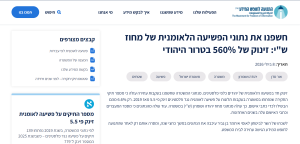
A screenshot of the original Movement for Freedom of Information headline. In English, it states: “We revealed the nationalist crime data for the Judea and Samaria (West Bank) District: A 560 percent jump in Jewish terrorism”.
Its wording closely follows the Movement for Freedom of Information’s account of police data. Translated from Hebrew, MFI wrote: “The number of investigation files opened by police following complaints of nationalist crime against Palestinians jumped 5.5-fold since 2019. Only 6.6 percent of them resulted in indictments.”
CNN appears to have repeated MFI’s interpretation of the figures, not just included figures the NGO obtained.
A separate police response that the MFI provided to CAMERA labeled the larger series “מספר התלונות שהוגשו”—the number of complaints filed. Complaints rose from 139 in 2019 to 779 in 2025: an increase of approximately 460 percent, not more than 560 percent.
The police data give a different series for investigation files: 95 in 2019 and 307 in 2025, an increase of approximately 223 percent. CNN called the first series investigations, even though the police identified it as complaints.
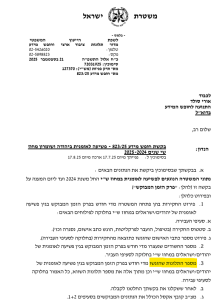
The first page of the Israel Police response that the MFI provided to CAMERA. The relevant portion is highlighted in yellow.
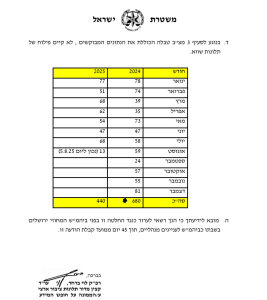
The second page of the Israel Police response that the MFI provided to CAMERA. The relevant portion is starred in black.
The indictment claim has a separate problem.
MFI says prosecutors filed 52 indictments in 2025. But in the spreadsheet MFI published, 52 cases from 2025 appear under פרקליטות–תביעות—a prosecution status, not an explicit count of indictments. Dividing those 52 cases by the larger 779-complaint figure does not establish that 6.6 percent of investigations resulted in an indictment, either. The figures may raise serious questions about accountability, still, they do not support CNN’s wording without further explanation of the categories and time frame.
Following communication from CAMERA, MFI changed its article headline to exclude the 560 percent figure. CNN did not change its article at all to reflect the reality of the police data.
The problem is not that the police figures show no rise in complaints or investigations; both series increased. The problem is that CNN repeated an NGO’s reading of the data without independently checking the numbers or verifying the data and then blurred the distinctions the data requires.
None of this makes attacks on Palestinians less serious or every Israeli building decision defensible. It does mean that accurate reporting cannot squeeze Area C into a familiar American story, with Israelis cast as westward settlers and Palestinians as Indigenous peoples displaced by them.
As indigenous rights activist Ryan Bellerose argued in Tablet Magazine in 2017, Jews are indigenous to the land of Israel: their peoplehood, language, religious traditions, and ancestral ties took shape there. Palestinians’ longstanding presence does not erase that history or make the American settler–Native American analogy fit.
CNN leaned heavily on organizations focused on Israeli construction, left the strategy behind Palestinian construction out, and repeated police statistics that the underlying records do not appear to support.
The reality is more complicated than the American story, and CNN’s readers deserve reporting that reflects it.