
60 Minutes recently presented a surprising, and dubious, claim when speaking about the complexities of the West Bank.
During Lesley Stahl’s Oct. 11, 2026, report aired on 60 Minutes, (written version: “Some Israeli settlers use sheep as tool to push Palestinians from their West Bank homes,” by Lesley Stahl, Shachar Bar-On, and Jinsol Jung) on the West Bank. Stahl states that “sheep have taken over huge swaths of land: 20% of the West Bank. Some 200 sheep farms have popped up in recent years.” There was no source provided. The claim isn’t insignificant; the entire thesis of Stahl’s report is reflected in the headline, that “Israeli settlers use sheep as a tool to push Palestinians from their West Bank homes.” If Stahl and CBS are inflating statistics to fabricate a sense of severity, that is journalistic malpractice.
After doing some research on the matter, CAMERA discovered that the claim likely originates from either an egregiously inaccurate interpretation of an Israeli news report or from a plainly unreliable report by the activist organization Peace Now.
The two figures—20 percent and 200 sheep farms—appear to come from two different sources cited in an article by ACLED in the same paragraph.
First, ACLED cites Peace Now data claiming that roughly 200 farming outposts have been built in the West Bank since 2023. Notably, Peace Now has a long history of making dubious claims regarding land in the West Bank and fooling journalists into repackaging its shoddy research.
It then cites an article at Ynet News which covers claims by an Israeli organization, the Farm Association (FA), that settlers supposedly control “more than 1.1 million dunams…in Area C, roughly one-third of the area,” which corresponds to approximately 20 percent of the total area of the West Bank (approximately 5.65 million dunams). These two data points appear to match those made by Lesley Stahl in her own words without any attribution.
But neither individually nor together do these two sources actually support Stahl’s claim that Israeli “sheep have taken over…20% of the West Bank.”
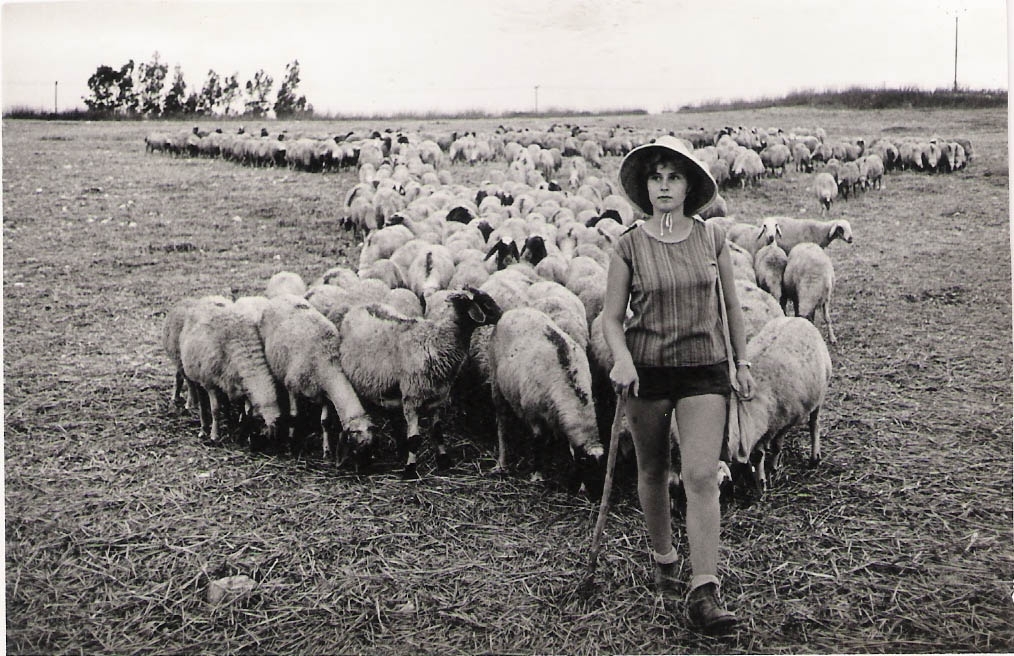
An Israeli shepherd leading her flock. Courtesy: PikiWiki
The FA did not claim that 1.1 million dunams of land was being used by sheep; it said 1.1 million dunams was being used for both agriculture and grazing. It did not break down the figure any further.
But what about Peace Now? The mere existence of roughly 200 farming outposts does not establish control over 20 percent of the West Bank. But another recent Peace Now report does shed light on the credibility of the overall claim.
A December 2024 report, coauthored by Peace Now and Kerem Navot, claimed that 14 percent, not 20 percent, of land in the West Bank was being used by Israeli shepherds.
The probity of this report as the veracity of Stahl’s claim goes beyond merely an unexplained 50 percent higher figure given by Stahl less than two years later. The methodology of Peace Now’s report reveals the claim to be thoroughly unreliable.
In the report’s section, “Methodology: How was the extent of grazing lands seized by settlers estimated,” it begins:
The lands seized by settlers after the establishment of shepherding outposts were assessed and mapped by observing signs that Palestinian agricultural lands had remained uncultivated for extended periods, as well as evidence of road construction, water infrastructure installation, and the construction of fences and gates.
Noticeably absent from the methodology is evidence of the physical presence of sheep.
Set aside the fact that the language concludes that all land in Area C of the West Bank is “Palestinian” land, which contradicts both reality and the Oslo Accords governing the territory (mutually agreed to by both Israel and Palestinian leadership).
There are a plethora of reasons why agricultural lands might be left uncultivated. Peace Now appears to discount all of those reasons in favor of assuming the only possible explanation is invasive Israeli settler sheep. It also fails to explain what an “extended period” of time is.
Even more questionable is that the methodology also assumes that the only plausible explanation for road construction is that sheep are afoot. The Palestinian Authority illegally builds a road over ancient Jewish historical sites? Must be Jewish shepherds nearby.
To say this methodology is flawed is an understatement. It is the kind of methodological rigor one might expect of an activist organization with a partisan agenda, but it is not the kind of methodology that any credible journalistic institution should rely on.
CAMERA has written to CBS requesting substantiation on this claim.
Stahl’s Other Unsupported Claims
The case of the colonizing sheep is not the only questionable claim made in Stahl’s report. Several other dubious claims, often heard from activist organizations, are also repeated by CBS without qualification.
Stahl claims, for example, “More than 100 Palestinian communities have been displaced or erased by the settler violence and the ever-encroaching sheep.” But this data is undermined even by the U.N., which is infamous for inflating data to delegitimize Israel and Israeli settlers. According to OCHA, only “45 Palestinian communities have been fully displaced” since January 2023. Many of those communities are tiny herding clusters (averaging around only 80 residents, based on OCHA’s own data), often comprising of just a handful of tents and tin shacks. Some, such as Khirbet Tana, are not even permanent residences and were demolished not by settlers or sheep, but by the lawful authorities due to the structures having been illegally erected.
What Stahl appears to be doing is also counting what OCHA describes as “partially displaced” communities, which is explained as a “community where some families experienced displacement in the context of settler violence.” Once again, this methodology raises obvious questions. “Displacement in the context of settler violence” could mean almost anything and establishes no causal relationship.
It is undeniable that tensions and violence in the West Bank create stress for families. If an Israeli family decides to move from a smaller settlement to a more built-up settlement to feel more secure, would that count as displacement in the context of Palestinian violence?
Stahl also uncritically repeats OCHA’s claim that there have been “more than 1,600 incidents” of settler violence. In doing so, it is apparent that 60 Minutes believes that as long as the U.N. says so, a claim must be credible, dispensing with any obligation to hold power and institutions to account. Had they examined the claim any further, they would have quickly learned that OCHA counts attacks by Palestinians against Israelis as incidents of settler violence. The figure also includes incidents where no Israeli settlers were even involved, but rather incidents involving armed Palestinians and Israeli security forces. One report by Regavim, a right-wing counterpart to Peace Now, found, for example, that OCHA was counting over 1,300 incidents of either Jews peacefully visiting the Temple Mount or Muslims rioting atop the holy site as settler violence.
The political dispute over the West Bank, and the accompanying violence, is a serious issue. Many actors are involved: the Israeli government, the Palestinian Authority, the United Nations, Israeli organizations, Palestinian terrorist organizations, foreign offices around the world, and even Iran. The uncurious and unchallenged amplification of one narrative does nothing to untangle the reality of the situation.
Stahl speaks of the West Bank and “Palestinians who hope to make it the heart of their future state.” But she never contends with the historical reality that complicates this sanitized, emotional narrative. If that is all that the Palestinians desire, why have they repeatedly rejected offers that would have given them exactly that, a state on the land at issue?
Perhaps if 60 Minutes dug a little deeper into the stories they report on, more light might be shed onto the intractability of the conflict shaping the West Bank and beyond.