
Trita Parsi is back on ABC by unpopular demand.
Parsi was born in Iran but grew up in Sweden, before immigrating to the United States. He is the co-founder and executive vice president of the Quincy Institute; a Blame America First think tank. Parsi has espoused the Iranian regime’s talking points for decades, for which the Iranian opposition reviles him, suspecting that he is a “lobbyist” for the regime that oppresses them and their kins.
Before establishing the Quincy Institute, he co-founded the National Iranian American Council (NIAC) in 2002, which promoted giving concessions to Iran. He was frequently in touch with the Iranian ambassador to the United Nations, Javad Zarif, including arranging meetings for him with members of Congress. Zarif would go on to become the foreign minister and vice president for strategic affairs in the Islamic Republic. Parsi was a key advocate for 2015’s Joint Comprehensive Plan of Action (JCPOA), the Iran nuclear deal, which Zarif negotiated, and which lifted sanctions on Iran.
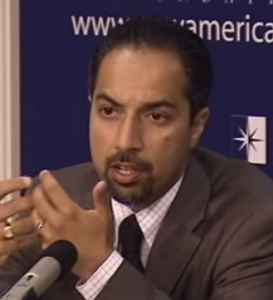
Trita Parsi, via Wikimedia Commons
In his latest appearance on an August 11 edition of ABC News Live, Diane Macedo asked Parsi for his take on the latest Iranian assassination plot against U.S. President trump during a July 2026 trip to Turkey. The Washington Post first broke the news about the credible missile threat against Air Force One, which prompted Trump to stealthily change aircraft using a catering truck. Israel informed the United States of intelligence indicating the assassination plot, which spurred on the U.S. Secret Service to make the drastic decision to covertly hide Trump’s whereabouts on the return trip.
But Parsi placed the blame on Trump, stating:
What I think is important to note though, is that despite 47 years of enmity between the United States and Iran, there’s never been any incident of this kind in the past, so even credible threats against the life of an American president from the Iranian side until Trump himself initiated this escalation by killing the Iranian general Soleimani and killing the Iranian supreme leader.
Parsi’s quote is misleading.
History did not begin in 2020. Soleimani and the Islamic Revolutionary Guard Corps (IRGC) Quds Force he commanded between 1998 and 2020 provided the improvised explosive devices to terrorists in Iraq fighting against U.S. forces. Those weapons killed more than 600 Americans and maimed thousands more. Parsi does not provide this background for the 2020 strike to eliminate Soleimani in Iraq.
Nor did he mention Iran’s own assassination attempts against political figures which well predate the targeted strikes on Soleimani. There is a long trail of Iran’s successful and failed attempts on the lives of dissidents in the diaspora, including in the United States.
But it does not stop there. Iran has attempted to eliminate politicians through its proxies and hired mercenaries. Iran-backed Hezbollah suicide bombers killed Lebanese member of parliament and former prime minister, Rafic Hariri in 2005. In 2011, the FBI uncovered an Iranian plot to assassinate the Saudi Ambassador to the United States, Adel al-Jubeir, by bombing the popular Georgetown restaurant, Cafe Milan, which would have certainly killed many Washingtonians. The implication that Iran hasn’t always played dirty through assassination plots and murder for hire simply holds no water.
It would have been shocking, however, if Parsi did not pin blame for the latest threat against Trump on the United States, given his track record. In the past, he excused IRGC attacks on civilian ships in the key waterway, the Strait of Hormuz. In February 2026, he argued that there should be no deal with Iran that limits the regime’s missile program, which represents its most potent threat to Israel and other neighbors. In January 2024, he asserted that a Houthi terrorist blockade in the Red Sea was the result of the United States providing arms to Israel.
Parsi’s broad framing should have initiated some follow-up questions from Macedo, the most pressing of which would be, “Why has Iran already engaged in political assassinations abroad and assassination attempts in the United States even before Soleimani and Khamenei’s eliminations?”
Macedo, however, did not ask this. When interviewing such a partisan guest as Parsi, ABC must do better to push back on his talking points. Macedo gave Parsi a platform to spout misleading claims masquerading as valid analysis while excusing an Iranian plot to murder Trump. When the topic of discussion is assassination plans against American political leaders, Parsi shouldn’t be allowed to play politics and give PR to our enemies without contest.