
For decades, Trita Parsi has espoused the Iranian regime’s talking points with no pushback. His interview with ABC’s Linsey Davis is the latest example. She interviewed the Quincy Institute co-founder and executive vice president on July 8, following U.S. airstrikes in response to Iranian attacks against oil tankers near the Strait of Hormuz.
Davis begins with a sensible question: “Since the ceasefire and memorandum of understanding, Iran continued to strike ships in the Strait of Hormuz. What do you think their strategy is if they knew that more hostilities could result?”
Parsi responded:
Actually, they haven’t been striking at ships randomly. What has happened is there’s two different corridors in the Strait. … What they don’t want is that the ships go through the southern corridor without coordinating with the Iranians.
Parsi’s response is a copy and paste of the Islamic Republic’s, which acknowledges it is attacking “certain commercial vessels that have been navigating through routes not coordinated with Iran.” ABC might want to just read from the website the next time to save itself time for booking Parsi.
The ministry’s excuse, repeated by its de facto spokesperson, Parsi, contradicts the Memorandum of Understanding between the United States and Iran, which provided that Iran would “make arrangements using its best efforts for the safe passage of commercial vessels,” to remove “the technical and military obstacles,” and to abide by “applicable international law…”
Within just over one week of the Memorandum being signed, however, Iran was still attacking vessels in the strait. On June 25, a cargo vessel was “hit on the starboard side by an unknown projectile” in the Strait of Hormuz, just off the coast of Oman in Omani territorial waters, according to United Kingdom Maritime Trade Operations (UKMTO). It halted an evacuation out of the Strait of Hormuz that the International Maritime Organization had supported, in order to facilitate the passage of ships that had been hindered by the conflict in the Gulf.
The violations of the memorandum persisted. On June 27, Iran attacked the M/T Kiku near the Strait of Hormuz. The UKMTO confirmed several additional attacks on July 5, 6, and 7.
The attacks prompted the U.S. military to launch retaliatory strikes against regime targets in Iran on July 7 and 8.
Parsi excuses attacks on civilian vessels because they were in the wrong shipping lane, but the reality tells a different story. Foundation for Defense of Democracies Iran expert Miad Maleki said it best: “The ‘Hormuz fee’ proposal is simply the maritime extension of the same strategy [for Iran]: normalize the regime’s most coercive tools by selling them as technocratic arrangements and regional ‘institutionalization.’ Once you recognize that lineage, the idea stops looking like bold conflict resolution and starts looking like another attempt to launder extortion into policy.”
Parsi continued:
What the Iranians are fearing is that the United States is trying to create a new corridor in the south of the strait that would be kept open even if the war resumes. … There is a way of resolving this, but more strikes from either side is just making diplomacy … all the more difficult.
Parsi is right. The U.S. military is upholding the freedom of navigation in international waters, which has been a bedrock of maritime order for centuries and enshrined in international treaties. Davis’ failure to raise this point and ask Parsi how Iran is not the aggressor for undermining of the international order against third-country ships is poor journalism.
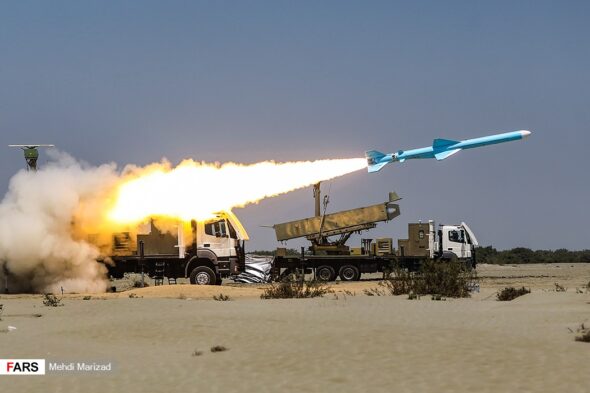
Iranian missile launch (Fars Media Cooperation via Wikimedia Commons)
Additionally, by taking away Iran’s main point of kinetic leverage in negotiations, their military grip on the Strait of Hormuz, the U.S. can accomplish more diplomatically. But Parsi suggests that appeasement is the path forward. He argues that the only way to resolve the battle over the Strait of Hormuz is to leave the regime with the capabilities to extort commercial shipping.
Parsi’s recommendations are expected. He is an immigrant from Iran, reviled among the Iranian opposition under the suspicion that he is a “lobbyist” for the regime. He founded the National Iranian American Council (NIAC) in 2002, recommending concessions to Iran, and became a key advocate for 2015’s Joint Comprehensive Plan of Action (JCPOA), the Iran nuclear deal, which lifted sanctions on Iran.
Parsi has ties with the Islamic Republic, including the former foreign minister Javad Zarif, whose tenure in New York overlapped with the founding of NIAC. An email correspondence in 2006 between Zarif and Parsi viewed by law enforcement experts suggested at the time that NIAC was operating “as an undeclared lobby” of the Islamic Republic, and that Parsi even tried to set up meetings between Zarif and members of congress.
“Happy to hear that you will meet with [Rep. Wayne] Gilchrest and potentially [Rep. James] Leach. There are many more that are interested in a meeting, including many respectable Democrats,” Parsi wrote to Zarif.
Flash forward to today.
In February 2026, Parsi argued that there should be no deal with Iran that limits the regime’s missile program, the regime’s most potent threat to Israel and other neighbors.
It’s worth noting that part of the reasoning for the U.S. military’s Operation Epic Fury was that intelligence reports indicated that Iran was attempting to make itself “untouchable.” According to Secretary of State Marco Rubio:
Iran was trying to build a conventional shield … in essence have so many missiles and so many drones that no one could attack them, and they were well on their way. … That was an intolerable risk.
Davis should have challenged Parsi on the aforementioned points. By choosing to allow Parsi to suggest that Iran was justified in attacking commercial vessels, and that the only path toward a durable peace is capitulation the regime, she left her viewers with the regime’s talking points masquerading as legitimate policy analysis.