
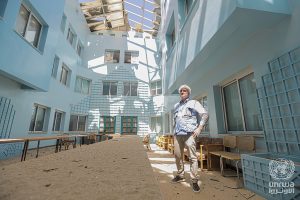
The Director of UNRWA Affairs in Gaza, Mr. Matthias Shamale at the UNRWA headquarters in Gaza, May 19, 2021. (credit: Mohamed Hinnawi, CC BY-SA 3.0 IGO, via Wikimedia Commons)
Famously, the slogan “All the News That’s Fit to Print” graces the front page of every New York Times edition. The slogan was coined at the end of the 19th century by the paper’s publisher, Adolph Ochs. Of course, in today’s hyper-globalized world, the slogan is wishful thinking. No paper could realistically cover all the important news stories of the day.
Still, it would be hard to argue that outlets like the New York Times, the Washington Post, CNN, and others adequately cover even those stories they do print. They often devote precious space to emotive or opinionated claims, while omitting highly material and relevant information that sheds important new light.
Provided below are three important, but underreported, stories from the week bearing on Israel and the Middle East that media consumers should know.
UNRWA Plans Mass Layoffs as It Advances Plan to Transfer Responsibilities to the Board of Peace
United Nations Relief and Works Agency for Palestine Refugees (UNRWA) Acting Commissioner-General Christian Saunders will soon present a plan to gradually shut down the agency and transfer its responsibilities to the Board of Peace, Israel Hayom reported Nov. 1, 2026, citing Arab and Western diplomatic sources.
The U.N. agency has been conducting mass layoffs in the Gaza Strip over the past several months. Saunders told the staff union in early October that he intends to end the services of thousands throughout the agency, citing the organization’s financial deficit.
At the end of June, UNRWA announced a $100 million deficit. Before the Oct. 7, 2023, Hamas massacre, UNRWA’s largest donors were the U.S. and some European countries, accounting for 75 percent of the agency’s $1.1 billion budget. After the Israeli military and U.N. Watch provided substantial evidence that UNRWA employed active Hamas terrorists, including several who participated in the massacre, the U.S. and several other European countries suspended their aid to the agency. As of 2026, the U.S. and Sweden remain the only two countries to have completely cut funding to the agency.
In July 2026, the Board of Peace posted on X, “UNRWA has no place in the new Gaza. We are turning the page on the complex of perpetual aid dependency & conflict. The people of Gaza deserve better.” It reaffirmed this position in September.
The Board of Peace’s policy as it relates to UNRWA’s involvement in Gaza is unchanged.
We will only work with trusted partners who will deliver for the people of Gaza and contribute to a deradicalized Strip.
UNRWA fails on those litmus tests.
Our approach is the right one to reduce perpetual dependency and lead Gaza towards a self sustained, thriving economy that delivers opportunity and better conditions for Palestinians.
https://t.co/v4QNltYeXQ
— Board of Peace (@BoardOfPeace) September 25, 2026
An April 2025 Israeli Defense Intelligence report estimated that about 12 percent of UNRWA employees were ranking members of Hamas or other designated terrorist organizations. A January 2024 U.N. Watch report said thousands of UNRWA teachers had publicly glorified terrorism and praised the Oct. 7 attacks. IMPACT-se reported that UNRWA textbooks glorified terrorists, promoted antisemitism, and encouraged militancy. On Oct. 23, 2026, The Jerusalem Post reported that a teacher said administrators at a Gaza UNRWA school threatened her with scissors after she challenged pro-Hamas rhetoric.
American media has hardly covered the downfall of UNRWA over the past few months, and in past reporting on actions Israel took against UNRWA, has cast doubt upon the agency’s ties to terror. The lack of coverage suggests an unwillingness to give legitimacy to official findings of extremism within a U.N. agency.
Steadfast UNRWA critics, Hillel Neuer, head of U.N. Watch, and former Israeli lawmaker Einat Wilf welcomed Sunday’s planned shutdown. Wilf called it a “blessed direction, as long as it doesn’t involve replacing one source of funding with another,” but warned that ending UNRWA services “without putting an end to the fictitious status where every descendant is a ‘Palestinian refugee’ with a ‘right of return’ will change nothing.”
In “The War of Return: How Western Indulgence of the Palestinian Dream Has Obstructed the Path to Peace,” Wilf and co-author Adi Schwartz argued that the demand for return to Israel is the greatest obstacle to peace and that UNRWA perpetuates Palestinian refugee status across generations, unlike other U.N. refugee agencies.
U.N. Elects Five New Judges to International Court of Justice
On Tuesday, the U.N. General Assembly and Security Council elected five judges to nine-year terms on the International Court of Justice (ICJ), beginning Feb. 6, 2027. Israeli Ambassador Danny Dannon condemned some of those elected for their previous anti-Israel positions.
Of the five, three—Dapo Akande (United Kingdom), Francois Alabrune (France), and Rena Lee (Singapore)—will replace ICJ judges Ronny Abraham (France), Dalveer Bhandari (India), and Leonardo Nemer Caldeira Brant (Brazil). The U.N. bodies also renewed the terms of Mahmoud Daifallah Hmoud (Jordan) and Phoebe N. Okowa (Kenya), elected in May and November 2025, respectively, to fill seats vacated by Nawaf Salam (Lebanon) and Abdulqawi Ahmed Yusuf (Somalia).
Jordanian Judge Hmoud previously served as Jordan’s U.N. ambassador, legal adviser to the Jordanian Foreign Ministry, and a member of the U.N. International Law Commission, which he chaired in 2021. On Oct. 30, 2023, in a U.N. Security Council debate, he accused Israel of “ethnic cleansing” and “war crimes.” He earlier presented Jordan’s positions in the 2024 ICJ proceedings on the legal status of Israel’s presence in the West Bank and east Jerusalem, and in the 2004 proceedings on Israel’s security barrier, built to block suicide bombers from entering Israel during the second intifada. Jordan then rejected Israel’s self-defense argument.
In 2024, Hmoud argued for Jordan that Israel’s West Bank activities and presence amounted to unlawful annexation and apartheid, reiterating the peremptory norm that territory cannot be acquired by force under any circumstances, including self-defense. Notably, Jordan seized the same territory by force in 1948 and annexed it. It then pursued policies to make the territory a permanent part of Jordan. Israel captured it in the 1967 Six-Day War after Jordan attacked Israel following Israel’s pre-emptive strike on Egypt. The ICJ’s 2004 and 2024 advisory opinions largely mirrored Jordan’s arguments.
Both Kenyan Judge Okowa and British Judge Akande served as legal advisors to Namibia and Japan, respectively, in the same 2024 ICJ proceedings that Hmoud was involved in regarding the West Bank and east Jerusalem. Both countries supported the ICJ ruling that Israel’s continued presence in the area is unlawful, and Israel must bring an end to it “as rapidly as possible.” Both judges have backgrounds in academia, serving as professors of international law at Queen Mary University of London, and Oxford University, respectively.
French Judge Alabrune shares Hmoud’s background in diplomacy. Most notably, he served as a legal representative on behalf of France in the ICJ’s Gambia vs. Myanmar case. The Organisation for Islamic Cooperation set up this case as the modified foundation of the Genocide Convention on which to build South Africa’s case against Israel. In this case, France supported interpreting the threshold for determining genocide in such a way that would bolster South Africa in its genocide case against Israel.
Renee Lee is the sole judge-elect without involvement in cases related to Israel. Her expertise lies in the Law of the Sea, international arbitration, and multilateral negotiations and largely has a diplomatic background.
Amb. Danon commented on X, stating, “Electing judges who have previously taken positions against Israel raises serious doubts about the Court’s impartiality. Yet another example of the UN’s institutional bias against Israel.”