
In May 2026, the New York Times published an article by opinion columnist Nicholas Kristof. Titled “The Silence that Meets the Rape of the Palestinians,” it charged Israel with widespread, systematic sexual abuse of Palestinian prisoners, including using dogs for rape. The column caused significant controversy and faced tremendous pushback from CAMERA itself as well as other critics who found serious problems with Kristof’s arguments and journalistic practices.
The Times’ Executive Editor, Joseph Kahn, has now made fresh comments about the controversy. As the executive editor, Kahn “oversees all aspects of The Times’s global newsroom and news report.” Surprisingly, his comments suggested the outlet’s newsroom was distancing itself from Kristof.
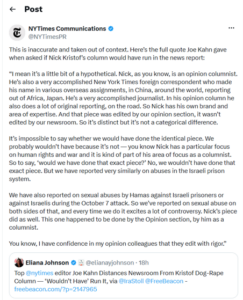
Importantly, Kahn said that the newsroom would not have published an identical piece: “it’s impossible to say whether we would have done the identical piece. We probably wouldn’t have.” Then, he repeats this point again, stating: “we wouldn’t have done that exact piece.”
Kahn also made sure to clarify that he and the newsroom were not responsible for column. According to Kahn, Kristof’s work “was edited by our opinion section, it wasn’t edited by our newsroom. So it’s distinct, but not a categorical difference.”
Kahn’s comments regarding Kristof’s column were published on July 8, 2026, by the Washington Free Beacon. In response to the Beacon’s report, which the Times deemed inaccurate, the outlet’s communications team publicized the text of Kahn’s remarks regarding Kristof in a post on X.
What Kahn is not saying is of outmost importance, and raises two critical questions: how and why?
How would the reporting have been different from the newsroom? Why would it have been done differently? Readers are only able to make educated guesses. That the newsroom never followed up on Kristof’s claims with more reporting, despite the bombshell nature of the allegations, may help answer these questions.
But Kahn avoids answering these questions, seeking only to vaguely project an appearance of distance between himself and his newsroom on the one hand and Kristof on the other.
The significance of these questions should not be understated.
First, Kahn’s remarks are not the first time the Times has tiptoed around owning Kristof’s column and answering the criticism. In May, the newspaper backed the columnist while also appearing to qualify his claims. Kathleen Kingsbury, the head of the Times’ opinion section, backed the column and Kristof himself. However, a collection of letters to the editor addressing the column was titled “Palestinian Accounts of Rape by Israelis.” Why is this significant? Because Kristof’s column made serious allegations in his own words. Now, it appears, the Times downgraded them to merely allegations made by others. In doing so, they avoid accepting responsibility for their own columnist’s words.
Second, this isn’t the first time that differences between the news and opinion rooms have been made public. The New York Post, Puck, and the Israeli outlet Ynet reported that members of the paper’s newsroom were very critical of and even embarrassed by Kristof’s column. Kingsbury herself apparently felt enough pressure to clarify that “the Times’s news staff in the Middle East played no role in Nick’s column.”
Third, the May column regarding Israel’s treatment of the Palestinians was neither the first nor the last time Kristof was involved in major controversies. In the past, he aggressively promoted similarly attention-grabbing stories that ended up being false. Those lies were later exposed, which led to him acknowledge his mistakes in 2014.
And in June 2026, about a month after his column on Israel and the Palestinians, Semafor reported that Kristof’s columns quoted or mentioned individuals who previously donated money to his failed gubernatorial campaign—but Kristof did not disclose these connections. When Kristof returned to the newspaper following his political adventure, the Times promised its readers Kristof would disclose such ties. Following this discovery, the Times said it would review Kristof’s work.
Given Kahn’s comments, Kristof’s debacles, the Times’ own tiptoeing around the column, and the previously reported “civil war” between the newsroom and opinion section, the Times needs to provide its readers with answers. Kristof’s column makes grave allegations. The Times must clearly state its position on these arguments.
For the Hebrew version of this post, please see CAMERA Hebrew.