
CAMERA’s Israel office this week prompted correction of an Associated Press article which cherry-picked disputed and dated data about the Gaza Strip’s food security situation from the perennially factually challenged Integrated Food Security Classification (IPC), while ignoring United Nations information with a far more positive — and current — assessment. The Jan. 20 correction, which noted that the IPC claim in question was older than AP had reported, subsequently appeared in at least 113 secondary media outlets across the United States and beyond.
The Jan. 19 article, “Trump’s board of peace has several invited leaders trying to figure out how it’ll work,” had initially stated (archived here), grossly misleading about the Gaza Strip’s present improved food security situation:
The U.N. World Food Program on Monday said it has “significantly expanded” its operations across Gaza 100 days into the ceasefire, reaching more than a million people each month with hot meals and food parcels. But it warned the situation remains “extremely fragile.”
It noted that malnutrition has been prevented for 200,000 pregnant and breastfeeding women, as well as children under 5.
Still, the most recent Integrated Food Security Phase Classification (IPC) analysis in December indicated that 77% the population is facing crisis-level food insecurity.[Emphasis added.]
AP’s choice to provide background information including a figure from IPC data released in December, while ignoring more recent information from the United Nations, which is a partner of the IPC mechanism, was striking.
Indeed, the United Nations reported on Jan. 5:
“The January round is the first since October 2023, in which partners had sufficient stock to meet 100 per cent of the minimum caloric standard,” UN Spokesperson Stéphane Dujarric told journalists on Monday.
That’s compared to the end of 2025, when each family received just 50 to 75 per cent of the calories needed to stay healthy. [Emphasis added.]
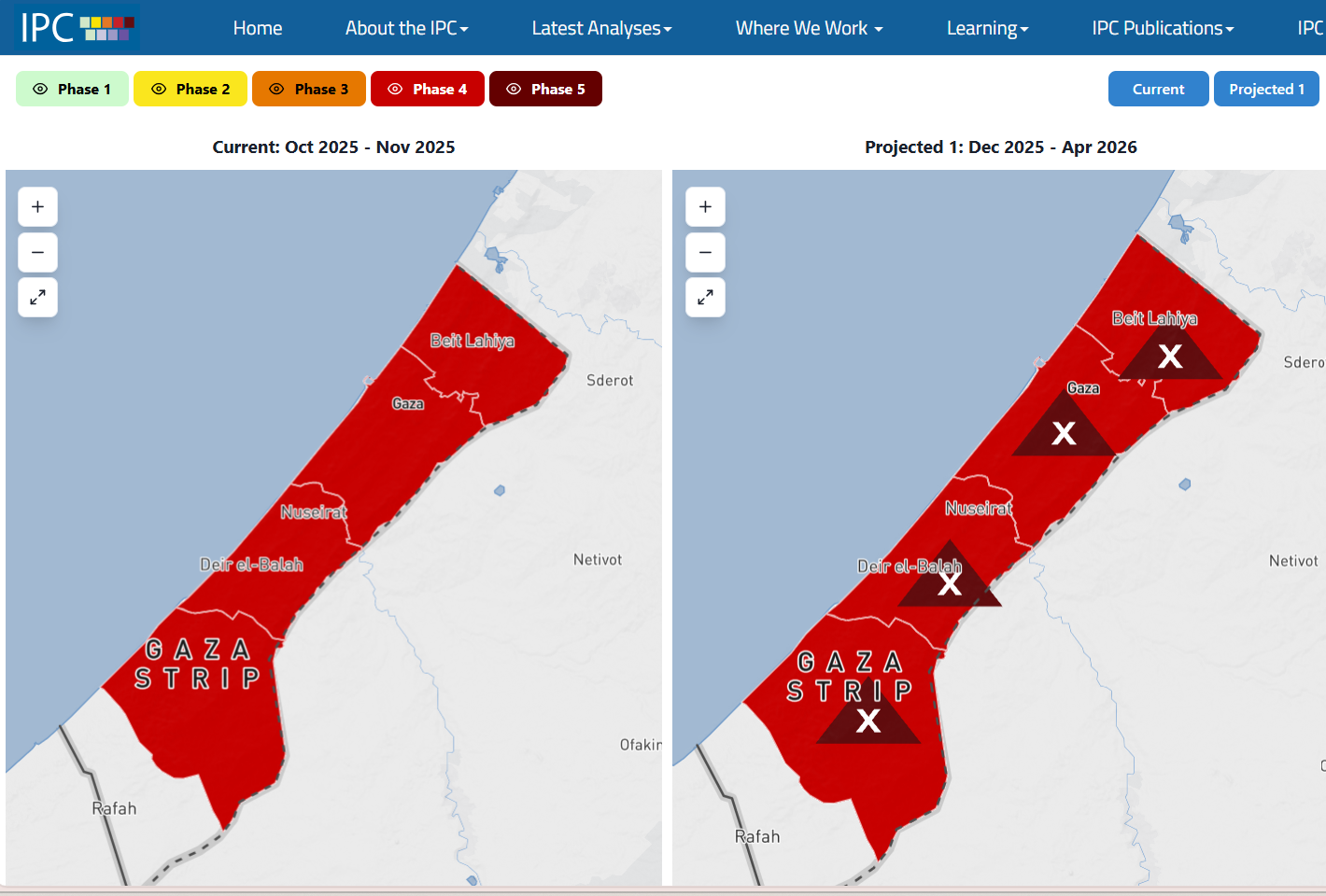
Screenshot of IPC’s December 2025 report covering data in October and November
Moreover, contrary to AP’s claim, the IPC’sDec. 19 report did not indicate”that 77% the populationis [note the present tense] facing crisis-level food insecurity.” Rather, it reported: “Between 16 October and 30 November 2025, around 1.6 million people (77 percent of the population analysed) faced high levels of acute food insecurity (IPC Phase 3 or above).” [Emphasis added.]
In other words, IPC’s December report related to food security prior to December, and not in December.
CAMERA contacted AP, pointing out the significant gap between the IPC’s questionable and clearly outdated claim that”77% the population is facing crisis-level food insecurity” versus the U.N.’s more current information that in January, “partners had sufficient stock to meet 100 per cent of the minimum caloric standard,” and also flagging the wire service’s erroneous reporting on the timeliness of the IPC figure.
As a result, on Jan. 20, AP amended the article to state:
The most recent Integrated Food Security Phase Classification (IPC) analysis, which assessed the situation in October and November, indicated that 77% the population was facing crisis-level food insecurity. [Emphasis added.]
In addition, the following note was appended to the bottom of the article alerting readers to the change:
This story was first published on Jan. 19, 2026. It was updated on Jan. 20, 2026, to make clear that the IPC figure cited was released in December but assessed the situation in October and November.
The corrected text has appeared on more than 113 news sites across the United States and beyond, including The Toronto Star, San Francisco Chronicle, ABC News, Seattle Times, Newsday, and the Connecticut Post, along with the sites affiliated with scores of local radio and television states.
As of this writing, AP has not yet corrected the Spanish version of the same article.
For the Spanish version of this article, see CAMERA Español.