
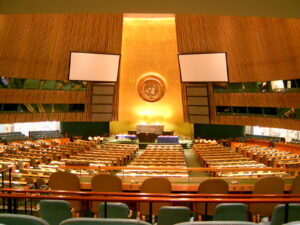
United Nations General Assembly in New York City (illustrative). (credit: Mr Bullitt, CC BY-SA 3.0, via Wikimedia Commons)
“There is no one true interpretation of what international law mandates, regardless of what ‘experts’ at outlets … claim,” CAMERA U.S. Media Research Manager David Litman previously wrote.
Drawing from a famous Pirates of the Caribbean line, that the pirate code is “more what you’d call ‘guidelines’ than actual rules,” Litman noted that, without enforcement, international court rulings and proclamations function merely as suggestions.
Considering this reality, CNN corrected its July 20, 2026, article (“Israel’s far-right openly boasts of resettling Gaza as election looms”) on July 23 to clarify who considers Israeli settlements illegal.
The article had authoritatively stated, “All Israeli settlements in the occupied West Bank are considered illegal under International law.”
Following CAMERA’s outreach, the outlet amended the article to state, “All Israeli settlements in the occupied West Bank are considered illegal under International law by most of the international community and the United Nations.” [Emphasis added]
CAMERA had previously flagged this exact error to CNN. Regarding the Feb. 8 article, “Israel tightens grip on West Bank ahead of Netanyahu’s visit to US,“ CAMERA alerted the network to the same blanket phrasing. CNN explicitly promised in communication with CAMERA to update the wording as requested, but it only corrected two other reported errors in that story, leaving the erroneous absolute claim on settlement legality untouched until July.
This is a small change with significant implications. The correction acknowledges that the legal status of West Bank settlements is a matter of debate among international law experts and not an absolute, indisputable fact.
CNN’s framing obscured reality by conflating political opinion with binding international law. By initially declaring settlements unconditionally illegal, the article treated non-binding U.N. resolutions and International Court of Justice (ICJ) advisory opinions as enforceable precedent, ignoring that neither body possesses the statutory authority of a global supreme court that overrides state sovereignty.
Those who entirely disagree with the U.N. and ICJ perspectives on the legality of settlements include numerous, highly regarded academics and jurists, including Barrister Natasha Hausdorff, former ICJ President Judge Stephen Schwebel, Prof. Julius Stone, Prof. Yoram Dinstein, Prof. Wolfgang Bock, Prof. Eugene Rostow, and Prof. Sir Elihu Lauterpacht, and many others. International bodies have applied a unique double standard to Israel compared to other territorial disputes, as exemplified by Dr. Shany Mor on X:
I can name a lot more than 5. Let’s start with 23 easy ones:
1. Designating a combatant a journalist automatically immunizes that combatant from attack.
2. A territory is occupied even if there is no presence whatsoever after a hostile armed force by virtue of being blockaded. https://t.co/4TXyUF0zER— Shany Mor שני מור شني مور (@ShMMor) April 7, 2026
Cyprus provides a parallel case, which international organizations treat differently. They condemn its division, and Turkey’s transfer of tens of thousands of civilian settlers into Northern Cyprus is illegal under Article 49(6) of the Fourth Geneva Convention. Yet, no international court has ruled it as such, nor has any major international body taken steps to penalize Turkey; the ICC continues to ignore petitions by Cypriot representatives to open an investigation into Turkish war crimes on the island.
Furthermore, a key basis for disputing the “illegal” charge lies in the Oslo Accords, the bilateral peace framework that both Israel and the Palestinian Authority (PA) signed and the U.N. endorsed. The Oslo Accords did not prohibit settlements; instead, the agreement designated them an issue to be solved pending a final peace agreement. It even required that “The Palestinian side shall take all measures necessary to prevent such hostile acts directed against the Settlements [and] the infrastructure serving them.”
Notably, while CNN scolded Israel for expanding settlements, which critics generally view as a violation of Oslo II’s prohibition against steps “that will change the status of the West Bank,” the network completely ignored the PA’s obvious disregard of its obligations to “take all measures necessary to prevent such hostile acts directed against the Settlements” and their supporting infrastructure. Instead, the PA continues to reward and bankroll terrorism against all Israelis.
CNN’s framing of this issue raises the question of whether the journalist who wrote the story reports the news or is an activist. How would CNN’s audience know that there are two sides to the issue if CNN only reports one? Changing the sentence to indicate that the legality of settlements is not absolute truth, but rather debatable, is the first step in upholding an objective newsroom.
For the Hebrew version of this post, please see CAMERA Hebrew.