
Who exactly is Hussam Abu Safiya? Major outlets like CNN, The Associated Press, ABC News, Reuters, and NPR reported in June and July 2026, that Israel has been mistreating him, while international NGOs (such as Amnesty International) have actively defended him over what they claim is an unjust detention.
In each of these reports, Israel’s accusation that Abu Safiya is a member of Hamas is a throw-away line. Reporters cast the claim with doubt and never meaningfully engaged with it.
However, there is photographic evidence available that he – at least – had significant ties to high-ranking members of the terrorist organization.
Before the IDF and the Shin Bet apprehended him, Abu Safiya served as the director of Kamal Adwan Hospital in Jabaliya, Gaza. As a pediatrician and neonatologist, he frequently worked directly in those units.
What’s suspicious about a hospital?
Kamal Adwan Hospital is one of several medical facilities in the Gaza Strip affiliated with the Military Medical Services (MMS), a body governed by the Hamas-run Interior and National Security Ministry. Some MMS members actively participated in the Oct. 7, 2023, terror attack. The IDF has documented Hamas’s exploitation of Gaza’s hospitals to hide weapons and fighters well and members of the international community have condemned the practice.
The IDF raided Kamal Adwan Hospital twice after the Oct. 7 massacre: first in Dec. 2023, and again in Dec. 2024.
During the 2023 raid, Israeli forces apprehended the hospital’s then-director Ahmad Al-Kahlout. In an IDF interrogation published on Dec. 19, 2023, Al-Kahlout admitted to his Hamas membership, stating he was recruited in 2010 and held a rank equivalent to a colonel or brigadier general in a western military. He confessed that Hamas had turned the hospital into a military facility, even housing a kidnapped Israeli soldier at one point. “There are employees in the hospital who are military operatives of the Izz ad-Din al-Qassam Brigades – doctors, nurses, paramedics, clerks, and staff members,” Al-Kahlout said, estimating that 16 staff members were Hamas operatives.
While Al-Kahlout ran the hospital, Abu Safiya ran its pediatric department. During that same December 2023 raid, Israeli military footage revealed a handgun and bullets hidden inside incubators in the hospital’s Neonatal Intensive Care Unit (NICU).
Abu Safiya’s arrest and Hamas ties
A year later, during the December 2024 raid, the IDF and Shin Bet apprehended Abu Safiya himself. According to the military, security forces arrested him alongside “Hamas engineering and anti-tank missile operatives” and 15 other terrorists who allegedly partook in the October 7 attacks.
While media reports frequently highlight Abu Safiya’s role as a pediatrician, his institutional ties run deeper. The MMS and several news outlets have referred to Abu Safiya as a colonel – notably, the exact same rank Al-Kahlout held. Furthermore, in Dec. 2016, the MMS published a photo of Abu Safiya and Al-Kahlout attending the same event, both wearing military fatigues alongside a variety of other Hamas personalities.
Insights into how Abu Safiya managed the hospital under Hamas rule during this period come from Dr. Baxtiyar Baram, a Kurdish Danish citizen, who volunteered at the Kamal Adwan Hospital in April and May 2024 through the Norwegian aid committee, NORWAC. In interviews with Israel’s i24 and the Kurdish Rudaw network, Dr. Baram explained how Hamas exploits hospitals to hide leaders.
In his interview with i24, he explicitly mentioned Abu Safiya, recalling the doctor’s anger when a Hamas terrorist tortured Dr. Baram inside a hospital interrogation room after accusing him of spying for Israel. Discovering that the hospital guards supported the torturer, Abu Safiya attempted to replace the security personnel without success. Dr. Baram added that, later, a leader within the Gaza Health Ministry, Dr. Muhyiddin, provided him with a note apologizing for the incident.
“I have seen it with my eyes that the hospitals have been used for hiding Hamas leaders…. we saw them and even spoke with them.”
Gaza’s Kamal Adwan Hospital has been in the spotlight this week due to false reports of “massacres” allegedly taking place inside. Here’s a reminder… pic.twitter.com/rGNhRxTK5u
— Eitan Fischberger (@EFischberger) December 19, 2024
While he may have objected to the treatment of this volunteer doctor in his hospital, Abu Safiya’s personal views closely aligned with Hamas. In the days following the Oct. 7 massacre, he shared several Facebook posts celebrating the attack.
On October 8, he shared an image of Palestinians holding keys, a symbol for the “right of return,” breaking through a hole in a concrete separation barrier shaped like Israel. His caption stated: “Oh our country, we are coming back. We are a small family and we return millions.”
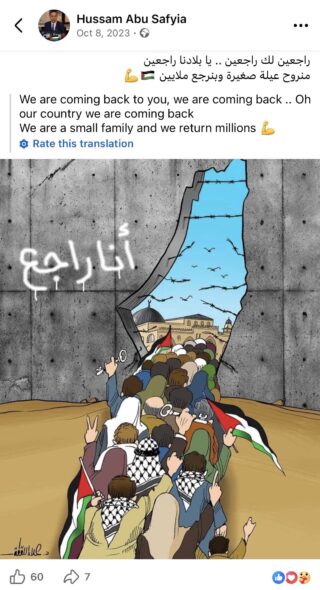
Screenshot of Hussam Abu Safiya’s Facebook post in support of the October 7, 2023, Hamas attack, from October 8, 2023.
On October 9, he shared a picture of paragliders – referencing the terrorists who paraglided into Israeli territory on October 7 – with the caption: “And they thought their fortresses would protect them from God, but God came upon them … and cast terror into their hearts.”
He writes about the October 7th massacre: “And they thought their fortresses would protect them from God, but God came upon them from where they did not expect,
and cast terror into their hearts.” pic.twitter.com/43TJFrrw7k— Eitan Fischberger (@EFischberger) October 25, 2024
Even before the attack, on Apr. 11, 2022, Abu Safiya shared a photo of a Palestinian terrorist, writing: “Oh Allah, … protect the beloved people of Palestine and Al-Aqsa Mosque from the oppression and aggression of the Jews.” This accusation that Jews are targeting al- Aqsa Mosque has historically been a tool of Palestinian leaders to incite violence against Jewish communities. He posted similar pro-terror content on other occasions in 2021 and 2022.
While Abu Safiya’s ideology and affiliation with Hamas are clear, the precise operational role he played to warrant his detention likely remains classified. Israel holds Abu Safiya under its controversial Incarceration of Unlawful Combatants Law. This permits authorities to hold individuals in administrative detention without formal charges for up to six months at a time, subject to judicial review. These detentions can be renewed indefinitely. Israeli military prosecutors and security agencies use this tool when presenting evidence in an open court would compromise sensitive sources, such as exposing the identity of an informant on the ground in Gaza. It also safeguards covert intelligence-gathering methods from terrorist organizations reverse-engineering.
Legally, administrative detention is intended strictly as a measure of last resort to neutralize imminent threats. However, its use reliably spikes during periods of intense conflict and upheaval. Critics routinely condemn the practice for its undemocratic nature and lack of due process, while Israeli security officials maintain it is a necessary counter-terrorism tool in asymmetric warfare where traditional evidentiary standards would cost civilian lives.
For instance, in his book Justice in the West Bank: The Israeli-Palestinian Conflict Goes to Court, Yonah Jeremy Bob highlighted the 2015 case of Muhammad Abu Saha, whose day job included performing for disabled children as a circus clown. Like in the case of Abu Safiya, Amnesty International fiercely criticized the IDF for placing Abu Saha in administrative detention, dismissing the legal proceedings as a “circus act.” However, classified intelligence revealed that Abu Saha was actually an active member of the Popular Front for the Liberation of Palestine and was actively planning a terror attack at the time of his arrest. Abu Saha’s arrest under administrative detention was the only way to neutralize the immediate threat without exposing vital intelligence sources, Jeremy Bob cited the IDF as saying.
While the presumption of innocence is a hallmark of democracy and a vital standard for newsrooms, omitting open-source evidence of Abu Safiya’s terror ties delivers a profoundly distorted picture to the public. Through omission, major news outlets invert the narrative – indicting Israel for arresting a doctor while entirely failing to scrutinize an individual with documented terror links.