
Judaism Without Zionism?
On April 6, 2026, The New York Times’ Max Strasser published a flattering review of a new book by Molly Crabapple, Here Where We Live Is Our Country: The Story of the Jewish Bund. This review is not merely an evaluation of a new book about a long-gone political movement of Jewish radicals in Eastern Europe. In his review, Strasser uses the opportunity to propose an alternative for today’s anti-Zionist Jews; the essay’s title “What Does Judaism Look Like Without Zionism?” makes it abundantly clear.
The article opens with a discussion on the Israel-Hamas war and its influence on American Jewry. It discusses the growth of Jewish pro-Palestinian groups, increasing disenchantment with Israel among young Jews, rising antisemitism, and how the word “Zionist” became toxic (at least with some American Jews). Clearly, both Strasser and Crabapple—a proud anti-Zionist who seems to abhor Israel—use this historical work to chart a potential model for lefty anti-Zionist American Jews. Other reviews of the book, in the Forward, for example, do the same.
The Times’ review caused an uproar on social media. Mark Horowitz, formerly an editor for The Times, Wired, New York Magazine, and Tablet Magazine, wrote: “Times Opinion editor asks the question, ‘What Does Judaism Look Like Without Zionism?’ But he leaves out the 6 million answers that history already provided,” an obvious reference to the Holocaust. Other commentators also brought up the Bundists’ demise during World War II and the Holocaust as a testament for how misguided their vision was for Jewish life in Europe.
What’s the Argument?
Let us pose a question: If Strasser’s review, and, by extension, The Times, raise the clearly provocative question of Judaism without Zionism, what is their answer?
They do not seem to have one.
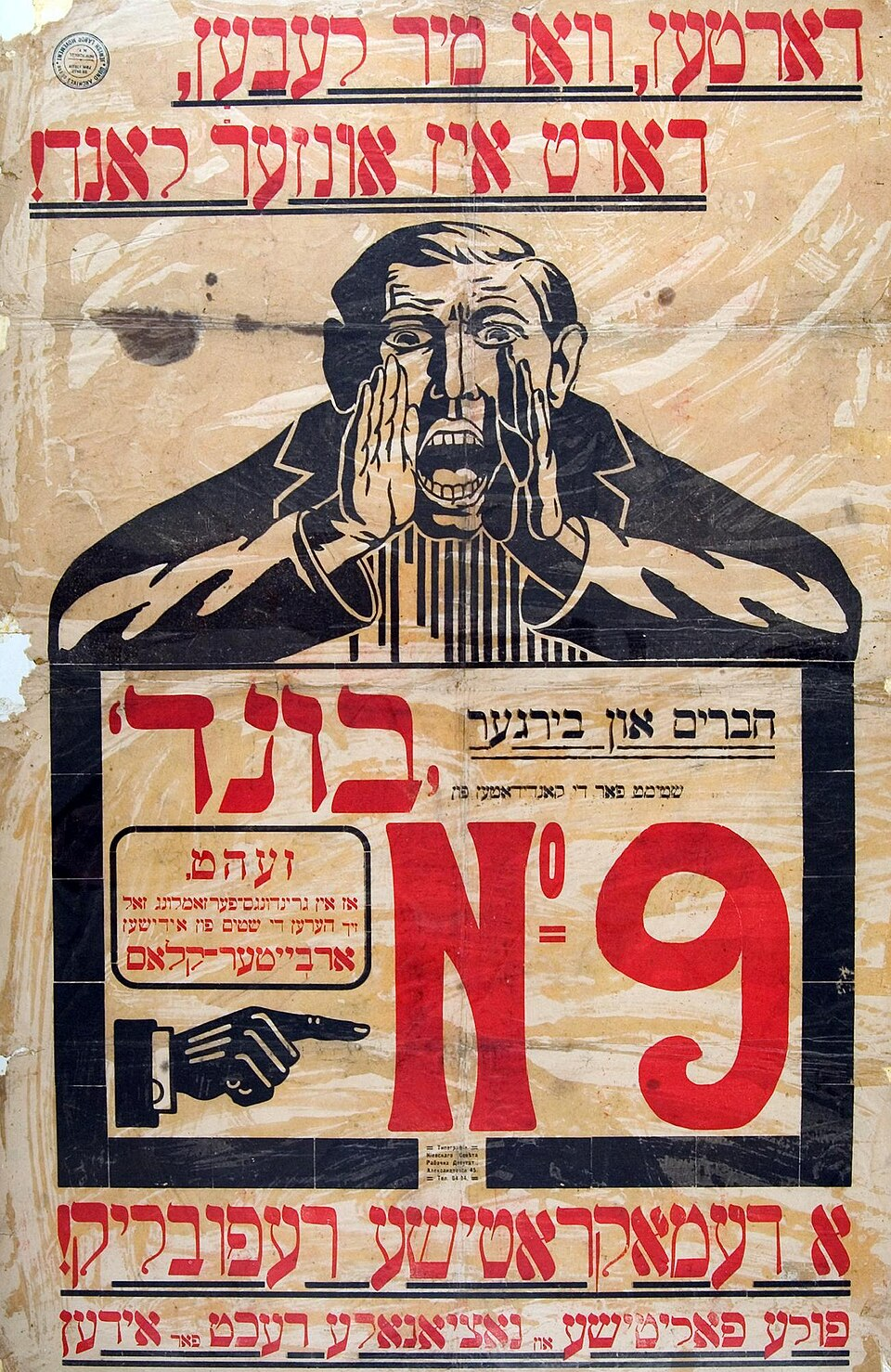
The Jewish Labor Bund election poster, 1917. The heading reads: “Where we live, there is our country!”
The Bund was a Jewish socialist movement formed in 1897 in the Jewish Pale of Settlement in the Russian Empire. It advocated for a socialist revolution, equal rights, and opposed the discrimination against Jews. The movement also sought Jewish national-cultural autonomy. This autonomous status was to materialize in Jews’ current home countries in Europe, where Jews were to fight antisemitism. This focus on Jewish life in the diaspora, as well as the Bund’s emphasis on the joint class struggle of both Jews and non-Jews, clashed with Zionists’ nationalism and their insistence on forming a national home in Palestine. For the Bund, Zionists only served the interests of bourgeois Jewry. Zionists and Bundists were bitter rivals and the latter were fervently anti-Zionist.
By 1921, the Bund was dissolved, and most of its members joined the Russian Communist Party. The Bund’s remaining membership kept the organization alive in Poland. The Nazis killed most of the Bund members and supporters during the Holocaust. Others, out of touch with changing times, continued to oppose Zionism after the Holocaust but failed to rebuild the movement.
The allure of such an organization for left-wing American Jews is partially understandable. Bundists were anti-Zionist socialists. But the antisemites they sought to fight murdered them. In the Jewish world, they lost to the Zionists. Bundists, as Strasser (and Crabapple) recognize, were the losers.
Still, is a contemporary Bund even feasible? Strasser understands full well that his would-be neo-Bundists of the contemporary American Jewish left are nothing like their proposed ancestors. He notes, “Should those seeking an alternative [to Zionism] return to Bundism?” while acknowledging, “That might not be as easy as it sounds.” Left-wing American Jews are not as secular as the original Bundists were. They “wear prayer shawls to protests and organize Palestinian liberation Seders.” Today’s New York is nothing like Minsk in 1906. Yiddish might have been revived among some young Jews, but for most people “’Seinfeld’ and bagels remain the real common language.” Working class Jews, Strasser writes, will not be able to build a Bund-like alternative. And he does not even touch on how a Jewish socialist movement that failed during revolutionary socialism’s peak could succeed in an ultra-capitalist country where socialism remains unpopular.
Left-Wing Fantasies
Given these admissions of unfeasibility, what is the purpose of the Times and Strasser’s conjuring up of the Bund as a potential Jewish alternative to Zionism? Strasser tells us that Crabapple’s book offers “inspiration, not prescription.” He adds that the Bund was:
The kind of movement leftists today dream about — political party, social movement, mutual aid group — with tens of thousands of members. The Bund published newspapers and ran soup kitchens and summer camps; its athletes competed in a socialist version of the Olympics. Bund activists organized across Eastern Europe and beyond — they helped elect a congressman on the Lower East Side.
Crabapple and other sympathetic reviewers of her work are also unsure of the current feasibility of Bundism or how to translate this history into action today.
So, “What Does Judaism Look Like Without Zionism?” Nothing really. It is a fantasy that “lefties today dream about.” Left-wing nostalgia. And this, perhaps, is the greatest problem with this Times review: it raises a provocative question, but it only romanticizes the past rather than providing an answer.
A Reminder
Given the tragic fate of the original Bundists, it seems fitting to end with a reminder for both Strasser and Crabapple as they seek to bring the movement back. This reminder is especially important because Crabapple takes pride in being a lifelong lefty and the daughter of a Marxist mother who told her about Karl Marx’s theory of surplus value at the age of six. Aside from Marx’s economic writings, Strasser and Crabapple might want to consult his The Eighteenth Brumaire of Louis Bonaparte. After all, this text opens with Marx’s well-known adage concerning the uses that actors make of the past: “Hegel remarks somewhere that all great, world-historical facts and personages occur, as it were, twice. He has forgotten to add: The first time as tragedy, and second as farce.”