
This Nov. 1, 2026, Op-Ed by CAMERA’s Aaron Goren was published by the Jerusalem News Syndicate.
It should not obfuscate Palestinian responsibility to hold their own elections, while trying to paint Israel as the sole factor preventing them from happening.
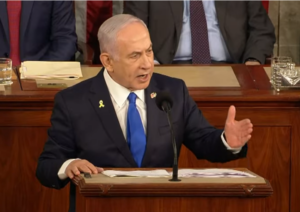
Benjamin Netanyahu speaking to the U.S. Congress, retrieved via Wikimedia Commons.
(Nov. 1, 2026 / JNS) Israeli elections are exhausting. And not just by nature. Mainstream media’s coverage of the elections of the only democratic nation in the Middle East is oftentimes staggeringly flawed. Take, for example, NBC’s Richard Engel, who poses the rhetorical question, “Can Palestinians vote in Israeli elections?”
Engel spent nearly two-and-a-half minutes on a geographical tirade attempting to take a benefit of citizenship and portray it as something unfairly denied to non-citizens. He states:
Palestinians in the West Bank and the Gaza Strip … live under occupation. They are not Israeli citizens, and they do not have the right to cast ballots. … So which Palestinians can vote? Only Palestinians who are also Israeli citizens.
How does “living under occupation” turn into a right to vote? Iraqis and Afghanis lived under coalition occupation for years. Yet only Iraqi and Afghani citizens of the United States were allowed to vote in American elections. Neither the Japanese nor Germans were given a right to vote in American, British or Russian elections, either. Surely, there must be something more to the argument than this apparent double standard.
The New York Times made a similar error. The newspaper notes that “the stakes of the Israeli elections are high for Palestinians in the West Bank, but they do not have the right to vote in them.”
So, too, are the stakes of Ukrainian elections for Russian citizens, but no one has ever suggested “having stakes in the outcome” equates to “having a legal right to vote” in an election. Except for Israel, that is.
Such wording works to gloss over and distract from the fundamental issue. Palestinians are not Israeli citizens, and by and large, they do not wish to be. To grant them the vote, Israel would effectively have to annex the West Bank and Gaza Strip. Not only would this foreclose the internationally supported two-state solution framework, but—if one accepts the situation is one of “occupation” as opposed to “disputed territory—then such an act would violate international law.
Read the rest of CAMERA’s Op-Ed at JNS.