
In France 24 coverage of the damage sustained at Jabal Amel Hospital in the Lebanese city of Tyre, language is not the only distinction between the Spanish and English versions of the same article. In the two reports, the alleged facts themselves changed substantially.
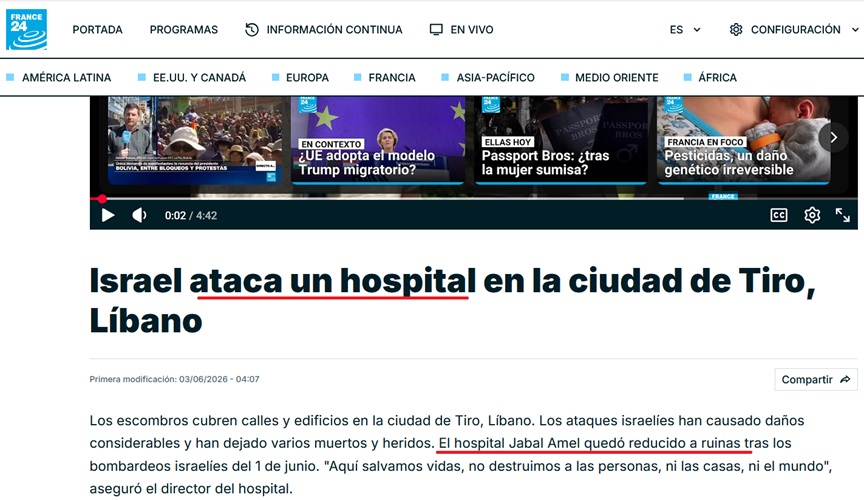 The June 3, 2026 Spanish-language version states in its headline that “Israel attacks a hospital in the city of Tyre, Lebanon,” and claims that the hospital had been “reduced to ruins following Israeli bombardments on June 1.”
Yet images appearing in the accompanying video report completely contradicted this assertion. Though the video opens with the claim that the hospital’s façade had been destroyed, the report’s own footage refutes this claim.
 At the end of the segment, a doctor states that the damage is “proof of Israel’s deliberate attack against the population.” The narrator adds that “the hospital continues operating as best it can in the areas that were spared from the bombardments.” If the hospital was “reduced to ruins,” as the article claimed, how is it that “areas were spared from the bombardments?”
In contrast to the Spanish article, the English-language version published a day earlier did not allege that the hospital was “bombarded” (“‘Life and Hope’: Lebanon hospital resilient after Israeli attack“). Its opening paragraph states:
Israeli strikes near the Jabal Amel hospital in Tyre on Monday killed four people and wounded 127, including four doctors, 27 nurses, and eight administrative employees, Lebanon’s health ministry said.
They also caused “severe and extensive damage” to the facility, it added.
In other words, Israel did not attack the hospital.
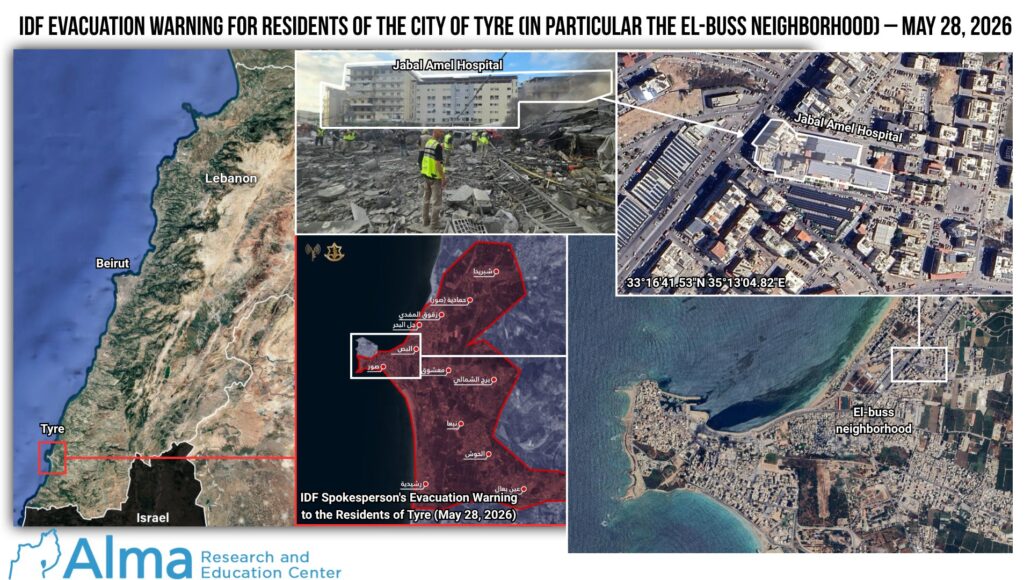 This account was consistent with the findings of the Alma Research and Education Center, which concluded: “the airstrike was not directed at the hospital itself, but rather at a target located in close proximity to the hospital.”
Furthermore, Alma noted:
The extensive documentation indicates that the damage sustained by the hospital was indirect and resulted from the blast wave generated by the strike, rather than from a direct hit on the building. The footage clearly shows that the hospital structure remained intact, was not directly targeted, and was not destroyed as a result of the strike.
Indeed, France 24’s own footage confirms as much. Yet the graphic evidence did not prevent the publicly funded French broadcaster from describing the incident in Spanish not only as an attack on the hospital, but as its complete destruction.
The Alma center also pointed out that several days before the strike, the Israel Defense Forces’ Arabic-language spokesperson had issued an urgent evacuation warning to residents of Tyre and surrounding neighborhoods and camps, including the El-Buss neighborhood where the hospital is located. This France 24’s English-language report noted this fact.
The research center further emphasized that:
Hezbollah systematically operates from within civilian environments and conducts military activity both near and inside sensitive civilian infrastructure, including hospitals, schools, and similar facilities. At times, Hezbollah also prevents or hinders the evacuation of civilians from areas adjacent to its military assets.
In English, France 24 offers a product that respects the intelligence of its audience. In Spanish, by contrast, it treats that audience as a receptacle for ideology and misinformation.
For the Spanish version of this article, see CAMERA Español.