
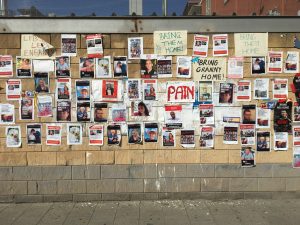
Kidnapped posters with photographs of the hostages and missing held in Gaza by Hamas, at the wall outside of the Kirya military base area. The October 7 terror attack on Israel, November 3, 2023. (credit: Yossipik, CC BY-SA 4.0, via Wikimedia Commons)
The headline alone—“Captured alive, but killed in captivity…”—of Jeremy Diamond and Tal Shalev’s Oct. 8, 2026, article illustrates exactly how little blame these CNN reporters place on Hamas for the hostage crisis, and how willingly they blame Israel for the crimes of Palestinian terrorists.
On Oct. 7, 2023, over 7,000 Palestinian terrorists and civilians targeted the Jewish state by either invading it or firing rockets at civilian populations across the country. The terrorists killed approximately 1,200 people, mostly civilians, and took 251 hostages.
CNN’s surface-level article on the third anniversary of the October 7 attacks explained how Israelis commemorated the day. The following day, however, the news outlet indicted Israel and its military for the actions taken every day since. In the broadcast, the article, and Jeremy Diamond’s social media posts, the story focused heavily on the hostages who were killed as a result of Israeli military actions.
“We found 24/40 deaths can be traced back to Israeli military actions, including when Israeli military actions led captors to kill their hostages,” Diamond wrote on X. In a thread of six posts about the article, Diamond blamed Israel for the deaths of hostages in all of them, even when Hamas terrorists pulled the trigger, such as in the cases of Hersh Goldberg-Polin, Carmel Gat, Eden Yerushalmi, Ori Danino, Alexander Lobanov, and Almog Sarusi.
Our latest report about the 40 hostages who were abducted alive on Oct 7, but died in captivity is based on interviews with dozens of hostage families and Israeli mil & gov’t officials.
And it’s layered. So I want to break down the most important findings, beginning with… 1/🧵 https://t.co/BzBpdSepb2— Jeremy Diamond (@JDiamond1) October 8, 2026
The October 8 article did acknowledge the complexity of the urban combat, noting the “unprecedented challenge” of fighting in dense areas where Hamas used hostages as “human shields.” The article also outlined how the IDF made efforts to secure the hostages during airstrikes and offensive military action, detailing a “24/7 mechanism” that utilized restricted zones to protect them. It even noted that strikes on significant targets were often delayed or called off over concerns for hostage safety.
While the article briefly acknowledges that Hamas tortured and executed hostages, its overarching framework and headline relentlessly shift the ultimate responsibility onto the Israeli government. Ultimately, Shalev and Diamond applied most of their blame for the death of hostages in captivity to Netanyahu.
This bias is evident in how Diamond framed his interviews. In one of Diamond’s X posts, he refers to his interview with Yuval Dancyg, the son of slain hostage Alex Dancyg, stating, “Many hostage families… hold Hamas AND the Israeli gov responsible…”
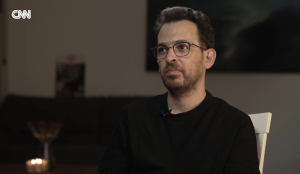
Screenshot of Yuval Dancyg during Jeremy Diamond’s interview with him posted to X on October 8, 2026.
However, in the article itself, Shalev and Diamond quote Dancyg as saying, “The ones that are responsible for what happened to them, first of all, is Hamas.” While Dancyg added that the government shared blame for prioritizing the war over the hostages, CNN’s social media framing elevated the blame on Israel to be equal to or greater than Hamas.
Hostage negotiations
Throughout the article, Shalev and Diamond peppered quotes from Israeli officials stating that Netanyahu’s demands delayed potential hostage-release deals. However, CNN’s own past reporting contradicts this singular blame. On Sept. 1, 2024, CNN cited a senior US official noting that Hamas’s execution of hostages “calls into question Hamas’ seriousness about a deal.”
In the same article, CNN quoted Netanyahu stating, “Israel agreed to a hostage release deal… Hamas refused. Even after the United States updated the outline… we agreed, and Hamas again refused.” Yet, the Oct. 8, 2026, article completely reframes these May-July 2024 negotiations, claiming Hamas had agreed to the framework before Netanyahu inserted “new demands” that “disrupted what they say was ‘almost a done deal.’”
Axios’s Barak Ravid reported this same framing in August 2024, explicitly attributing it to Hamas: “Hamas… rejected an updated U.S. proposal… blaming Israeli Prime Minister Benjamin Netanyahu for moving the goalposts…” The fact that CNN would adopt Hamas’s perspective as its own narrative illustrates the news organization’s moral bankruptcy.
Taken together – the blaming Israel for Hamas murdering hostages and for not immediately agreeing to every one of the terrorist organization’s demands in negotiations – Diamond and Shalev are playing the role of public relations agent for Hamas.
CNN’s Omissions
CNN also omitted vital context regarding Israeli public opinion and key testimonies. Notably, as of May 30, 2024, Israel’s military action in Gaza maintained broad support, with 73 percent of Israelis surveyed by Pew Research Center saying the response was either about right or hadn’t gone far enough. Public opinion only shifted significantly toward a ceasefire around the war’s two-year mark in October 2025, according to an Institute for National Security Studies public opinion survey published in November 2025.
Furthermore, the day before CNN published the Diamond-Shalev article, Brett McGurk, the Biden administration’s senior official leading hostage release efforts, told Dan Senor on the “Call Me Back” podcast that “the idea that Hamas was just ready to release all the hostages is complete bull***t.”
Of course, McGurk’s comments were too inconvenient for CNN to include in its rehashing of hostage negotiations. As were the comments by family members and former hostages who advocated for continued military pressure. Tzvika Mor, founder of the Tikva Forum whose son Eitan was kidnapped, responded to McGurk’s interview by stating, “We insisted that the State of Israel must not yield to Hamas… Deals don’t come out of thin air, but from pressure on Hamas.” Similarly inconvenient to CNN’s agenda was a statement from Iris Haim, whose son Yotam was mistakenly killed by Israeli soldiers. In December 2023, she told the soldiers involved: “I know that what happened is not your fault, it is the fault of no one except Hamas…”
Even former hostage Avinatan Or told Israeli journalist Ilana Dayan on Oct. 5, 2026, in an interview on N12’s investigative program “Uvda,” that he believed Israel should not agree to a deal at any cost, noting, “The debate was over matters of life and death, whether you save lives now or protect lives in the future.” He added that he explicitly told his captors he was willing to stay in captivity for years so they would realize he wasn’t “worth holding, and that will be the victory.”
This consequence of releasing hostages at any cost, including releasing convicted murderers who could return to terror and cost more lives, was entirely absent from CNN’s report. This omission occurred despite heavy public debate on the issue, which was apparent in the news and opinion columns of English-language Israeli outlets as the negotiations took place. In January 2025, then-Shin Bet head Ronen Bar highlighted this recidivism rate to the Israeli security cabinet, stating that “82% of those released in the Gilad Shalit deal in 2011 returned to terrorism.” (Schalit was exchanged for more than 1,000 Palestinian prisoners, including Yahya Sinwar, the architect of the October 7 attack.)
CNN Fails to Capture Complexity of Crisis
Two years of war and a grueling hostage crisis undeniably highlighted the extreme complexities of urban combat and diplomacy. Yet, CNN entirely failed to convey this complexity. The network ignored Ronen Bar’s warnings about the deadly recidivism of released terrorists, and it erased the intense internal debate within Israeli society, a debate clearly evidenced by the existence of the Tikva Forum alongside the Hostages and Missing Families Forum.
Ultimately, CNN missed the most crucial point: Hamas is a terrorist organization that kidnapped and murdered Israelis. By accepting Hamas’s framing, CNN fundamentally shifts culpability away from the perpetrators. Hamas’s standing order to execute captives if the IDF approached does not transfer the blame to the rescuing soldiers; the responsibility belongs entirely to the terrorists who initiated the crisis. It is striking that reporters who frequently cite international law to condemn Israeli policies fail to note the illegality of Hamas kidnapping Israelis on October 7.
Furthermore, CNN’s refusal to mention the virulent antisemitism embedded in Hamas’s charter and the organization’s members’ vows to repeat the attack in its on-site reporting illustrates a profound agenda.
In downplaying Hamas’s agency while placing primary blame on Israel, CNN compromises the very standard of objective reporting it claims to uphold.