
October 28, 2026 UPDATE:
The New York Times Corrects
After CAMERA informed journalists of the problems detailed here, The New York Times corrected its piece so that it no longer contains a fabricated, anti-Islam quote attributed to Israeli Prime Minister Benjamin Netanyahu. Our post from October 27 has been edited below with a detailed update to reflect the issue and the correction.
The New York Times fabricated a quote it attributed to Israeli Prime Minister Benjamin Netanyahu. In Roger Cohen’s Oct. 27 article, “Two Visions, Two Israels, One Nation in the Balance” the paper of record wrote:
Mr. Netanyahu, who seemed doomed after the Oct. 7 attack, has revived his fortunes through the assassinations of the leaders of Hamas, Hezbollah and Iran, as he has stood with the global far right in the name of what he calls a “civilizational alliance against Islam.” (emphasis supplied)
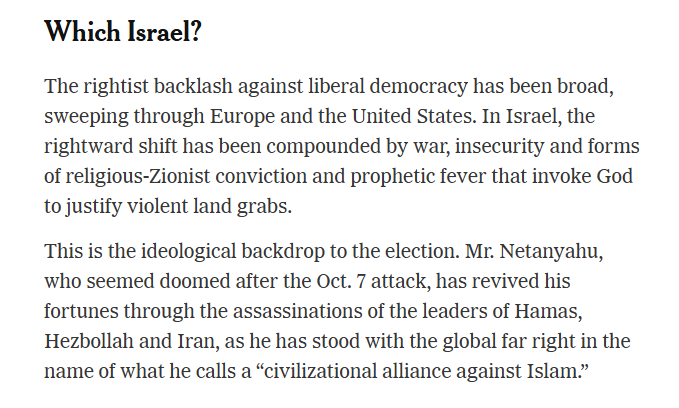
CAMERA was unable to find such a quote attributable to Prime Minister Netanyahu – in English or in Hebrew.
The Times, like anyone, is free to analyze or critique Israel’s and Netanyahu’s policies and actual words. It is not, however, permitted to invent false quotes which suggest the democratically elected leader of a sovereign nation has declared an alliance against a religion practiced by one quarter of the world’s population (approximately two billion people), which is also practiced by approximately 20% of Israeli citizens.
Such inaccurate coverage of Israel by The Times has often carried serious consequences. After its botched coverage falsely attributed an explosion at al-Ahli Hospital to an Israeli airstrike (it was actually hit by a Palestinian Islamic Jihad rocket), violent riots spread throughout the Arab world and diplomatic initiatives aimed at addressing the conflict were scuttled. It even scuttled one effort to protect Gazan civilians during the war.
There is no question the Prime Minister has made statements – forceful ones – decrying radical Islam and Islamist extremists or militants. In February 2026, Netanyahu described alliances against the “radical Shia axis” and “emerging radical Sunni axis.” In the months after the Oct. 7 Hamas-led attacks in Israel, he proclaimed there was a war between civilization and barbarism – not Islam. More than a decade ago, Netanyahu made clear in his 2014 speech to the United Nations that what he was talking about was “not Islam, but rather, “radical Islam.”
These actual quotes of the Prime Minister are a far cry from a pronouncement that he personally, and/or on behalf of his nation, has joined or seeks a global “alliance against Islam.”
CAMERA contacted The New York Times to seek a correction or – if it could provide it – substantiation for such a quote.
On Oct. 28, the paper corrected the paragraph to state Netanyahu had spoken about a "'common Judeo-Christian civilization[al] battle' against the threats of 'radical' Islam." This is a dramatic change, specifying more accurately that Netanyahu had only spoken about radical Islam, and not that he, as the Prime Minister of Israel, was against Islam.
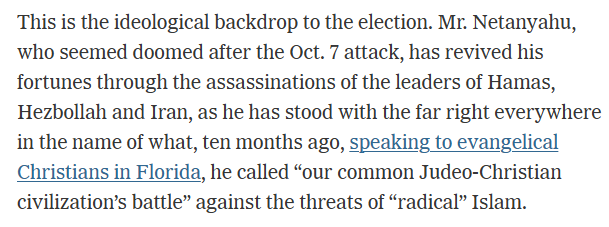
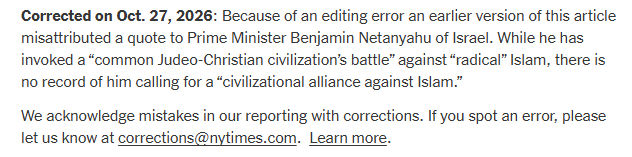
In addition to correcting the article, The Times included an Editor's Note at the conclusion of the article. In it, the paper acknowledged there was no record of the Prime Minister calling for (or, as the paper originally wrote, being part of) a "civilizational alliance against Islam."
This article has been translated into Hebrew, which can be read here.
Update: The New York Times Corrects
After CAMERA informed editors of a fabricated, anti-Islam quote falsely attributed to Israeli Prime Minister Benjamin Netanyahu, the newspaper published the following correction:
Because of an editing error an earlier version of this article misattributed a quote to Prime Minister Benjamin Netanyahu of Israel. While he as invoked a "common Judeo-Christian civilization's battle" against "radical" Islam, there is no record of him calling for a "civilizational alliance against Islam."
We commend The New York Times' retraction of the quote, correction of the article and explanatory Editor's Note.