
CNN’s historically shallow and ideologically driven understanding of the 1948 Arab-Israeli war and the status of Israeli Arabs thereafter was on full display in “A killing a day: How a crime epidemic is spotlighting inequality in Israeli society.”
In this Feb. 15, 2026 report detailing a crime wave sweeping Israel’s Arab sector, CNN describes “Palestinian citizens of Israel” as descendants of those “who were not expelled or forced to flee their homes when Israel was established in 1948.”
Here, CNN implies that the reason many Arabs in 1948 were “expelled or forced to flee” was due to the establishment of Israel. This is a one-sided narrative that misses key context.
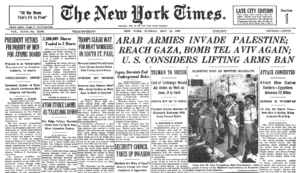
The New York Times front page, May 16, 1948. (credit: screenshot, New York Times print archives)
Upon Israel’s establishment in May 1948, five Arab armies – Egypt, Jordan, Iraq, Syria, and Lebanon – launched a genocidal war aimed at Israel’s destruction. The local Arab population did not sit out of the fighting, instead largely supporting the Arab armies, as Benny Morris describes in 1948: The First Arab Israeli War. Exceptions included the Druze population, which sided with Israel, and the Christian population, which largely remained neutral.
Even before May 1948, after the UN recomended partitioning the land into Jewish and Arab states on Nov. 29, 1947, Arab leadership in British Mandatory Palestine, headed by Nazi-allied Haj Amin al-Husseini, declared its intention to forcibly halt the establishment of a Jewish state. This Arab leadership had been inciting pogroms against the local Jewish communities for decades. In the next few days, Arab mobs attacked Jewish civilians and shops across major cities. Haganah units (the IDF’s predecessor) intervened while British authorities stood by.
This civil war period, characterized by Arab guerilla attacks on Jewish civilians, and Haganah defensive operations, persisted until the pan-Arab invasion.
Many local Arabs fled the violence, and most who were expelled had lost their battles against Jewish forces in the war. For the establishment of Israel to be the cause of this, Israeli leadership at the time would have had an expulsion plan, yet there was no such plan. Even Israel’s Declaration of Independence appealed to the Arab population in Israel to live in peace and participate in building up the country “on the basis of full and equal citizenship and due representation.”
Israeli Arabs under military rule
The CNN article then states that Israeli Arabs were “given citizenship but lived under military rule until 1966, and many say they continue to face discrimination in Israeli society today.”

David Ben-Gurion declares the establishment of the State of Israel, May 14, 1948. (credit: Rudi Weissenstein, Public domain, via Wikimedia Commons)
Again, CNN details a one-sided perspective. While many Arab Israelis did live under martial law until 1966 some lived in mixed cities that were only under martial law, at the latest, until 1951, like in Jaffa, Lod, Ramle, and Acre. In Haifa, the local Arabs were not subjected to martial law. In these cities, Jews and Arabs lived side-by-side, albeit with some tensions.
In this period, Israel still faced numerous threats from the same surrounding Arab countries, collectively known as the Arab League, which had waged war against it in 1948. In the 1950s, state-backed guerrillas infiltrated and attacked Israel from the Gaza Strip (then occupied by Egypt) and sometimes from Jordan (including the modern-day West Bank). Additionally, the Arab League launched a multi-tiered boycott aimed at economically crippling the nascent state, including attempts to force western companies to stop doing business with Israel. Concurrently these same countries repeatedly& ;voiced their intent to destroy the Jewish state.
At the same time, between 1948 and 1966, over a million Jewish refugees fled to Israel , driven by Islamist persecution in the Arab world and the Holocaust.
Given that much of Israel’s Arab sector had just allied themselves with these same surrounding countries in the 1947-49 war, it is not surprising that, as these same countries continued to threaten Israel, the Israeli government viewed much of its local Arab population with suspicion.
However, as early as 1949, Arab Israelis had the right to vote and were represented in the Knesset. Arab representation consisted of two members elected through lists affiliated with David Ben-Gurion’s ruling Mapai party and another served under the Communist Party Maki.
While there is no doubt Arab Israelis do face discrimination in Israeli society today, there are also Arab judges, including one on the Supreme Court , Members of the Knesset, doctors, lawyers, engineers, business executives, and university academics. Additionally, within the Israeli military, there are Druze, Christians, and Muslims at nearly every hierarchical level.
Palestinian citizens of Israel identifier
The CNN report says that the “Palestinian citizens” it refers to make up 20 percent of the Israeli population, including Druze, Muslim, and Christian citizens in its make-up; however, each group has quite different experiences and histories in Israel.
Palestinian is a national identity, like that of Egyptian or Lebanese nationalities. By identifying Israel’s Arab sector as Palestinian, CNN imposes a national identity that surveys consistently show is not primary for the overwhelming majority of Arab citizens of Israel. Most recently, an early 2025 Central Bureau of Statistics survey found that 56 percent of Israel’s Arab sector primarily define their identity as Arab, followed by 25 percent who define themselves as Muslim first. Just three percent identified primarily as Palestinian, and 11 percent said their Palestinian identity was secondary.
While personal identity is complex and individuals are free to self-identify, the Palestinian identity is widely understood as a national and political identity, rather than an ethnic one, a distinction made explicitly in both scholarship and political discourse. Professor Rashid Ismail Khalidi, in the introduction to his book, Palestinian Identity, explicitly frames his work as an examination of the “construction of the national identity of the Palestinian people.” [Emphasis added] Throughout the book, there is not a single mention of an ethnic Palestinian identity and Khalidi never describes Palestinians as a distinct ethnic group.
This understanding is echoed by political actors themselves. Ta’al party founder MK Ahmad Tibi, in May 2019, while rejecting the label “Israeli Arab,” stated: “We are Palestinians by nationality, and we are Israeli citizens.” [Emphasis added] Ta’al is a non-Zionist Arab nationalist party that participates in Israel’s parliamentary system while rejecting Zionism and advocating for a non-Jewish state .
The Arab citizens described in CNN’s article are Israeli, predominantly of Arab ethnicity. Describing them collectively as Palestinian reflects a specific political framework, one that emerged in the early 20th century in opposition to Zionism. It is not a neutral descriptor of ethnicity or legal status.
The CNN report’s central flaw
The central flaw in CNN’s reporting is not that it acknowledges present-day inequality, but that it retroactively projects today’s social hierarchies onto a vastly different historical reality.
In 1948 and earlier, Arabs in Mandatory Palestine were not a marginalized minority but part of a regional majority that overwhelmingly opposed Jewish sovereignty and actively participated in a war to prevent it. Jews, by contrast, were a vulnerable minority emerging from centuries of persecution and violence.
By reducing this complex and dynamic relationship into a single narrative of uninterrupted victimhood, CNN distorts history. CNN’s reporters should have recognized that the circumstances of Arab citizens in Israel today cannot be understood without acknowledging that in 1948, a majority of those who lived within this territory were combatants in a failed attempt to destroy the Jewish state, not passive victims of its creation.