
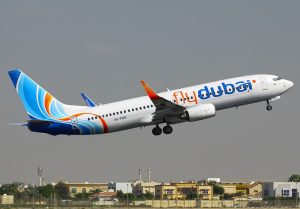
Flydubai Boeing 737-800 (A6-FDN) seen at Dubai International Airport. This aircraft crashed as Flydubai Flight 981 in Rostov-on-Don on 19 March 2016, Nov. 14, 2011. Illustrative. (credit: Mohammadreza Farhadi Aref, CC BY-SA 4.0, via Wikimedia Commons)
On Sept. 30, 2026, FlyDubai flight FZ1073 from Dubai to Tel Aviv plunged 17,000 feet in two minutes. Two and a half hours into the trip, the copilot repeatedly stabbed the captain in what Emirati and Israeli officials later concluded to be a harrowing 9/11-inspired attempt to crash the aircraft into Israel’s Ben Gurion Airport outside of Tel Aviv.
After several passengers heroically disarmed and detained the assailant, two off-duty FlyDubai pilots diverted the aircraft to Tabuk, Saudi Arabia, saving the 180 people on board.
On American television networks, pundits did not wait a single day to pivot from the human tragedy to political gamification.
Less than 12 hours after the plane landed safely, MS NOW’s Katy Tur introduced a starkly different angle on The Moment. “To be deeply cynical, I have to also note that . . . Israel is in an election cycle,” Tur commented to her panel, continuing, “Benjamin Netanyahu is running again. He’s trying to keep the seat of power. How does this affect things over there?”
Aaron David Miller, a Senior Fellow at the Carnegie Endowment for International Peace, engaged the premise: “Netanyahu is trying everything he can to raise the fear level in Israel . . . and whatever this was, he has made the most of the moment.”
That evening, MS NOW reporter Chris Hayes echoed the narrative, claiming Netanyahu “has not wasted any time using the attempted plane crash to bolster his security credentials. . . . He’s going to say, ‘We’re not safe anywhere. Everybody is after us.’”
Over on CNN, Eurasia Group regional managing director Firas Maksad likewise speculated that Netanyahu would “politicize that incident for political and electoral gain,” a point host Anderson Cooper deflected, but did not challenge, stating, “Let’s be quite clear, we won’t have the answers to quite a lot of questions likely for some hours now.”
The immediate pivot to electoral consequences stripped the humanity from the 180 passengers, most of them Israelis, who had just narrowly escaped death. It also exposed a striking hypocrisy: politicizing a near-tragedy while accusing Netanyahu of doing precisely the same thing.
Their pontification ignored the facts on the ground. Before any of these broadcasts aired, Netanyahu delivered his first speech after the incident that same evening in Israel but never called the incident a terrorist attack or even a plane hijacking attempt. If his immediate instinct was to exploit the crisis to galvanize a frightened nation, he inexplicably chose not to use the strongest language available to do so.
Prime Minister Benjamin Netanyahu:
“This morning, there was a serious security incident on a flight from Dubai to Israel. Almost all the passengers on the flight were Israelis. During the flight, as they approached the country, one of the pilots stabbed the second pilot, and apparently tried to crash the plane with everyone on board.I spoke with one of the Israeli passengers. He told me that the plane went into a spin and began to dive. He told me that, somehow or other, he managed to break into the cockpit with one of the crew members, and that together they neutralized the stabbing pilot while he was trying to sabotage the plane’s systems. Another flight crew on board entered the cockpit and managed to stabilize the plane.
I salute these heroes, who displayed exceptional resourcefulness and courage. They saved many lives. They prevented a huge disaster.
The plane landed safely at Tabuk Airport in Saudi Arabia. All passengers are out of danger. The stabbing pilot was arrested and is currently being interrogated by the Saudi authorities.
We are maintaining constant communication with the relevant authorities to ensure the ongoing well-being of the passengers and their safe return home.
I have instructed the security services to prepare for additional potential threats.
We are holding ongoing situation assessments, and we will update you as the situation develops.”
— Prime Minister of Israel (@IsraeliPM) September 30, 2026
Press Clings to Political Angle
Even as Israeli and Emirati investigators concluded between October 1 and 3 that the Omani copilot was executing a pre-meditated jihadist plot, the press clung to the political angle.
The Washington Post reduced the Israeli public to caricatures, suggesting they would view the event strictly through partisan lines as either a testament to “Mr. Security” or yet another security lapse.
The Wall Street Journal followed suit on October 3, running the headline, “Netanyahu, in Tough Election Fight, Embraces Those Who Stopped FlyDubai Attack.” In the article, Feliz Solomon wrote that the attack “fits into Netanyahu’s campaign pitch that Israel is under attack from all sides and only his right-wing coalition can protect it.”
While mainstream outlets stopped at political calculation, the framing they introduced, which was hyper-focusing on how the attack benefited Netanyahu, provided a springboard for far darker fringe conspiracy theories.
By immediately asking “who benefits?” rather than focusing on the victims or the ideology of the attacker, the press led the internet’s most polarizing actors.
If mainstream journalists were willing to call the timing of a near-fatal crash convenient for Netanyahu, social media influencers took that logic to an extreme: it was too convenient. According to an ADL analysis, at least 25,000 posts about the FlyDubai incident on X in the first 48 hours included conspiracy theories. Activists like Jackson Hinkle independently pushed “false flag” narratives claiming Netanyahu orchestrated the entire plot, while Hasan Piker declared the timing of the near-tragedy “unbelievably beneficial, unbelievably fortuitous for Benjamin Netanyahu.”
The urge to make Israeli electoral politics the primary story over an attempted terrorist attacks that would have killed hundreds, if not thousands, of people demonstrates a callous disregard for human life, especially the 180 people whose lives hung in the balance. It minimizes the very real, ongoing vulnerability of Israelis who have faced decades of aviation terror. More dangerously, it demonstrates how mainstream newsrooms help normalize a cynical lens that fringe actors can independently push to radical edges.