
On July 21, Hamas was broke. The Washington Post reported that it could not pay its fighters, or pay “death benefits” to families of slain terrorists. It was in ceasefire talks. A week later, Israel has been forced to create a “humanitarian pause,” that is, a ceasefire, with Hamas giving up nothing in exchange.
How did we get from there to here? This is another story of advocacy masquerading as journalism.
On July 20, The Jerusalem Post had reported, “Israel, the US, Qatar, and Egypt are still waiting for Hamas’s response to the proposed hostage and ceasefire deal presented by mediators last week.” A source reportedly told N12 news, “Hamas’s foot-dragging – even if it believes it serves its interests – may ultimately work against it.”
And according to the Washington Post report on the 21st, Hamas was in a financial crisis and couldn’t pay its fighters: “Hamas is facing its worst financial and administrative crisis in its four-decade history, facing stiff challenges in mustering the resources it would need to continue to fight Israel and rule Gaza.” (Emphasis added.)
The article made clear, according to multiple Gazan sources, that the seizure of humanitarian aid had been an important source of revenue for the terrorist group.
Hamas profited “especially off the aid that had cost them nothing but whose prices they hike up,” said a Gazan contractor who has worked at Gaza’s border crossings during the war.
Over nearly two years, he said, he saw Hamas routinely collect 20,000 shekels (about $6,000) from local merchants, threatening to confiscate their trucks if they did not pay. He recalled that civil servants for the Hamas-led government said several times that they would kill him or call him a collaborator with Israel if he did not cooperate with their demands to divert aid. He said he refused. But he added that he knew at least two aid truck drivers who he said were killed by Hamas for refusing to pay.
The Washington Post also quoted sources explaining that the reason Hamas wanted a return to the old methods of aid distribution, prior to the creation of the Gaza Humanitarian Foundation, was because the group needs that revenue.
In other words, at this point, Hamas was over a barrel. Based on this report, it certainly seemed that if Hamas could be prevented from resuming aid theft, the group would not be able to hang on for much longer.
But the very same day as that Post report, 28 world leaders stepped in to put pressure, not on the side that started the war with a brutal and savage attack and that continues, nearly two years later, to hold hostages, but on Israel. These countries made a statement saying the war in Gaza “must end now.” And the following day, July 22, Hamas rejected the ceasefire proposal that was on the table, adding new demands, including the demand that the Gaza Humanitarian Foundation cease operations.
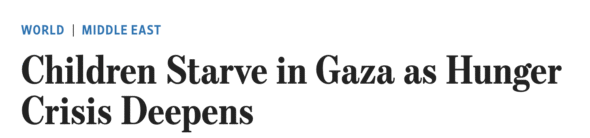
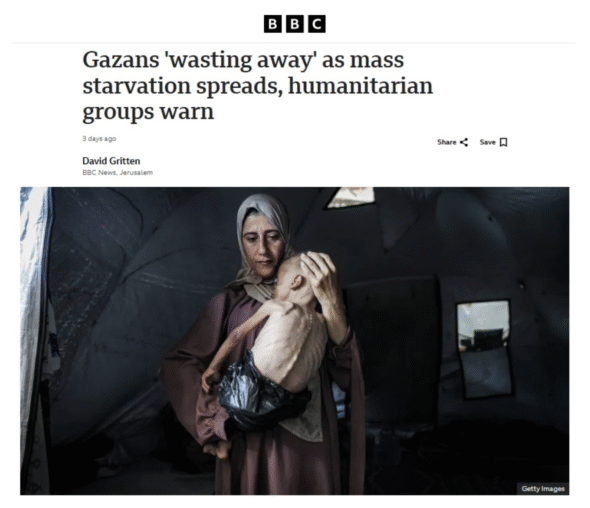
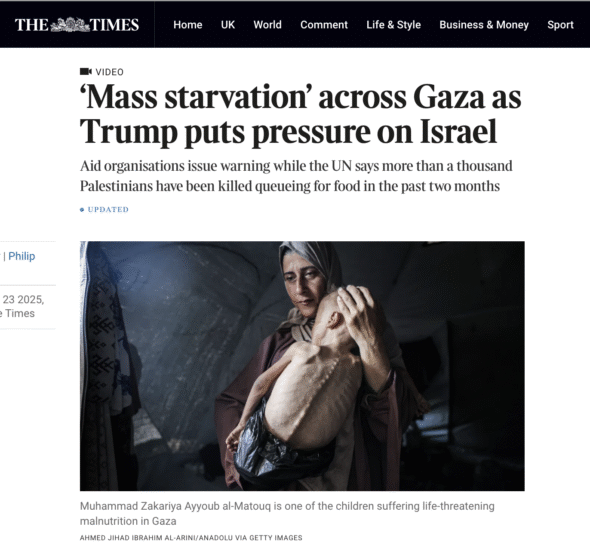
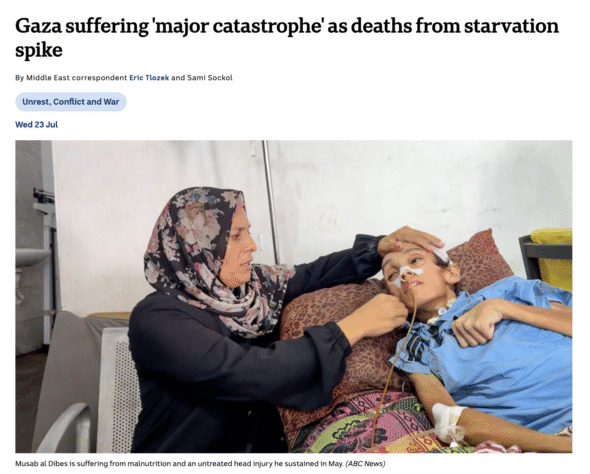
At this point, the international media stepped up, as if in concert, with a cacophony of headlines and photographs designed to put pressure on Israel to give Hamas exactly what it wanted – the ability to live another day.
July 23, Wall Street Journal:
July 23, BBC:
July 23, The Times (UK):
July 23, ABC (Australia):
July 24: Sky News:
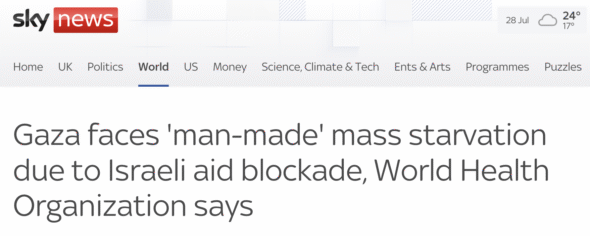
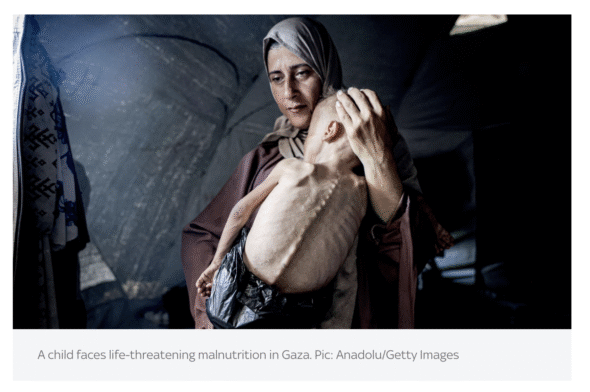
July 25, New York Times (front page):
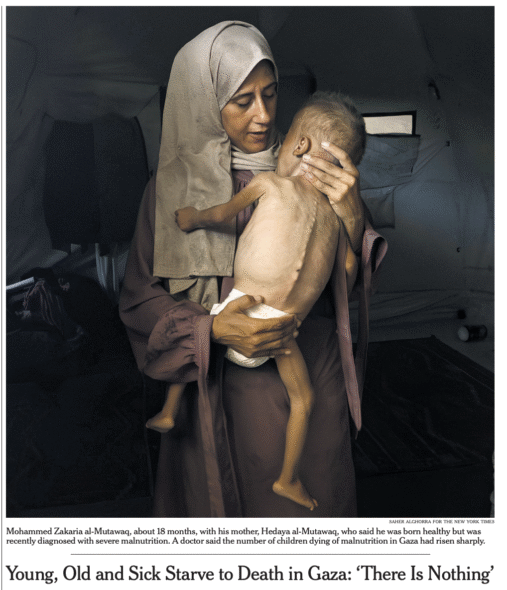
UPDATE: On July 29, the Times appended the following Editors’ Note to the online version: “This article has been updated to include information about Mohammed Zakaria al-Mutawaq, a child in Gaza suffering from severe malnutrition. After publication of the article, The Times learned from his doctor that Mohammed also had pre-existing health problems.” By then, of course, the damage had been done.
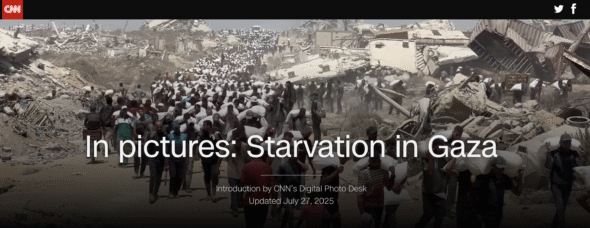
July 24-28, CNN:
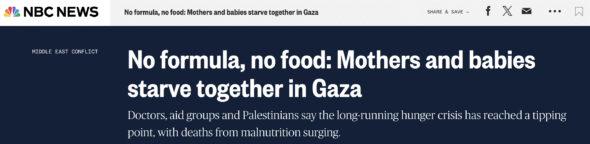
July 25, NBC:
July 25, Daily Mail, under the headline, “Reduced to skin and bones in Gaza: Horrifying story behind photo of starving child with a plastic bag as a nappy”:
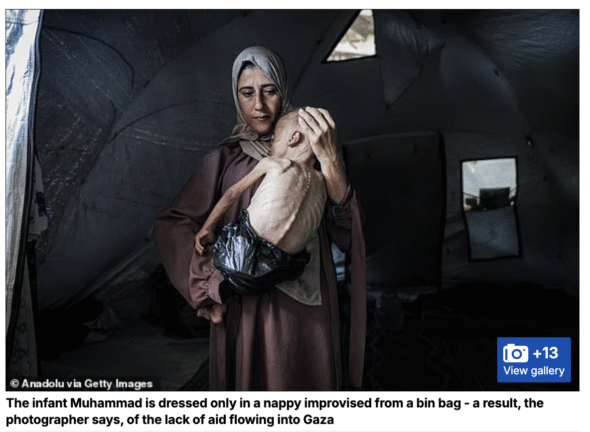
Many of these articles, notably, relied on photographs of the same child with cerebral palsy and his widowed mother – widowed, very likely, as independent journalist David Collier shows, because her husband was a combatant. Most did not disclose the child’s underlying medical condition.
There is no doubt the people of Gaza, including children, are suffering. This is tragically always the case in war. The intent of this article is not to diminish that point. And this suffering occurs even though, as John Spencer, Chair of Urban Warfare Studies at the Modern War Institute, has said, “There is no historical precedent for a military providing the level of direct aid to an enemy population that Israel has provided to Gaza.”
But the only way to fully put an end to their suffering, to the cycle of war and ceasefire that has gone on since Hamas took power in Gaza, is through a Hamas surrender that includes releasing all of the hostages. Based on the reporting noted above that Hamas was out of money, that it was, “facing stiff challenges in mustering the resources it would need to continue to fight Israel and rule Gaza,” it seemed like that goal could have been within reach. Propagandistic headlines of the past week that exaggerated suffering and put the blame only on one side have most likely served only to prolong the war, along with the misery on both sides.