
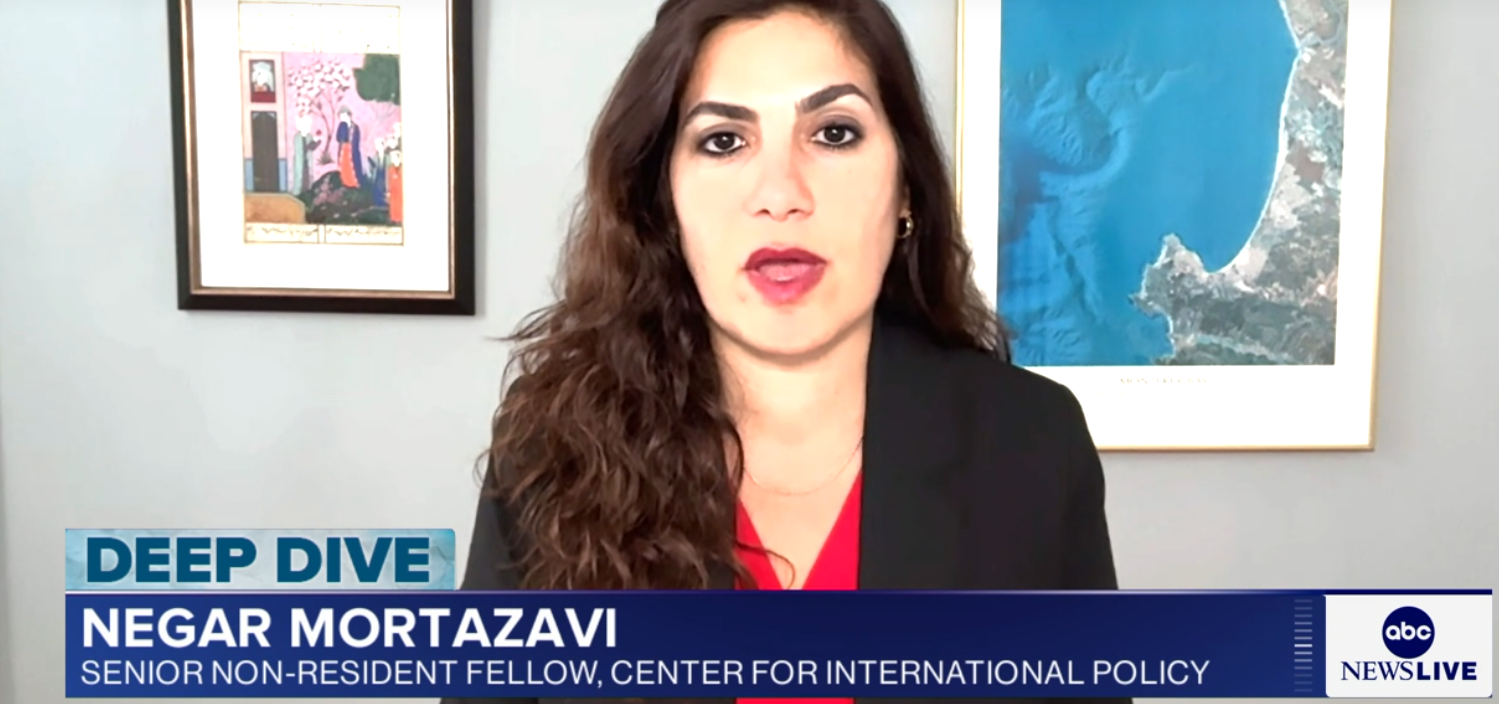
In two interviews on June 8, 2026, ABC News Live’s Ike Ejiochi invited back Iranian regime apologists Negar Mortazavi and Trita Parsi to discuss Iran and Lebanon.
There was no “deep dive” on Iran and Lebanon despite the promise in the segment, “Regional power struggle intensifies as Iran-Israel tensions reshape Lebanon.” Instead, Mortazavi, a senior fellow at the Center for International Policy and editor and host of “The Iran Podcast,” used the opportunity to obscure Hezbollah’s origin story while whitewashing Iran’s role in decades of terror.
In the second broadcast that day, “Trump’s warning to Nektanyahu raises stakes as Israel-Hezbollah tensions escalate,” Parsi, founder and former president of the National Iranian American Council (NIAC), misrepresented the Lebanese people’s feelings about Hezbollah and identified Israel as the obstacle to peace in the region, not Iran.
In both interviews, ABC’s Ejiochi immediately framed Israel as aggressor when he asked the guests why Israel’s attacks on Beirut, after its “advances” in Lebanon, were a red line for Iran, prompting it to strike Israel. Neither Ejiochi nor his guests acknowledged that it was Hezbollah’s fire at northern Israel which prompted Israel’s June 8 strike in Beirut in the first place.
ABC then transitioned from the micro to the macro. In response to a question about Hezbollah, Mortazavi gave the organization a total makeover. Instead of explaining to viewers that Hezbollah is a U.S.-designated international terror organization, she labeled it a resistance movement.
Both she and Parsi disconnected Iran from Hezbollah (while lionizing Iran for wanting to “rescue” Lebanon from Israel) and kept Iran’s muqawama (“resistance”) doctrine and genocidal aims away from ABC’s audience. Ejiochi remained silent.
Mortazavi did not provide the history of Hezbollah’s founding, shortly after Ayatollah Khomeini’s1979 Iranian Revolution, which aimed to export the Islamic revolution. Indeed, she never mentioned Hezbollah’s origin and instead framed its role in Lebanon as simply to resist “Israeli attacks and occupation of Lebanon going on for decades.”
Ejiochi did not ask what Mortazavi meant given than Israel withdrew from Lebanon in 2000.
ABC News never asked Mortazavi about Iran’s overwhelming financial support for Hezbollah via cash, weapons and direct leadership provided every single year since its founding. Instead of explaining to ABC News viewers that Hezbollah is a proxy and arm of the Iranian Revolutionary Guard Corps, Mortazavi cited the group simply as an “ally” of Iran whose “geopolitical goals align” with the Islamic Republic. Describing a heavily armed proxy as merely an “ally” fundamentally distorts the reality of the relationship between the Islamic Republic and Hezbollah. Because Ejiochi pushed back on nothing, ABC’s audience was left with a fundamentally flawed understanding of the Middle East.
In his interview, NIAC’s Parsi, widely considered to represent the de facto Iranian lobby, villainized Israel and had nary a negative word for the Islamic Republic. Whether durable peace in the region could be achieved had nothing to do with Iran, he averred. He touched on tropes suggesting that Israel was pulling the strings and said the U.S. had not shown the capacity or willingness “to reign in Israel.”
Sounding like an Islamic Republic negotiator, Parsi told Ejiochi that any ceasefire deal must include Lebanon, for fear the Israelis will otherwise restart the war and drag the United States back into it. Meanwhile, Parsi completely ignored how Hezbollah shirked its 20-year-old obligation to disarm and evacuate the area south of the Litani River pursuant to U.N. Security Council Resolution 1701.
Contradicting a Gallup poll from December 2025, Parsi maintained that the Lebanese people widely believe that Lebanon’s negotiations with Israel are “a complete betrayal” because the negotiations are centered on disarming Hezbollah with no discussion about getting the Israelis to leave Lebanon.
In fact, 79 percent of total Lebanese adult respondents said the Lebanese army should be the only group allowed to maintain weapons, meaning that Hezbollah should disarm. Lebanese Sunnis, Druze, and Christians had higher percentages (87, 89, and 92 percent respectively). The Lebanese Shia, approximately one-third of Lebanon’s population, are widely known to align with Hezbollah (a Shia group), brought down the percentage, as only 27 percent of them agreed.
Significantly, nearly a year ago, Israeli Prime Minister Benjamin Netanyahu publicly stated that Israel would withdraw if the Lebanese armed forces could disarm Hezbollah.
Journalist and podcaster Haviv Rettig Gur defines Iran’s muqawama doctrine as an ideological framework in which even catastrophic damage the Islamic Republic sustains is almost a catalyst. “Resistance is the translation, but it’s bigger than just the word resistance in English,” he explains. Iran believes the suffering and death of its own people is religiously justified if in service of a holy war, Gur said, adding that the regime’s “willingness to sustain . . . devastation is to them their great force multiplier . . . not . . . a deterrent.”
Iran shares this depraved ideological framework with Hamas, Hezbollah and the Houthis, all of whom it financially supports – an essential fact which eluded ABC News. It is an extremist ideology very far from American understanding. Thus, when journalists like Ejiochi fail to explore the issue with any seriousness, regime apologists like Mortazavi and Parsi get away with using the simple translation of resistance to describe Hezbollah (or with other groups, collectively the “Axis of Resistance”). The regime apologists avoid ideological talk and define “resistance” as simply and easily as possible, through only a geopolitical lens.
By validating both Mortazavi’s and Parsi’s narratives, which contradict documented history and reputable polls, ABC purveyed misinformation. The failure to push back hid the depraved reality of the Iranian regime, leaving viewers with a wholly distorted view of Middle East actors.
For the Hebrew version of this post, see CAMERA Hebrew.