
Major outlets, including Reuters, The New York Times, and The Washington Post, reported last week that the Islamic Republic of Iran had replaced the previous secretary of the Supreme National Security Council, Mohammad-Bagher Zolghadr, with Mohsen Rezaee (sometimes spelled Rezaei). There was a similar key omission in all those reports: Rezaee is wanted by INTERPOL for a terrorist attack against the Asociación Mutual Israelita Argentina (AMIA) in 1994.
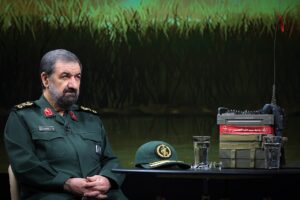
Khamenei.ir, CC BY 4.0, via Wikimedia Commons
On July 18, 1994, a suicide bomber drove a car into the Jewish center in Buenos Aires, known as AMIA. The attack killed 85 innocent people and injured over 300 more, mostly Jews. Investigators identified Lebanese national and Hezbollah operative Ibrahim Hussein Berro as the terrorist.
Three decades of controversial investigations followed to determine who else was behind the attack. The weight of the evidence points to Iran as the primary conspirator. Infamously, the chief investigator, Alberto Nisman, was found dead of a gunshot wound the night before he was due to present his findings to the Argentine National Congress. Prosecutor Viviana Fein declared the death a suicide at the time, but in May 2016, Fein was charged with covering up Nisman’s murder.
The assassination left Nisman’s work incomplete, but his report still revealed important facts about the AMIA attack. It led authorities to charge former president Cristina Fernández de Kirchner with treason related to the AMIA cover-up in 2017. The charges were eventually dropped. As a sitting senator, she had legal immunity.
Another key revelation was the likely role played by Iranian officials. Nisman requested INTERPOL to issue arrest notices for five prominent figures in the Islamic Republic in 2007, as well as a Hezbollah leader Imad Mughniyeh (who was killed the following year by Israel) for planning the attack. Two of the indictees bear relevance: The current commander of the Islamic Revolutionary Guard Corps, Ahmadi Vahidi, and Rezaee. Consequently, neither individual can travel to any INTERPOL member states.
This leads to another important facet of the Rezaee appointment omitted by the media. As secretary of the Supreme National Security Council, Rezaee holds the top foreign policy job in Iran, dictating the agenda to other senior government officials like Foreign Minister Abbas Araghchi.
Importantly, Iran operates a two-front diplomatic effort. While Araghchi, the foreign minister, attends multilateral summits and conducts diplomacy with the free world to present Islamism with a human face, Rezaee oversees security matters. When it comes to scheming to circumvent sanctions with foreign partners and meeting with the Russians over arms trade, he becomes the regime’s chief diplomat. In effect, he is the supreme leader’s envoy. International travel is therefore a key function of the job. Using the warrant to prevent Rezaee from performing his duties effectively will be an important task for the U.S. government.
The allegation against Rezaee and the logistical complication that INTERPOL’s warrant poses matter a lot and have policy implications. Iran has not simply elevated an anti-Zionist to its top foreign policy position, but a man who, the evidence suggests, plotted a massacre of non-Israeli Jews, which belies Iran’s claim that its anti-Zionism should not be confused with Jew hatred. It should also raise worries about a spike in Iran’s transnational criminality and terrorism outside the Middle East. And last, Rezaee’s inability to travel freely is an obstacle to performing his duties, and policymakers and intelligence analysts should take notice of it to monitor how he gets around it and to prevent that. Journalists poorly served everyone by omitting such a key part of his profile.