
From the beginning of the war to his Mar. 17 death, Ali Larijani served as the CEO of Iran. The late Supreme Leader Ali Khamenei had made him the second most powerful man in Iran because they shared a vision and temperament. Yet, countless news reports now rue the loss of a “pragmatist” whom the United States could rely on as a peace partner.
“Analysts say that while Larijani was seen as a pragmatist rather than an ideological hardliner…,” CNN claimed. “Though he was a veteran conservative politician, Mr. Larijani had a reputation as a relative pragmatist within a system increasingly dominated by hard-liners,” wrote The New York Times. “Larijani had been seen as one of the more pragmatic faces of Iran’s establishment,” the Guardian reported.
Larijani owed his prominence to the fact that he was perfectly aligned with Khamenei. He and his boss both acted moderately in pursuit of extreme ends.
🔴Ali Larijani, Secretary of Iran’s Supreme National Security Council and the regime’s effective leader, has been eliminated.
Throughout the years, Larijani was considered one of the most veteran and senior figures within the Iranian regime leadership, and was a close associate… pic.twitter.com/kBIgSSGBm0
— Israel Defense Forces (@IDF) March 17, 2026
So who really was Ali Larijani?
His father, Grand Ayatollah Hashem Larijani Amoli, was from northern Iran and had moved to the Najaf, Iraq to further his scholarship. Ali Larijani was born there in 1958. When Ali was a child, his family relocated to Qom, Iran, where his father became acquainted with Ruhollah Khomeini, a contrarian Shi’ite cleric who would lead the Islamic Revolution of 1979 and become the Islamic Republic’s first supreme leader.
Then, seminaries were the only place where Iranians could participate in intellectual debates and philosophical inquiries. This helped Larijani distinguish himself among his peers and later emerge as a key interlocuter with foreign journalists and diplomats in adulthood.
Larijani was smart. He attended the top university in Iran and obtained a doctorate in philosophy, writing his dissertation on Immanuel Kant’s mathematical theory.
Hashem Larijani insisted that his sons should marry into powerful families. At the age of 20, Ali Larijani married the daughter of revolutionary cleric Morteza Motahhari. Soon after, when Larijani was still in college, the revolution overthrew the Pahlavi regime. There is no evidence that either Larijani was particularly active in the revolution. Larijani’s father-in-law, however, became the head of the newly-established Revolutionary Council, a clerical body and the de facto transitional government of Iran, overruling the de jure government and executing people in revolutionary tribunals; it was dissolved after the Islamic Republic adopted a constitution in 1980.
Larijani used his family connections to receive government jobs. Amidst the Iran-Iraq War, he joined the Islamic Revolutionary Guard Corps (IRGC). The regime had created this second military force because it did not trust the regular military to export its Islamic revolution abroad and worried about a possible coup. Larijani served in a desk job at the IRGC Ministry, thus avoiding combat. His family’s clerical connections and his position in the IRCG enabled him to cultivate political and military connections while keeping him out of harm’s way. He retired after only 10 years as a brigadier general, the second-highest attainable rank.
After the war, Larijani joined the regime’s propaganda efforts. In 1992, Mohammad Khatami, the Minister for Culture and Islamic Guidance, (i.e., the chief censor), resigned following accusations that he was too soft in countering America’s “culture war” on Iran. Larijani succeeded him in cracking down on cultural content in newspapers, movies, and music deemed offensive to the regime’s Islamic orthodoxy.
In 1993, Khamenei appointed Larijani to be the head of the Islamic Republic of Iran Broadcasting (IRIB), which controls state radio and television, then the only broadcast network in Iran. All content had to survive Larijani’s razor, and he ran IRIB as Khamenei wanted. One of his earliest projects was a show called “Identity.” Co-produced with the secret police, it used state television to attack intellectuals and journalists as anti-regime activists. His targets included religious intellectuals who would criticize the regime on its merits from an Islamic perspective. The program aired confessions from political prisoners, extracted after months of torture, and laid the groundwork for the subsequent “chain murders” of intellectuals by the secret police. Much of his tenure overlapped with the peak of the reform movement that sought to curb Khamenei’s power. Larijani used his role to discredit reformists, such as accusing participants in a reformist conference in Berlin of blasphemy and falsely blaming reformists for the “chain murders.”
In 2005, Khamenei appointed Larijani as Secretary of the Supreme National Security Council and also granted him a seat on the Expediency Council. The supreme leader appoints most members, often elder statesmen. The former conducts Iran’s foreign and defense policy, and the latter decides the general direction of the regime, both operating in secrecy. Meanwhile, Mahmoud Ahmadinejad, an IRGC favorite, replaced Khatami as president, marking the regime’s transformation into a military dictatorship. Larijani owed his rise to his family’s clerical connections, but his IRGC background would serve him hereafter.
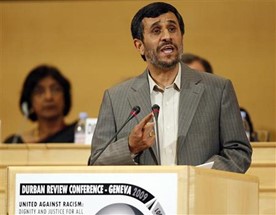
Former Iranian president Mahmoud Ahmadinejad speaking at the United Nations.
Ahmadinejad and Larijani were temperamentally opposites. Ahmadinejad wore his views on his sleeves and was impatient to advance Iran’s nuclear program. Larijani, fitting Iranian stereotypes about the clergy, hid his views to the best of his ability and understood that hastily progressing on the nuclear front, combined with Ahmadinejad’s extreme rhetoric, would lead to greater pressure on Iran.
In 2006, Larijani was charged with handling negotiations over its nuclear program. Ahmadinejad objected that he had been cut out of the process and stepped in to speak before the UN General Assembly, a task previously assigned to Larijani. Larijani resigned in protest. With Khamenei’s support, he then became the speaker of the parliament. During Ahmadinejad’s second term, he politically clashed with Ahmadinejad, who in turn publicly exposed the corruption of the Larijani family.
The 2015 Iran nuclear deal was the biggest debate during Larijani’s speakership. The agreement would have delayed Iran’s nuclear program but would leave Iran days away from a nuclear weapon by the time it would expire in 2030. On top of that, the deal would enable the regime to invest in its proxy, missile, and drone programs. Khamenei blessed the agreement, and Larijani, a patient man, agreed with the policy. He ensured its parliamentary approval against hardline criticism, eventually being outcasted by his former political coalition as a softie. Larijani stepped down from the speakership in 2020 and became a senior adviser to Khamenei.
In 2021 Ebrahim Raisi became president. His name had been floating as a potential future supreme leader, making him a rival of Ali Khamenei’s own son, Mojtaba Khamenei. Larijani spent the Raisi years on the sidelines. Raisi’s death in a helicopter crash in 2024, a subject of many conspiracy theories, returned Larijani to prominence.
The regime began employing a two-front diplomatic effort. It deployed Foreign Minister Abbas Araghchi for negotiations with the U.S. and its allies. To friendly nations, the regime deployed Larijani, who spent his last years tightening relations with Russia. After the 12-day war in June 2025, he took to national airwaves to insist that Iran had won the war and defend the regime (and implicitly Khamenei) on its foreign policy objectives before its domestic base. Khamenei rewarded him by making him the secretary of the Supreme National Security Council, effectively making him Iran’s CEO. Larijani had thus become the second most powerful man in Iran. Shortly thereafter, Larijani’s old foe Ahmadinejad was put under unofficial house arrest.
Five months after Larijani’s appointment, nationwide protests broke out in January 2026. This wasn’t the first time, however. After a previous round in 2019, mid-rank regime officials had revolted against the regime for using foreign proxies and excessive force to violently crack down on protesters. The regime relented somewhat and refrained from relying on brutal foreign proxy forces during another round of protests in 2022. But when the security forces were reluctant to cross the line again in cracking down on the January 2026 protests, Larijani brought foreign proxies back. Reports suggest that on Larijani’s orders, these forces massacred up to 36,500 protesters over four nights.
He spent his last weeks commanding the war against the United States and Israel while his team contacted foreign journalists to push a narrative of him being a pragmatist in order to save his life and to portray him as an acceptable option to run Iran.
Larijani was clever and did not speak bombastically, making him appealing to gullible foreign journalists and diplomats. He was fit for basic intellectual conversations, which charmed foreigners.
But Larijani was a moderate only in his methods. On his disagreements with Ahmadinejad leading to his resignation from the Supreme National Security Council, Larijani once commented:
The country’s strategic issues should progress with prudence and calculations. … Impulsive actions cannot work and cause problems for the country.
This is how Larijani always operated, and he survived so long because this vision and cautious temperament perfectly aligned with Khamenei’s, to whom he repeatedly proved his loyalty.
But the ends Larijani sought were hardly moderate. In a poorly written academic paper, Larijani conceded that some popular legitimacy is necessary for an Islamic regime, however, the people only get to choose insofar as who will best carry out Islamic imperatives. Compromise was necessary, he suggested, as long as they do not undermine Islamic principles, which are given by God and are therefore absolute.
Larijani and Khamenei both believed in tactical flexibility in pursuit of extreme ends. Khamenei chose him as his de facto successor because Larijani was competent, and there was nobody Khamenei trusted more than Larijani to change nothing. The media are right to call him pragmatic, but so was Khamenei, just enough to fool the world and buy time. The brutal Islamic Republic has lost a very valuable asset.