
On May 15, the BBC News website published a report by the Jerusalem bureau’s Yolande Knell on the topic of the eighth Fatah General Conference which took place May 14 to May 16 in Ramallah.
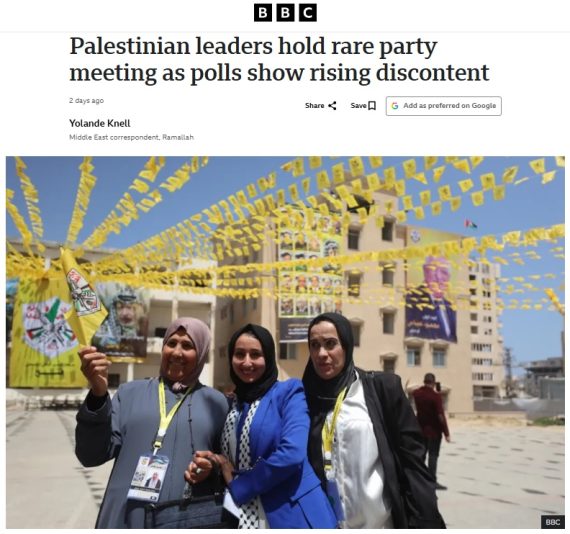 The BBC’s chronically patchy reporting on the topic of internal Palestinian affairs, together with the fact that the previous Fatah conference in 2016 did not receive any English language coverage, means that readers of Knell’s report – titled “Palestinian leaders hold rare party meeting as polls show rising discontent” – likely lack the background information needed to fully understand some of its content.
For example, Knell begins by telling her readers:
Top leaders of the main Palestinian political faction, Fatah, are electing its highest decision-making body, at its first major conference in a decade.
The 90-year-old Palestinian President, Mahmoud Abbas – who rules by decree – was re-elected as head of Fatah on Wednesday. [Emphasis added.]
Four paragraphs later, she adds:
Addressing the conference on its opening day on Thursday, Abbas promised the first presidential and parliamentary elections in 20 years – without giving a timeline.
“We renew our full commitment to continuing work on implementing all the reform measures we pledged,” he said. He declared that holding the gathering “on our homeland’s soil confirms our determination to continue on the democratic path”. [Emphasis added.]
BBC fails to provide an explanation as to why no legislative elections have taken place in over 20 years and Knell gives no clarification concerning the claim – from a president in the 22nd year of his four-year term of office who “rules by decree” – to be “on the democratic path.”
Failing to note that critics have faulted the Fatah-dominated Palestinian Authority of corruption – both internal and external – for many years, Knell continues:
The president and the Palestinian Authority (PA) are under increasing pressure from the US, European Union and Arab countries to carry out reforms and hold elections. They face claims of corruption and political stagnation – as well as declining legitimacy.
While she does not clarify the details of the reforms sought by “the US, European Union and Arab countries,” Knell does later tell her readers that:
The Palestinian reality has drastically changed since the last general conference at the end of 2016.
In 2023, the deadly Hamas-led assault on Israel triggered the brutal Gaza war. Palestinians have been “slaughtered, displaced and devastated”, Abbas said in his opening address to the conference, leaving an “unprecedented humanitarian catastrophe”.
At the same time, a key Israeli minister has pledged “to bury the idea of a Palestinian state”. Palestinians in the occupied West Bank and East Jerusalem increasingly face being pushed from their homes and land as Jewish settlements grow faster than ever.
Settlements are illegal under international law.
This is further weakening the PA – dominated by Fatah – which governs parts of the West Bank.
On top of that, Israel is withholding tax transfers that it collects for the PA – deepening its economic woes – because of an ongoing dispute about Palestinian school texts which Israel claims incite violence, and stipends to the families of those jailed or killed by Israel, including attackers.
The PA says it is now owed some $5bn (£3.7bn; 4.3bn euros), meaning it pays most civil servants only part of their salaries and restricts some public services. [Emphasis added.]
Israel is not the only country or body to have “claims” concerning the glorification of terrorism, incitement to violence and promotion of antisemitism in PA school textbooks. In July 2024 the PA committed to “reforming … the education curriculum” in an agreement with the European Commission. A U.S. State Department report to Congress relating to the period between June 2025 and May 2026 states:
There were insufficient changes to curriculum in PA-run or regulated schools during the reporting period. Curriculum continued to support antisemitism, incited violence, refused to recognize Israel’s right to exist, and glorified terrorism.
The same report notes that payments to convicted terrorists and their families – a topic which has been underreported by the BBC for years, including by Knell herself – have not ceased. The State Department report details:
Several open source reports demonstrate the PA continued the practice of “pay for slay,” despite claims and promises to the contrary. In February 2026, a full year after Abbas claimed to revoke the decrees, PA Minister of Finance Estephan Salameh said publicly that the PA remained committed to continuing compensation to the Palestinian terrorists and their families. He admitted compensation had not stopped, saying, “With effort and great, almost impossible difficulty, we continue to provide this rate [60 percent] of [PA public employee] salaries. We have not abandoned any Palestinian resident, whether they are prisoners or families of martyrs and wounded … We are not reducing or forgoing any salary.”
Notably, while Knell notes the PA’s comments concerning salaries to civil servants and restrictions on public services, she does not inform BBC audiences that at the conference she purports to cover, Mahmoud Abbas noted another category of payments affected by Israel’s withholding of tax revenues:
“The continued holding of Palestinian Authority funds by Israel is an unprecedented event that violates the agreements between the Palestinian Authority and Israel, as well as international law,” Abbas claimed in his Fatah conference address. “…The continued withholding of the Palestinian people’s funds, which have so far exceeded $5 billion…and all this needs to be paid to public employees, to prisoners …” [ie, terrorists. Emphasis added.]
Neither does Knell have anything to tell her readers about the terror-glorifying promotional videos put out by Fatah ahead of the conference or the terrorist records of some of the candidates for the Fatah Central Committee and Fatah Revolutionary Council. Palestinian Media Watch reported in The Algemeiner:
Director of the PLO Commission of Prisoners’ Affairs Raed Abu Al-Humus revealed the list of candidates a week ago. Among the 32 terrorists are 15 murderers who in total murdered 22 people, 8 terrorists who orchestrated attacks in which 53 people were murdered, and 9 other terrorists who carried out attacks and terror activity against Israelis.
On the topic of another (apparently successful) candidate, Knell states:
There is also disquiet that his [Abbas’] eldest son – a businessman – is on the ballot for a senior party position for the first time. …
Meanwhile, the president’s eldest son, Yasser Abbas – a businessman – is on the ballot for the first time to join the central committee.
For many that move – raising questions of nepotism – underlines the disconnect between the party and Palestinian public sentiment and deepens doubts about whether the PA really can make the significant reforms that it has pledged.
Remarkably, Knell has nothing to tell BBC audiences about the longstanding allegations of corruption levelled at Yasser Abbas.
Failing to note that members of a faction opposing Mahmoud Abbas were not invited to attend the conference or that those joining from Cairo included convicted terrorists who were released and deported in exchange for hostages held in the Gaza Strip, Knell writes:
The conference is being attended by more than 2,500 Fatah members – most of them in Ramallah, the administrative capital of the PA – but with a few hundred also spread between Beirut, Cairo and Gaza. …
Speaking among the ruins of Gaza, a Fatah activist, Samah al-Rawagh – who is joining the conference via video link – told the BBC that change was possible.
“The symbolism of having a conference hall in Gaza is profoundly significant,” she said. [Emphasis added.]
In fact, Fatah members in the Gaza Strip, who participated in the conference via video, gathered at Al Azhar university rather than “among the ruins of Gaza.”
Knell’s report also quotes a “political analyst” whom she fails to clarify worked for the PLO until 2023 – despite her having quoted him in that role in 2013. Thus, she writes:
There is anger over cronyism and corruption and the PA’s continued security co-ordination with Israel – which involves sharing information about Palestinian armed groups and is seen as benefiting the occupying power.
“When we talk about Fatah, we’re talking about the backbone of the Palestinian national movement, at least since the 1960s,” says political analyst, Xavier Abu Eid, in Ramallah. “And it’s a movement that’s going through a deep crisis.”
“The identity of Fatah is a revolutionary identity. It was about changing the status quo for the sake of liberating Palestine and turning the Palestinian cause from a humanitarian issue into a political issue.”
“But today this identity is being questioned. Is Fatah a national liberation movement or is it a group of bureaucrats that are going to work for the PA? Is it about the survival of the PA, or is it about the liberation of Palestine, or can you combine both?”
Knell refrains from explaining what “liberating Palestine” means and fails to tell readers that in his capacity as PA president, PLO chairman and Fatah head, Mahmoud Abbas has repeatedly refused to recognize Israel as the Jewish state.
 Such context would no doubt have been useful to members of the BBC’s audience reading an article illustrated with a photograph showing a flag which displays rifles, a grenade and an Israel-erasing map of “greater Palestine” but, as is evident throughout Knell’s report, context would only detract from the framing she chose to present.