
In a Dec. 30, 2025 broadcast highlighting damage to the rich cultural history of the Gaza Strip during two years of war, PBS NewsHour laments that “the destruction is not just a humanitarian catastrophe, but an erasure of civilization’s memory.”
Ironically, though, Jeffrey Brown’s lengthy segment is itself guilty of erasing the memory of the rich Jewish cultural heritage in the Gaza Strip dating back to antiquity, while simultaneously trampling over present-day facts.
Let’s start with October 2023, which, according to Brown, saw the supposed destruction of the coastal territory’s 1,600-year-old Church of St. Prophyrius. Brown reported:
The 1,600-year-old Church of St. Prophyrius was thought to be the world’s third oldest church. An Israeli strike in the first few weeks of the war destroyed it. [Emphasis added]
In reality, the church was not destroyed. Satellite images, pictures, and videos of the church’s chapel after the Oct. 19, 2023, strike show that while a building in the church compound was destroyed, the chapel itself was unharmed.
The satellite images below from Google Earth show the church compound, which is outlined in blue. The damaged area is outlined in red.
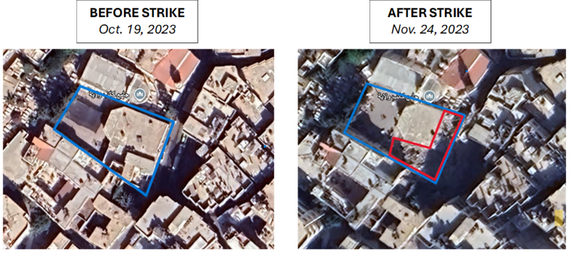
Before and after images of the Church of St. Prophyrius. (credit: screenshot/Google Earth)
As The New York Times unequivocally reported after the strike: “The chapel was not hit.” According to the same Times report, the compound includes “a chapel, seven buildings and a courtyard.”
Furthermore, PBS neglected to report Israel’s information that it was targeting a Hamas command center located in a building next to the church, and not the church itself. As The Times detailed:
A statement from the Israeli military on Friday said that the church was not the intended target of the airstrike. The fighter jets that carried out the attack were trying to destroy a Hamas command center near the church that the military believes has been involved in launching rockets and mortars toward Israel, the statement said.
“The incident is under review,” the statement said, using the initials of the Israel Defense Forces. The I.D.F. can unequivocally state that the church was not the target of the strike.”
The Israeli military later released a video of the strike, indicating that it was targeting the building next to the church.
By omitting the IDF’s explanation for the strike, Brown implied the military deliberately targeted the church without justification – a grave war crime if it were true – and a hefty accusation.
The Omari Mosque
Moreover, that same Hamas command center is also next to two (actually) destroyed sites detailed in the broadcast: the Omari Mosque and the Pasha Palace.
Regarding the mosque, which has long been the site of terror activity, Brown selectively reported: “The seventh century Great Omari Mosque, a crusader church turned early Islamic mosque with its towering minaret and marble columns now in ruins.”
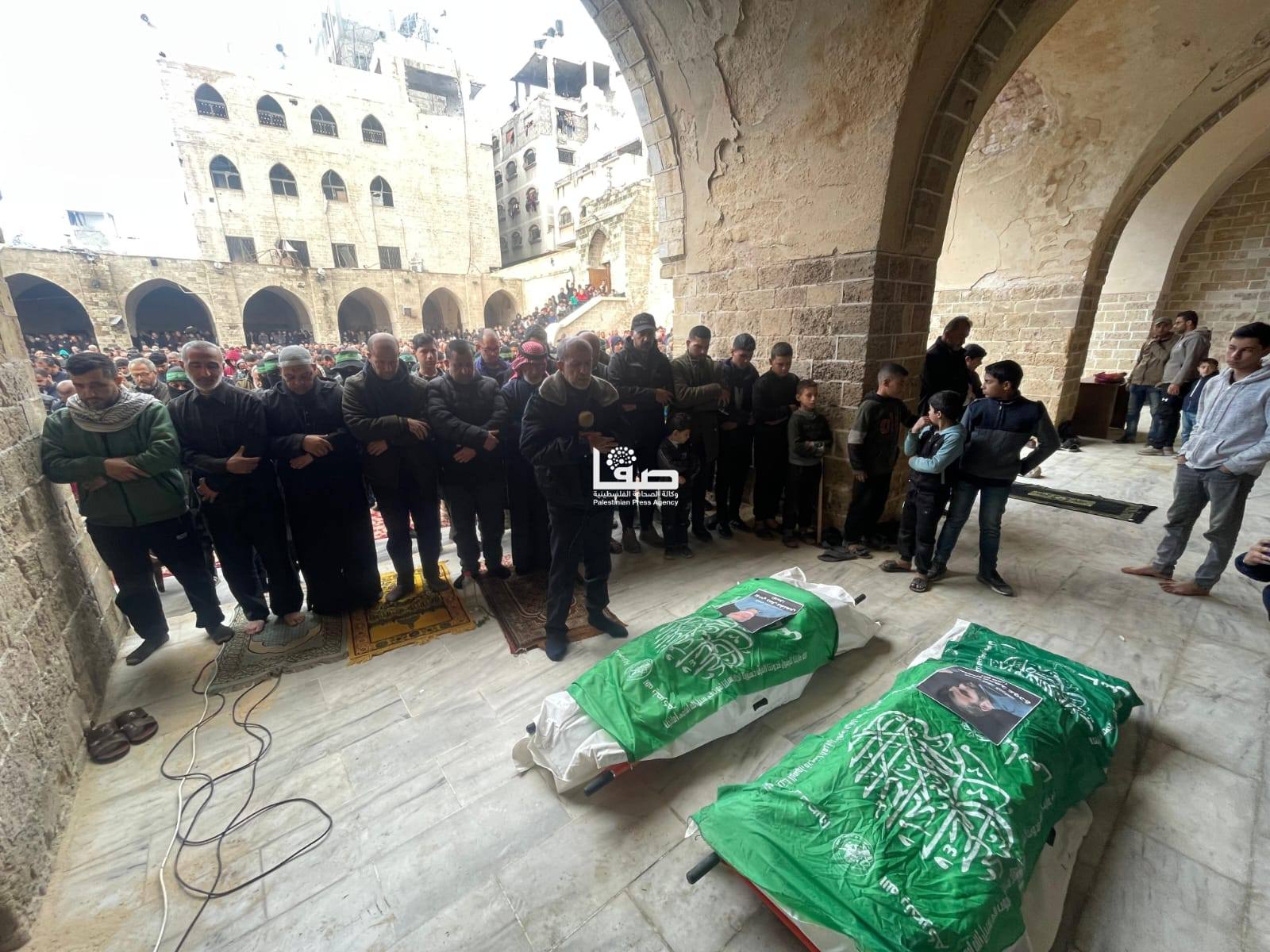
Mourners attend funeral of slain Hamas terrorists at the Omari Mosque, January 2025 (Facebook/Section 27A of the Copyright Act)
Other media outlets covering the destruction of the Omari Mosque forthrightly reported the Israeli military’s information about Hamas’ presence in the area. “At the Great Omari Mosque, the IDF say they bombed a tunnel shaft and terror tunnel,” the BBC reported.
Likewise, Haaretz reported: “The IDF said that Hamas used the site for terror activities, and that terrorists as well as a tunnel entrance were found inside.”
Furthermore, for decades, Hamas leaders have given speeches at the site and attended funerals for killed Hamas terrorists hosted by the church.
Hamas official Fathi Hammad commanded from within the mosque in July 2018: “O Muslims, wherever you find a Zionist Jew, you must kill him because that is an expression of your solidarity with the Al-Aqsa Mosque and an expression of your solidarity with… your Jerusalem, your Palestine and… your people.”
There is no shortage of additional examples demonstrating that Hamas exploited the exact location about which interviewee Mahmoud Hawari is quoted saying that “cultural heritage has flourished for thousands of years.”
In addition, Amnesty International reported in 2015 that the previous year, “In one of the most shocking incidents six men were publicly executed by Hamas forces outside al-Omari mosque on 22 August in front of hundreds of spectators including children.”
So much for the sanctity of sacred space.
The Pasha Palace
Brown lamented the destruction of the Pasha Palace:
First built in the mid-13th century, a seat of power during the Mamluk and Ottoman periods. Today, it’s a shell of its past glory, a historic structure reduced to rubble.
It used to serve as a museum of history in Gaza and housed thousands of rare artifacts. Now local archaeologists are undertaking the impossible task of recovery.
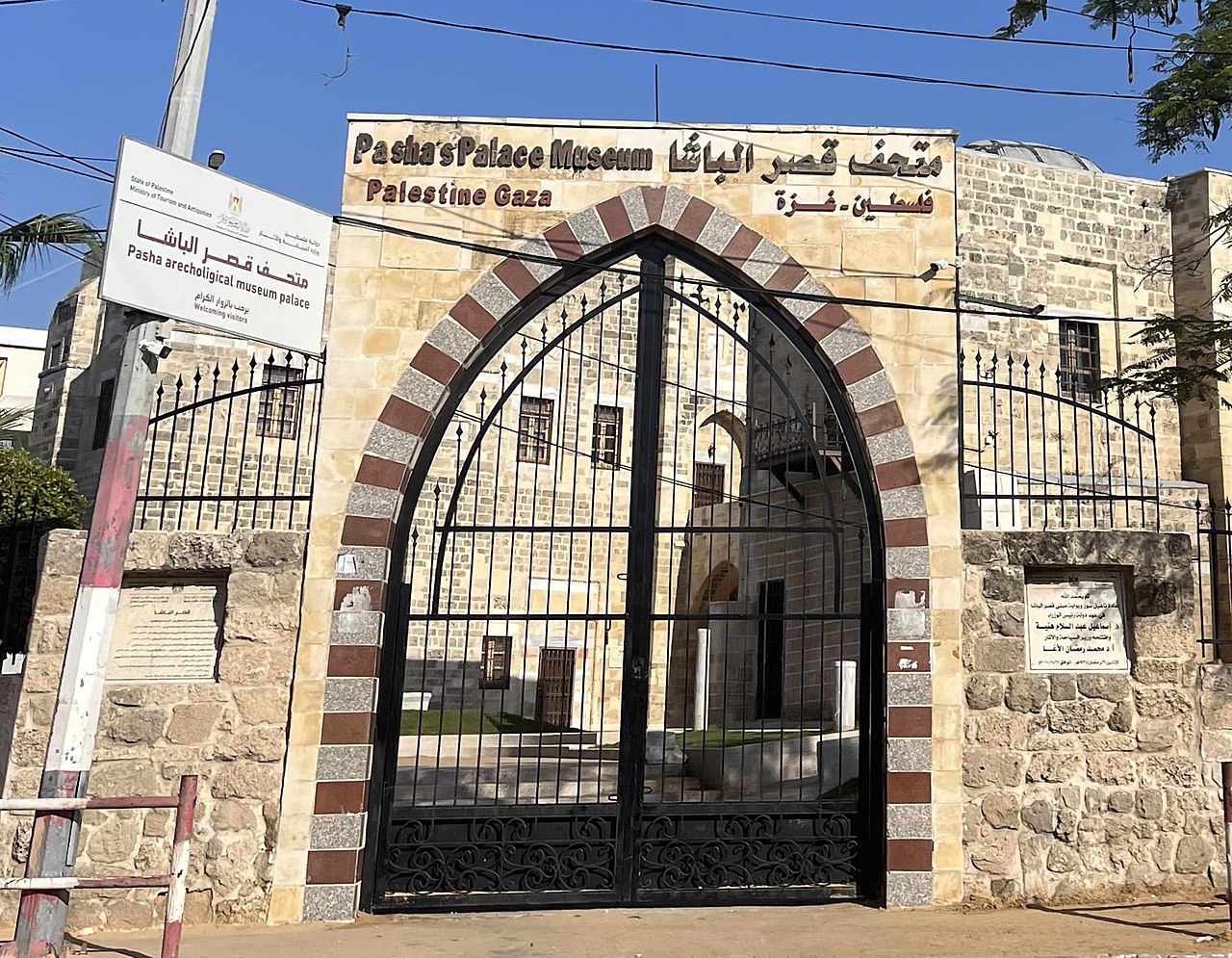
The Pasha Palace in November 2022 (Photo by Dan Palraz, CC BY-SA 4.0, via Wikimedia Commons)
The palace museum was destroyed in a December 2023 Israeli strike. Brown reported that there were 17,000 artifacts held at the museum, and since restoration work has begun, only 20 items have been found.
The general director of the palace’s restoration project, Hamouda al-Dahdar, stated in the broadcast, “Most of the artifacts were bulldozed and stolen inside those rooms.” In Turkish and Arabic-language news sites, al-Dahdar even more explicitly accused the Israeli military of looting artifacts, though there is no evidence of such crimes. To the contrary, an archeologist affiliated with the site dismissed the charge, Agence France Presse reported:
Palestinians quickly accused the army of pillaging. But EBAF [French Biblical and Archaeological School of Jerusalem] archaeologist Rene Elter said he has seen no evidence of “state looting”.
“My colleagues were able to return to the site. The soldiers opened boxes. We don’t know if they took anything,” he told AFP.
Most of what has been unearthed in archaeological digs in Gaza were either stored at the Pasha Palace museum or a Gaza City warehouse, according to AFP.
Although PBS reported on the reported destruction of the archaeological finds at the palace, it failed to note that the archaeological finds held at the Gaza City warehouse survived. This information substantiates the Israeli military statement which PBS did include: “Sites of cultural heritage and locations of historical and cultural significance are treated with the utmost sensitivity.”
Moreover, contradicting the broadcast’s suggestion that the Israeli military “deliberately targeted” cultural sites, in reality the IDF has taken steps to protect antiquities. As AFP reported, in September 2025, the Israeli military warned of an impending strike and ordered the French Biblical and Archaeological School in Jerusalem to evacuate its archaeological storehouse, which contained nearly three decades of archaeological findings (“Gaza Antiquities Rescued Ahead of Israeli Strike“).
“This was a high-risk operation, carried out in an extremely dangerous context for everyone involved – a real last-minute rescue,” EBAF director Fr. Olivier Poquillon told AFP. While the Israeli military supported efforts to save Gaza’s archaeological artifacts, Hamas did not. The rescue operation needed to be conducted in absolute secrecy.
The Hamam al-Sammarra bath house
Brown detailed the destruction of another site while ignoring the Israeli military’s information about Hamas’ presence at the location: “The 14th century Hamam al-Sammarra, an Ottoman era bath house noted for its arched ceilings, marble floors and heated systems, now a pile of rocks.” CNN reported what PBS neglected to note:
“A Hamas terrorist squad was based in the aforementioned structure which had also contained a network of terror tunnels. The IDF struck the terror target using precision munitions and while minimizing damage to uninvolved persons,” the IDF claimed in a statement.
The Shababeek Gallery
The trend persisted when Brown again concealed essential context about Hamas presence, this time in the vicinity of the Shababeek Gallery run by interviewee Shareef Sarhan.
Brown erred that the gallery was destroyed in October 2023. In fact, it was destroyed in late March 2024 during the IDF’s raid on al-Shifa Hospital which is mere meters away from the gallery. Sarhan himself announced the gallery’s destruction on his own Instagram account on April 1, 2024, the same day that the Israeli military concluded its operation at al-Shifa Hospital.
This hospital harbored hundreds of Hamas and Palestinian Islamic Jihad terrorists, including several high-up operatives. Additionally, the remains of Israeli hostages Yehudit Weiss,65, and Corporal Noa Marciano, 19, were found at the same hospital in November 2023, as were RPGs and AK-47s.
Several hostages, including Guy Illouz, Maya Regev, and Romi Gonen, were held and abused at Shifa Hospital.
The Barquq Castle
With respect to the Barquq Castle in Khan Yunis, hit on Dec. 18, 2025, PBS ignored the fact that the Israeli military said it was destroying tunnels and fighting terrorists face to face in the same area that very day.
By systematically failing to note specific IDF information about Hamas activity in the very sites in question, PBS bolstered the baseless accusation charging Israel with war crimes.
As Brown reported: “PEN America concludes that many of the sites appear to have been deliberately targeted, in breach of international law protecting cultural property.”
Why is the crucial information that Hamas embeds its fighters and weapons in these specific cultural sites, and in the labyrinth of tunnels beneath them, completely devoid from this broadcast?
Erasure of Jewish presence in Gaza
In a separate troublesome shortcoming, Brown erases Jewish history from the Gaza Strip’s rich cultural past, stating: “From Bronze Age artifacts to Byzantine churches, Gaza’s archaeological richness embodies the sweep of Mediterranean history.” Further erasing the area’s Jewish past, interviewee Mahmoud Hawari added:
In the last 2,000 years, it was an important port on the Mediterranean that brought merchandise from the East to the West. For example, the Roman Empire needed incense and spices that came from India through Arabia and into the port of Gaza and to the rest of the Mediterranean.
In the Byzantine time, it was a learning center for Christianity. In the Islamic times, also it was a flourishing center of culture and learning. And the buildings and the archaeological sites in Gaza testified to these facts.
Excluded from the segment was Gaza’s ancient Jewish history, which endures in Jewish tradition. The popular Shabbat song Ya Ribon Olam was written in Gaza in the late 16th–early 17th centuries by Rabbi Yisrael Najara. Archaeological evidence includes a 6th-century Byzantine-era synagogue discovered in Gaza City’s Rimal district in 1965, and a menorah relief once visible on a column at the aforementioned Omari Mosque, documented in 1870 and later chiseled away in the late 1970s, according to The New York Times.
“A tapestry of color and coastline, old city markets and ancient monuments, a place layered with more than 5,000 years of history” gave way to apocalyptic scenes, Brown said, lamenting the death of the territory’s vibrant cultural life in the segment’s opening.
By whitewashing Hamas’ habit of hijacking historic and cultural treasures into terror assets, PBS lets the terror organization off the hook for turning Gaza’s “riviera” of beach front views and cultural heritage into ruins.
And by ignoring CAMERA’s requests to amend the broadcast’s multiple significant failings — the cover up of Hamas’ presence at the described cultural sites thereby falsely implicating Israel in deliberate targeting of antiquities, the false reporting of the destruction of an intact church, and the complete erasure of the territory’s Jewish history — PBS itself leaves behind a journalistic wasteland in its wake.
For the Arabic version of this post, please see CAMERA Arabic.