
“Antisemitism is a real problem and El País is sensitive to [the issue],” Guillermo Altares, foreign desk chief of El País’ insisted in a damage control interview last week. The editor’s pronouncement was in response to the troublesome fiasco over the hugely influential Spanish newspaper’s publication — and then stealthy deletion with no public apology — of an anti-Jewish slur that the federal judge presiding over former Venezuelan President Nicolás Maduro’s case in New York strives to be impartial “despite being a well-known member of the Jewish community.”
Professed sensitivity notwithstanding, in no time at all the Spanish news outlet embroiled itself in another ugly incident involving antisemitism, this time via its Catalonia edition.
In the city of Barcelona, an unidentified pro-BDS group created an online map called Barcelonaz identifying Jewish businesses, Israeli companies with interests in Spain, and Spanish or international companies operating in Israel. Notably, a Jewish school and restaurants also appeared on the map, which explicitly invited users to contribute more information about additional Jewish and Israel-affiliated sites — an unmistakable act of antisemitic targeting. Esteban Ibarra, president of the Movement Against Intolerance, described it as “organized criminal antisemitism.”
The French-based GoGoCarto, which hosted the map, deactivated the project following complaints from Jewish community organizations. The European Jewish Congress said of the project’s name:
The use of “NAZ” appears to deliberately associate Jews and Israelis with Nazism, a form of antisemitic inversion that trivializes Nazi crimes while demonizing Jewish identity.
The EJC is deeply alarmed by the launch of Barcelonaz, an online interactive map that identifies Jewish-owned businesses, Israeli companies, and other entities alleged to have links to Israel in Catalonia.
The project is hosted on the French platform GoGoCarto and invites users… pic.twitter.com/kppB7ygtZV
— European Jewish Congress (@eurojewcong) January 2, 2026
In covering the antisemitic map which put a target on the backs of Spanish Jews, El País opted for a headline casting the hunted Jewish community as the predators of harmless “pro-Palestinian” advocates: “The Jewish community in Barcelona succeeds in shutting down a pro-Palestinian website that pointed to its businesses.”
In this gross inversion, in which an antisemitic website targeting Jews, including their businesses and even a school, is whitewashed as nothing more threatening than a “pro-Palestinian website,” Barcelona’s Jewish community becomes the bad actor.
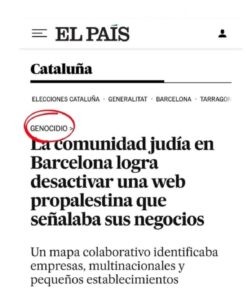 In a second inversion casting the victimized local Jewish community into perpetrators, editors initially opted to place the story under the “Genocide” category rather than tagging the article under an appropriate label such as “Antisemitism” or “Discrimination.” (Screenshot at left). In doing so, it promoted the odious and unfounded libel that Israel is carrying out a genocide and promoted the antisemitic trope that Spanish Jews ought to be held responsible for the Jewish state’s purported war crime.
Following several complaints, and likely mindful of the scandal ignited just hours earlier by the remark about a judge being impartial “despite” being Jewish, the newspaper nominally softened the “Genocide” language to “Massacre in Gaza.” But the change is negligible, as the new slur likewise carries no direct relevance to the content of an article about the local Jewish community. It continues to recast the local Jewish community’s own victimhood into responsibility for faraway alleged war crimes.
“Neither Jesús [Sérvulo González] nor El País are antisemitic, it was a mistake that we corrected when we saw it,” Altares, the El País editor, strived to assure his Haaretz interviewer.
But the repeated association of “the Jews” with narratives of suspicion, violence, or collective guilt suggests an editorial pattern that demands serious reflection, not technical mistakes.
Borrowing the newspaper’s own words, one might almost say that El País strives to appear professional despite being antisemitic.
For the Spanish version of this article, please see CAMERA Español. For the Hebrew version, please see CAMERA Hebrew.