
The problem with Israel at Eurovision Song Contest 2026, according to one of Spain’s leading mainstream newspapers, was quite simply the Jewish state’s participation.
El Periódico, an influential media outlet with a large national readership, published a revealing article covering Eurovision’s first semifinal. It was revealing not because it is harshly critical of Israel — by now, that’s a common feature of parts of the legacy Spanish-speaking press — but because of the level of political militancy disguised as cultural commentary.
Because El Periódico is not some fringe activist outlet, the piece’s tone was all the more striking.
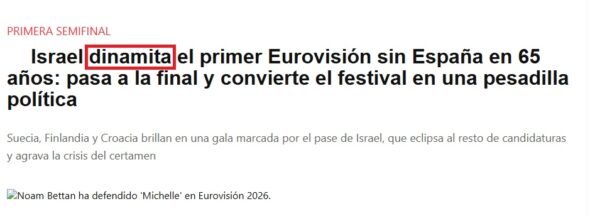 The headline, as it originally appeared, said everything: “Israel blows up the first Eurovision without Spain in 65 years: reaches the final and turns the festival into a political nightmare.” [Screenshot of the original headline at left.]
The May 17 article did not review a music competition. It constructed a narrative in which Israel appears as a kind of moral contaminant ruining the festival simply by being there.
The prejudice is impossible to miss as the article opened: “Eurovision trembles. Israel could win.”
What exactly is Israel supposed to do in order not to “blow up” Eurovision? Withdraw? Apologize for participating? Lose quietly so nobody feels uncomfortable?
The problem with the article was not that it criticized the Israeli government — criticism of governments is entirely legitimate — but that it turned the mere qualification of an Israeli song into a “political nightmare.” That’s an interesting choice of words. Apparently, it was not the politicians, commentators, activists, public broadcasters and delegations that have spent years turning Eurovision into a permanent anti-Israel campaign who are “blowing up” the contest. No. The problem was that Israel keeps participating — and, worse still, receiving votes.
The article adopted, without any distance whatsoever, the vocabulary of the most hardline anti-Israel activism. It cited “genocide,” “massacre” and “murders” as though these were legally established and universally accepted facts. There was no attribution, no nuance, and no context.
The distortion peaked with the piece’s statement: “The government of Benjamin Netanyahu initiated the massacre on October 7.”
The issue was not a mere factual flaw. This is journalism so ideologically distorted that it reversed victim and aggressor until the reality of Oct. 7 became almost unrecognizable.
Israeli suffering disappeared entirely from the narrative. The Israeli dead do not exist. The hostages do not exist. The survivors of the Nova music festival massacre do not exist. Israelis appeared only as an abstract embodiment of Western political evil.
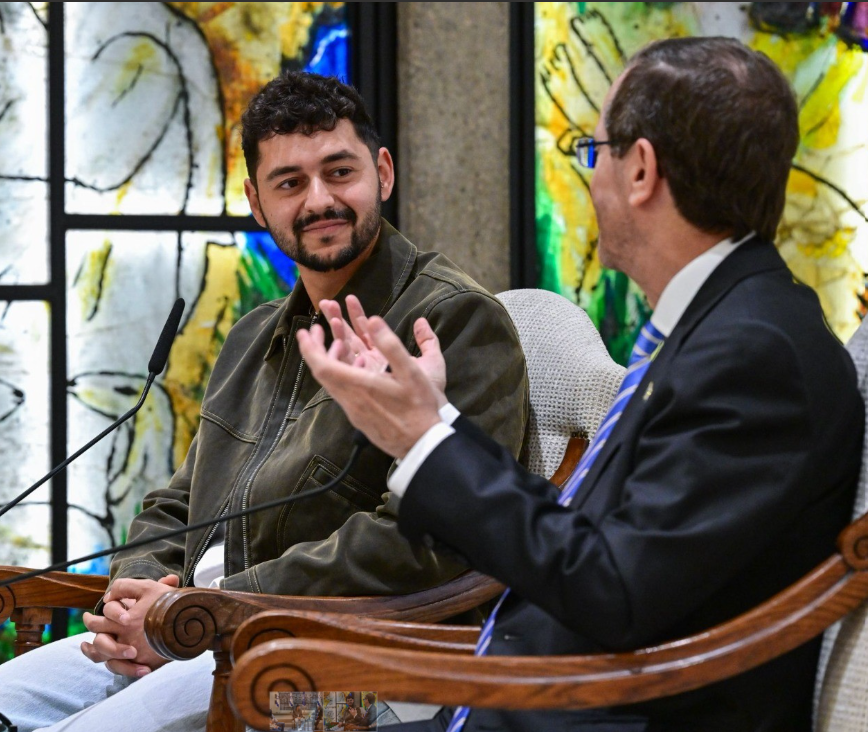
Israeli contestant Noam Bettan with Israeli President Isaac Herzog, May, 18, 2026 (Photo by Kobi Gideon/GPO)
But the article went even further. Immediately afterward, the author cited lyrics from two recent Israeli Eurovision songs to suggest they are political messages — and somehow proof that Spain was justified in withdrawing from the contest.
Judge for yourselves. It stated:
… KAN, [Israel’s] public broadcaster, has used [Eurovision] to show its particular vision of events with two clearly politicized entries: Hurricane and New Day Will Rise. “People walk away but never say goodbye. Someone stole the moon tonight, took my light. Everything is black and white,” sang Eden Golan. “New day will rise Life will go on. Darkness will fade. All the pain will go by but we will stay,” sang Yuval Raphael.
If someone considers “Someone stole the moon tonight” or “A new day will rise” dangerous political messaging, that probably says more about the listener than the singer.
When artists from other countries sing about grief, pain or hope, journalists rightly treat these sentiments as emotional expression. When Israelis do it, the emotions suddenly become suspicious propaganda. The article described the Israeli entries as attempts to “show their particular vision of events,” as if sharing an Israeli perspective in songs is nefarious. In other words: El Periódico even denies Israelis the right to trauma.
(Interestingly, the article’s author removed “Everyone cries. Don’t cry alone” from Raphael’s lyrics; Perhaps that excerpt risks humanizing Israelis as people who feel pain.)
The irony, of course, is that the same article demanded Eurovision remain “neutral” while turning its own coverage into a political manifesto. This demand raises a fairly basic question: since when has Eurovision ever been apolitical? For decades, Eurovision has mixed music with national identity, regional rivalries, activism, diplomacy and political messaging. The difference now is that “neutrality” increasingly seems to mean excluding Israel.
The article even suggested that Israel’s participation “endangered” the 16,000 people inside the arena. The logic is extraordinary because it shifts responsibility entirely: the problem is not those threatening disruption or turning the festival into a political battlefield, but Israel for showing up at all.
It is an unsettlingly familiar logic: the conflict is not caused by anti-Israel hostility, but by the visible existence of Israel itself. Not the threat, but the threatened.
And then there was the central contradiction running through the entire piece: if Israel is supposedly so universally rejected, why does it continue receiving massive public support in the televote?
Here another familiar pattern emerged. When Israel receives support, that support must somehow be illegitimate, manipulated, or morally suspect. The article pointed to organized Israeli televoting campaigns as though coordinated voting efforts were shocking anomalies rather than a longstanding Eurovision tradition practiced by fandoms, diasporas, and national delegations alike.
El Periódico failed to consider the possibility that millions of Europeans simply do not share the anti-Israel obsession of certain media outlets.
In the end, El Periódico‘s article revealed far more about the state of parts of the European media than it does about Eurovision itself. In certain media circles, criticizing Israel is no longer sufficient. Increasingly, the impulse is to symbolically expel Israel from any shared public space: universities, sports competitions, cultural festivals, even music contests.
And perhaps that is the real underlying question: if certain sectors of European society consider even an Israeli Eurovision song as intolerable, what form of Israeli presence is acceptable?
Following communication from CAMERA Español, editors at El Periódico quietly modified the original article without issuing any formal correction notice.
The changes are revealing. The headline now alleges that “Israel eclipses” Eurovision, as opposed to “blows up” Eurovision.
Within the article, editors exchanged the explicit accusation of “genocide” with a vague phrase about “the beginning of the conflict with Palestine,” meaning Hamas’ barbaric Oct. 7 attack, the biggest slaughter of Jews since the Holocaust. Strikingly, when assigning blame to Israel, the original article spoke with complete certainty. Once forced to correct and address Hamas and Oct. 7, El Periódico has trouble assigning responsibility.
Several key paragraphs disappeared altogether, including the accusation that Israel was “continuing to kill people in Gaza,” accompanied by casualty figures presented without attribution; the claim that Netanyahu’s government had “initiated the massacre on October 7,” effectively reversing the chronology of the Hamas attacks; the assertion that the Israeli delegation’s mere presence “put at risk” the 16,000 people inside the arena; and the tendentious interpretation of the song lyrics.
Yet even after the revisions, the corrected version reportedly still wrongly refers to Tel Aviv as Israel’s capital.
For the Spanish version of this article, please see CAMERA Español. For the Hebrew version, see CAMERA Hebrew.