
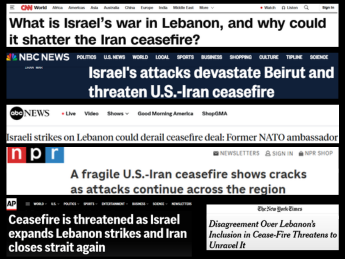
Collage of CNN, NBC News, ABC News, NPR, Associated Press, and New York Times headlines on Israeli strikes in Lebanon allegedly threatening the Iran-U.S. ceasefire. (screenshot/Canva)
When a single, unverified claim is repeated across major news platforms, it can quickly become the historical record. This dynamic was on full display in the days following the Apr. 8, 2026, declaration of the Iran-U.S./Israel ceasefire.
The headlines generally all made the same claim: Israel has strained the fragile truce by striking Hezbollah targets in Lebanon. There was just one problem with this narrative: Lebanon was not part of the agreement.
Nevertheless, within hours of the ceasefire taking effect, this exact message emerged as a unified chorus from leading American news outlets, including CNN, NPR, The New York Times, The Washington Post, MS NOW, NBC News, ABC News, The Associated Press, and Reuters. Between April 8 and 10, CAMERA found that the narrative was conveyed at the top of over 20 unique reports within those select news outlets.
Even after it became clear that the parties involved at least disagreed over whether the deal included Lebanon, news outlets continued to publish articles stating that Israel violated the truce.
Notably, among the unique reports CAMERA reviewed, just five also accused Iran of straining the ceasefire by keeping the Strait of Hormuz closed to traffic either in the headline or in the first sentence. Iran’s obligation to open the Strait was agreed to by all parties to the deal.
A social media post by Pakistan’s Prime Minister Shehbaz Sharif, a mediator in the negotiations, was the foundation for this global media blitz, backed by the Iranian regime’s own claims. It remains unclear why prestigious Western outlets anointed Sharif as the neutral arbiter of truth, considering his long history of anti-Israel rhetoric.
To understand the sheer scale of this manufactured reality, one only needs to look at the timeline.
The Narrative’s Timeline
The foundation of this narrative was laid at 2:50 a.m. when Pakistani Prime Minister Shehbaz Sharif announced the ceasefire’s commencement, claiming it included Lebanon.
Almost immediately, the actual “truce” with Iran was tested as four separate waves of Iranian missiles triggered sirens across Israel between 2:54 a.m. (7:54 p.m. ET) and 3:28 a.m. (8:28 p.m. ET). While the global media remained largely silent on these immediate Iranian provocations, they were quick to pivot by 2:30 p.m. (7:30 a.m. ET), labeling Israel’s targeted strikes against Hezbollah in Beirut as “ceasefire violations.”

A screenshot of The Times of Israel Live Blog on April 8, 2026.
This narrative persisted despite a definitive 6:00 p.m. (11 a.m. ET) correction from White House Press Secretary Karoline Leavitt, who told reporter Barak Ravid, and later a full press pool, that Lebanon was explicitly excluded from the agreement.
White House press secretary Karoline Leavitt tells me Lebanon is not part of the ceasefire agreement with Iran
— Barak Ravid (@BarakRavid) April 8, 2026
The day concluded with a stark geopolitical divide. While U.S. Vice President JD Vance and Israeli Prime Minister Benjamin Netanyahu issued public statements confirming the deal’s limited scope, Iran and Pakistan maintained that Lebanon was covered by the truce.
Despite this explicit contradiction from Washington and Jerusalem, the “violation” narrative persisted in the press. News outlets continued to publish articles accusing Israel of straining a ceasefire in a country where the U.S. and Israel had stated the ceasefire did not apply.
In diplomacy, silence can be interpreted as a signal. On April 8, before official documents were published, Beirut officials were noticeably quiet. If Lebanon had been shielded by this deal, its leaders would have been among the first to declare it. Instead, over the following days, Lebanon’s own Foreign Minister, Youssef Raggi, repeatedly posted on X about the Israeli strikes, while specifically noting that the ceasefire was between the U.S. and Iran. He excluded Lebanon from each statement. On April 13, Raggi explicitly confirmed that Lebanon was not part of the ceasefire, negotiated between America and Iran.
I received a call from the German Foreign Minister @AussenMinDE Johann Wadephul, who expressed his country’s firm support for the efforts of the Lebanese government to assert its sovereignty and achieve stability. He also emphasized that Germany is working toward reaching a…
— Youssef Raggi (@YoussefRaggi) April 13, 2026
It is highly telling that U.S. outlets trusted the word of a Pakistani mediator and the Iranian government over the American president, the vice president, the Israeli prime minister, and eventually, the Lebanese government itself.
When the media was finally forced to confront the falsehood, they didn’t issue retractions or corrections. Instead, they simply moved on, quietly abandoning the narrative as quickly as they had amplified it.
When caught pushing misinformation during wartime, the media’s defense is usually the “fog of war,” like in the case of the Al-Ahli Hospital blast. However, when the White House, the Israeli prime minister, and the Lebanese foreign minister explicitly align on the parameters of an agreement, the continued publication of contradictory claims is a conscious choice.
That major outlets built a global news cycle on assertions from Islamabad and Tehran, while ignoring explicit, on-the-record clarifications from Washington, Jerusalem, and Beirut, highlights a breakdown in journalistic conventions. Their subsequent failure to issue formal corrections further highlights a refusal to take accountability for inaccurately reporting events.