
A BBC News website report published on May 9 – “Lebanon says Israeli strikes killed 39“ by George Wright – includes the following paragraphs:
The Israeli military also occupies a strip of Lebanese land along the border, and officials say the aim is to create what they describe as a Hezbollah-free security zone to protect Israel’s northern communities.
In those areas, entire villages have been destroyed, in actions similar to the ones deployed by the Israeli military in Gaza. Rights groups say some cases could amount to war crimes.
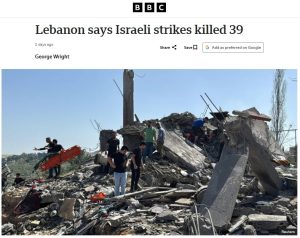 Not only does BBC withhold the names of those “rights groups,” depriving audiences of being able to make up their own minds about the sources of allegations of “war crimes,” but Wright also fails to provide any relevant examples and context that might explain why “entire villages have been destroyed.”
In an April 29 filmed report entitled “Watch: There’s a ceasefire in Lebanon – but the fighting hasn’t stopped,” BBC Jerusalem bureau’s Lucy Williamson told viewers (from 00:33):
Israel is also still demolishing buildings and infrastructure there. This week it blew up two large underground tunnels it says were used by elite Hezbollah fighters. [Italics added to words which Williamson emphasized.]
Williamson did not inform viewers of the location of those tunnels and neither did the footage that accompanies her statements.
The two tunnels in question were located in the town of Qantara – some 10 kms from the border with Israel – and the demolition operation took place on April 28. BBC audiences saw no stand-alone reporting on the topic of that operation and the Iranian regime enabled Hezbollah infrastructure and weapons it destroyed. As Times of Israel reported:
The Israel Defense Forces on Tuesday announced it had located and destroyed two major Hezbollah tunnels in the southern Lebanon town of Qantara, which it said were constructed by the terror group with “direct guidance” from Iran.
The tunnels were built over a decade, reaching depths of some 25 meters, and were “funded by the Iranian terror regime and as part of Hezbollah’s plan to conquer the Galilee,” according to the military.
The two tunnels — located near each other but not connected — spanned a total of some two kilometers in length, making it one of the longest underground systems found by the military in southern Lebanon to date.
Two days later, on April 30, the IDF announced the destruction of another tunnel. As Times of Israel reported at the time:
The IDF says it razed a 140-meter-long Hezbollah tunnel in the Ras al-Bayada headland south of Tyre, in southern Lebanon. …
Inside the tunnel, the IDF says troops located numerous weapons, as well as rooms where operatives would reside.
The IDF says the tunnel was “recently used by Hezbollah terrorists” to advance attacks.
Visitors to the BBC News website saw no stand-alone reporting on that story either.
On May 4, the IDF announced the destruction of a 30-meter-long Hezbollah tunnel. Times of Israel reported:
The tunnel had been used by Hezbollah to advance attacks, according to the military. Next to the tunnel, the IDF says troops located a cache that included some three tons of explosives, 43 Claymore-style mines, other mines, and anti-tank guided missile systems.
The next day, May 5, the IDF provided information concerning the destruction of a total of five tunnels south of the forward defense line.
In a report on Hezbollah tunnels, the Alma Research and Education Center stated:
The network consists of dozens, and possibly hundreds, of kilometres of five main types of tunnels: strategic tunnels, regional tunnels, approach tunnels (toward the border), attack tunnels (cross-border), and explosive tunnels. Beyond the functions described above, some of the tunnels also include launch positions for rockets and missiles, anti-tank and anti-aircraft missiles, secure movement routes for forces, and even passageways for small vehicles such as ATVs and motorcycles. …
It is important to understand this is not a localized project, but an entire combat doctrine. Hezbollah invested enormous resources in transforming its core areas of operation — Beirut’s Dahieh, the Beqaa Valley, and southern Lebanon — into a fortified military space above and below ground, while deeply embedding itself within the civilian environment.”
The BBC’s lack of interest in reporting the discovery and demolition of Hezbollah tunnels in southern Lebanon is of course highly reminiscent of its editorial approach to similar stories from the Gaza Strip.
In recent weeks alone, IDF forces operating on the Israeli side of the “yellow line” have destroyed four Hamas tunnels spanning a total of 800 meters, an 800-metre-long tunnel belonging to the Palestinian Islamic Jihad, eight Hamas tunnels with a total length of 2.5 kilometers in eastern Rafah and four more tunnels used by Hamas’ Khan Younis brigade to hold hostages with a total length of some four kilometers.
Such context is obviously relevant to descriptions of destruction of civilian infrastructure in both the Gaza Strip and Lebanon. However, rather than provide their audiences with that and additional relevant background, BBC journalists prefer to promote anonymous and unsubstantiated allegations of “war crimes.”