
In a pair of May 11 articles, The New York Times endeavored to solve the mystery of how Israel could end up with so many popular votes in the last two Eurovision contests. In “How to Win Eurovision With Just a Few Hundred Voters,” Times’ reporters Mara Hvistendahl and Alex Marshall were forced to concede Israel did nothing wrong.
Their companion article, “How Israel Turned Eurovision’s Stage Into a Soft Power Tool,” pivoted to analyze how Israel “used” the competition, suggesting nefarious political exploitation of a music event. But the report failed to show that Israel used Eurovision in any way that was different from other participating countries.
Eurovision is a 70-year-old song contest hosted by the European Broadcasting Union (EBU). Other non-European countries whose broadcasters are part of the EBU, including Australia, Israel, Cyprus, Azerbaijan and more, also competed. Juries from each participating country plus a popular vote determine the winner, with fans around the world selecting their favorites. Neither juries nor fans can vote for their own representative.
Israel won in 1978, 1979, 1998 and 2018. But it was Israel’s impressive popular vote in 2024 and 2025 that raised eyebrows. Given the anti-Israel sentiment that had been present at the 2024 competition in Malmo, a Slovenian broadcaster noticed what the authors called a “peculiar result.” The chairman of the board of Iceland’s broadcaster accused the Israeli government of “co-opt[ing] Eurovision.”
Hvistendahl and Marshall admitted there were no bots, no covert tactics, and no manipulation of votes. Buying advertisements? Legal. Coordinating social media messaging? Also kosher. Even the Eurovision director admitted Israel had done nothing wrong.
How could this be? The authors could not understand how countries where Israel is “deeply unpopular” still voted heavily for the Jewish state’s performer. They grasped for straws because they failed to appreciate the moment in Jewish history.
In 2024, Eden Golan represented Israel, where she placed second in the popular vote. The reporters’ analysis missed the pro-Israel sentiment unifying the Jewish world and its allies just seven months after the Hamas-led murderous invasion of Israel and while terrorists in the Gaza Strip still held 128 hostages. Such solidarity no doubt manifested in votes worldwide for Golan.
Politics played a role early on, as the EBU forced Golan to adjust her lyrics and change her song from “October Rain,” a reference to Hamas’ Oct. 7 attacks, to “Hurricane.” But Eurovision did not deem any Israeli promotions that year to be “excessive.”
Yuval Raphael, a Nova Music Festival survivor, represented Israel the next year. She hid in a roadside shelter under dead bodies for eight hours on Oct. 7, 2023. When she performed at Eurovision, there were still dozens of hostages held in Gaza, including 24 presumed alive. Jews worldwide were still protesting weekly for their release.
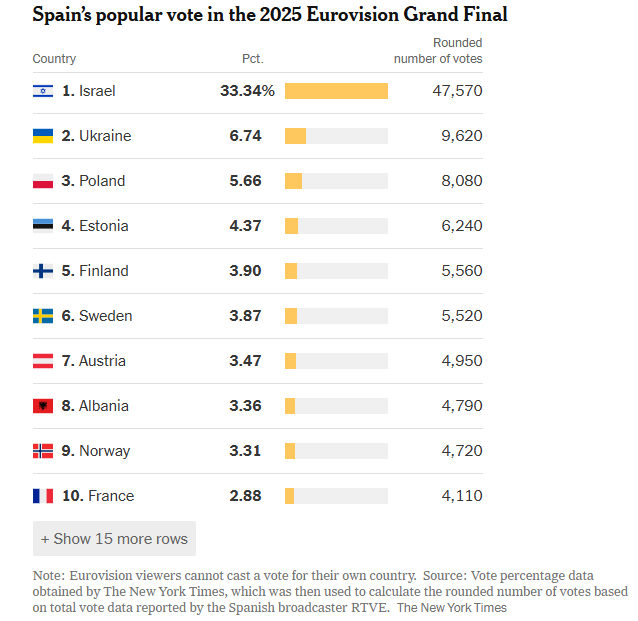
The Israeli prime minister and pro-Israel and diaspora groups encouraged people to vote for her. She finished second place overall and won the popular vote, including in countries where, as The Times wrote, “people have been outspoken against Israel’s policies.” The authors again ignored Jewish and pro-Israel solidarity as a factor in her win.
The authors believe Israel’s promotion could have affected the popular vote because in some countries, few vote. Blaming Israel for exploiting low voting rates is unserious, and anyway, The Times offered no data to support the contention that people who dislike Israel also vote in Eurovision. Eurovision director Martin Green told The Times that Israel did not violate rules and there was nothing wrong with the voting system.
In fact, Eurovision created a system that promotes the power of a small voter base. For example, the authors revealed, the director of a Norwegian pro-Israel organization urged his 15,000 members to vote for Israel. When they did, Eurovision sent an automated reply encouraging them to vote up to 20 times. (The uproar over Israel’s success in the popular vote resulted in a change of the rules, so as of 2026, only 10 votes are allowed per person.)
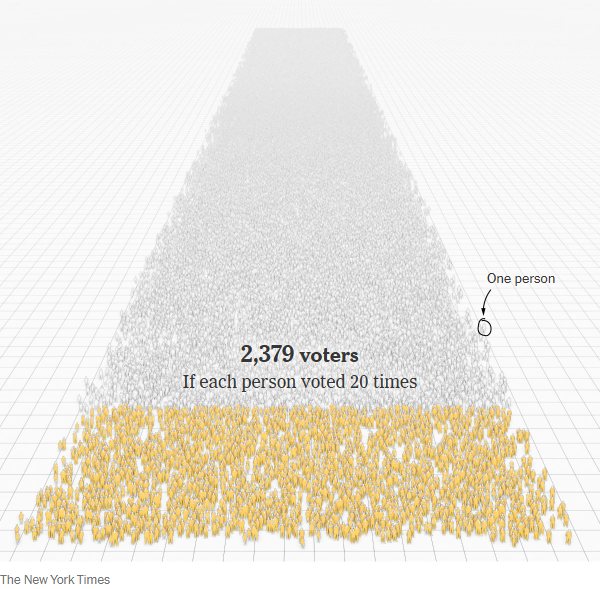
Israel’s 2026 entrant, Noam Bettan, briefly ran a campaign encouraging voters to “vote 10 times for Israel,” but Israel’s broadcaster stopped promotion and removed the videos immediately after Eurovision requested that it do so.
The Jerusalem Post reported that Malta and Poland had similar promotional campaigns with no rebuke. Other countries spent money flying their artists to pre-parties to win over fans. Yet, it was only Israel’s enthusiasm that was described by The Times as more “extensive and controversial” than any other country.
There was no scandal.
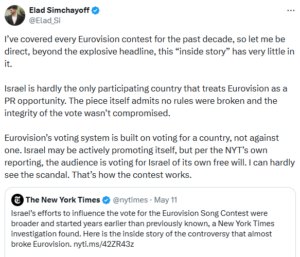
So instead, The Times argued Israel was using Eurovision as a soft power tool.
They alleged that because the Israeli government spent money on Eurovision-related advertising and in 2025, Prime Minister Netanyahu posted a graphic on his social media account which encouraged people to vote the maximum number of times for Raphael, this “politicized” the event. Meanwhile, the five-country boycott of Eurovision this year politicized the competition far more than any Israeli ad did.
The Jerusalem Post further eviscerated the “soft power tool” argument, writing, “Americans are famously indifferent to . . . Eurovision . . . so perhaps The New York Times reporters could not have been expected to know that every participating country uses its participation in Eurovision to promote its country’s image abroad.”
When The Times could not implicate Israel for cheating, it sought to vilify the Jewish state with the soft power argument. As The Post observed, “[n]o one noted the irony in the fact that this is the first time in history that ads by Israel’s foreign Ministry have been credited with having had worldwide influence…”
Some fans no doubt voted for the Israeli singer as a demonstration of support and unity. Others likely loved the song and performance. In thousands of words, numerous graphs and two articles, The Times never considered either of these endearing possibilities.