
Was Al Jazeera’s Anas al-Sharif a “terrorist” serving Hamas?
This is the question many have debated since an Israeli strike on August 10 killed him in Gaza. It is an important legal and moral inquiry—but it misses another equally vital question: Was al-Sharif a journalist in any meaningful sense of the word, regardless of his alleged terror affiliation?
This second question matters not only for the truth of his story, but for the credibility of countless reports emerging from Gaza.
Was Sharif a Terrorist?
Evidence of al-Sharif’s alleged ties to Hamas has been presented elsewhere. Multiple Hamas documents captured by the Israel Defense Forces (IDF) reportedly refer to him as a Hamas fighter, and photographs show him alongside senior Hamas leaders, including Yahya Sinwar, the architect of the October 7 massacre.
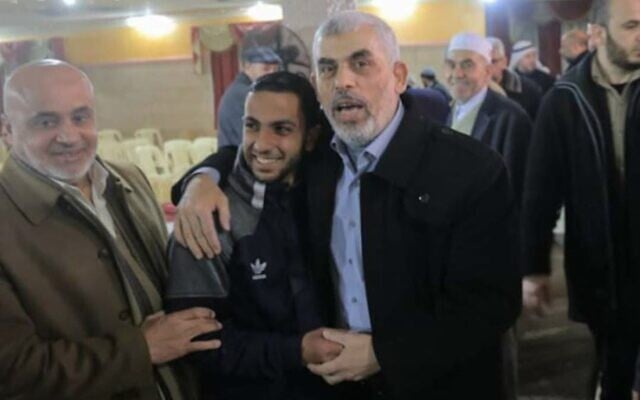
An undated image showing Hamas leader Yahya Sinwar embracing Anas al-Sharif.
Still, the debate persists. Outlets such as CNN (“Anas Al-Sharif became the face of the war in Gaza for millions. Then Israel killed him,” Aug. 12, by Mostafa Salem) say they cannot independently verify the documents. That skepticism is fair—rigorous journalists should always seek verification—though CNN’s inconsistent application of such standards raises questions.
Note, too, which side @CNN‘s journalists take for their word and which side they “cannot independently verify.”
A double standard can be many things – discrimination, activism, etc. – but it is not credible journalism, @CNNPR. https://t.co/OZWVIcO8Kl pic.twitter.com/jfoUphDmBN
— David Litman (@dmlitman) August 11, 2025
Was Sharif a Journalist?
In reacting to al-Sharif’s death, Ian Williams, president of the Foreign Press Association in New York, told CNN: “Frankly, I don’t care whether al-Sharif was in Hamas or not.”
The remark was revealing. It implied that his potential Hamas role was irrelevant to his status as a journalist. In reality, it should have been decisive.
Even if al-Sharif was not a Hamas operative at the time of his death, both CNN and the BBC have acknowledged that he previously worked “for a Hamas media team in the [Gaza] Strip.” That role makes him a terror propagandist, not an independent reporter.
After that, he joined Al Jazeera—a Qatari state-controlled network whose government openly supports and funds Hamas.
Al-Sharif’s own public record leaves little doubt about his allegiances. As documented by CAMERA’s Tamar Sternthal (“Journalistic Casualty: When Hamas Documents Aren’t Substantiation”), he repeatedly glorified Hamas and expressed partisan extremism. On October 7, while the massacre was still unfolding, he posted praise to God for the ongoing murder and kidnapping of civilians.
To all the journalists who’ve reached out to me about whether this screenshot is real — yes, it 100% is.
Anas deleted it once I exposed the truth about him, but I archived it here:https://t.co/fyUjslbux4 pic.twitter.com/hsu5jFZE1B
— Eitan Fischberger (@EFischberger) August 11, 2025
Yet CNN and others, in covering his death, omitted this background and instead portrayed him as an intrepid truth-teller: “His reports provided first-hand accounts of critical moments in the conflict.” Such framing ignores the fact that these “accounts” were filtered through someone with an open history of promoting Hamas’s narrative.
Trusting al-Sharif’s coverage would be akin to relying on an unrepentant former member of Islamic State’s Al-Furqan media arm to report impartially on the coalition’s campaign against ISIS.
What This Says About Gaza Coverage
CNN’s treatment of al-Sharif reflects a troubling disregard for journalism’s core principle of independence, particularly concerning conflicts of interest.
This is not an isolated lapse. In February 2024, CAMERA revealed that CNN was publishing work by Khader Al Za’anoun, who was simultaneously a propagandist for the Palestinian Authority’s official news agency. Similarly, in 2018 CAMERA alerted AP News to the Hamas affiliation of Hassan Eslaiah—yet AP continued using him through and beyond the October 7 attacks.
These incidents highlight an alarming tolerance of propagandists serving in the role of reporters. When organizations like the Foreign Press Association and CNN dismiss or ignore such conflicts of interest, they erode the profession’s credibility and betray the trust of fair-minded media consumers.
Trust in journalism relies on the industry’s professionalism, independence, and ethical boundaries. Abandon those, and the line between reporting and propaganda disappears.