
If, as Fred R. Barnard popularized, “a picture is worth a thousand words,” then the slew of publications that used graphics to demonize Israel in the weeks surrounding Yom HaShoah (Holocaust Remembrance Day) spoke volumes, relying heavily on the cynical weaponization of Jewish trauma and visual stereotyping.

Stephen Kapos sitting pictured on the right, among holocaust survivors and descendants demonstrating in London, June 4, 2025. (credit: RolandR, CC0, via Wikimedia Commons)
On Apr. 12, The New York Times published Olivier Kugler’s illustration that centered on Holocaust survivor Stephen Kapos, who Kugler surrounded with pro-Palestinian slogans like “Stop the genocide in Gaza” and accusations that Israel exploits Holocaust memory to shield itself from criticism.
While Holocaust survivors’ perspectives deserve public attention, especially around Yom HaShoah, it is notable that this was the only survivor narrative the paper chose to spotlight during a week dedicated to preserving the history of Nazi genocide.
Notably, the Times did not similarly elevate any survivor testimony focused on the Holocaust itself. By leveraging Kapos’ status as a Holocaust survivor to shield the claim that Israel is committing Nazi-like crimes against Palestinians, the Times amplified a libelous narrative against the Jewish state that inverts the Holocaust during a period meant to honor Holocaust victims and preserve the history of Nazi atrocities. Holocaust survivors are a dwindling global population around the world. As of April 2026, about half live in Israel, with the rest spread across various countries.
Their political views span the ideological spectrum, reflecting diverse personal histories and national experiences. In Israel, for example, Holocaust survivors who later served in the Knesset represented right-wing, centrist, left-wing, and religious parties, all of which were Zionist.
Survivors have testified that, during the Holocaust, Jews imprisoned in ghettos and concentration camps sang Hatikvah as the Nazis deported them in cattle cars, forced them into labor, and marched them to the gas chambers. At the liberation of Bergen-Belsen in April 1945, the BBC documented survivors singing Hatikvah.
At the time, the Zionist folk song was an expression of resistance. In Israel’s War of Independence, Holocaust survivors made up approximately half of the fighting forces. Their descendants today make up every corner of Israel’s societal fabric.
Tokenizing one member of this diverse group that endured unimaginable trauma is intellectually dishonest, morally reductive, and erases the complexity of a people whose six million murdered were denied the chance to tell their own stories—or to live to see the Jewish state that so many of them dreamed of.
By only representing Kapos’ view, it made it appear as if his is a common view among Holocaust survivors, and, consequently, it created a permission structure for its audience to libel Israel free from the fear of crossing the line into antisemitism.
L’Espresso magazine stereotypes all Israeli soldiers
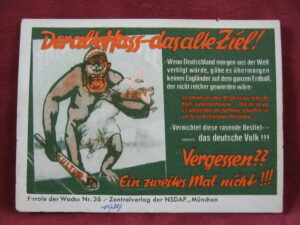
“The Old Hatred – The Old Gold!” Nazi propaganda poster from Germany, 1939. (credit: Harry Ryle Hopps, Public domain, via Wikimedia Commons)
On April 10, 2026, Italian left-leaning weekly magazine, L’Espresso, plastered newsstands with a cover portraying a religious Israeli soldier baring his teeth at an Arab woman in the West Bank, using imagery so grotesquely stereotyped it echoed the visual logic of classic antisemitic caricatures.
L’annessione della Cisgiordania, con i soldati complici dei coloni. Gaza annientata. L’avanzata in Libano. Il confine violato in Siria. La guerra all’Iran. Pulizia etnica e massacri. Così la destra sionista dà forma al Grande Israele
Il numero de L’Espresso, in edicola e su app pic.twitter.com/xXEeypA1l9
— L’Espresso (@espressonline) April 13, 2026
The cover went viral on social media, prompting condemnation from Israel’s Ambassador to Italy Jonathan Peled who said the image “distorts the complex reality Israel must live with, promoting stereotypes and hatred.”
Regardless of what occurred in the incident in which the photograph was taken, the photographer used this Israeli soldier to portray all Israeli soldiers in a negative light.
L’Espresso described the cover image as showing “a man wearing a kippah and peyot,” with a smirk signifying his “inhumanity” towards a Palestinian girl. But the photo portrays an adult woman, not a girl. The magazine’s misleading depiction relies on a selective snapshot of the soldier’s least flattering expression, reducing him to a violent caricature through stereotypical imagery, while presenting the Arab woman sympathetically.
Politico’s not-so-subtle cartoon
While the Times and L’Espresso engaged in more insidious forms of vilification, just a couple of weeks earlier, on Mar. 27, Politico published an overtly bigoted illustration. The illustration depicted various elected Republican leaders in bloodstained Jewish ritual garb, with imagery invoking long-standing antisemitic tropes of Jewish greed, covert control, and bloodlust. The cartoon contributed to propagating the bigoted trope that Jews nefariously influence America and cause mass suffering. Politico acknowledged the illustrator’s reliance on “ethnic stereotypes” and “tropes that have been involved in historically hateful ways” in a statement after deciding to remove the illustration after public outcry, however the damage was already done.
Across these illustrations, the recurring pattern is not simply criticism of Israeli policy, but the use of exaggerated visual shorthand that crosses the line of political critique into demonization of the Jewish state (a core tenet of the widely adopted International Holocaust Remembrance Alliance definition of antisemitism). These images recall a central tactic of Nazi and Soviet propaganda: reducing Jews to grotesque symbols rather than complex human beings, transforming a people into embodiments of collective evil.
The use of this imagery by media outlets waters complex realities down to visual indictment and dehumanization. The repeated use of these images casts Israel as uniquely blood thirsty and belligerent, echoing the same recycled propaganda tactics historically used to incite violence against the Jews.