
Within hours after the United States and Israel launched their opening strikes against the Islamic Republic of Iran on Feb. 28, images began to circulate of a bombed girls’ school in the Iranian city of Minab. International media outlets quickly adopted the unverified claims of sources closely aligned with the Iranian regime blaming the United States and Israel, and some cited as fact the unconfirmed rising death toll.
Al Jazeera, for example, reported as fact that Israel hit the school, claiming: “The death toll from an Israeli strike that hit an elementary girls’ school in Minab, a city in the Hormozgan province of southern Iran, has risen to 165 people, Iranian state media reported.”
Israel stated that it had no knowledge of any strike in that area. Meanwhile, U.S. Secretary of State Marco Rubio told reporters that American forces “would not deliberately strike a school” and that they would investigate whether the United States had any responsibility.
While many media outlets choose simply to repeat the regime’s accusations — often without clearly identifying its source — social media quickly filled with alternative and contradictory claims.
‘It Was an Iranian Missile’
According to one widely circulated claim, the Minab school had been struck by a malfunctioning rocket launched by Iran’s Revolutionary Guards.
Open-source analysts quickly demonstrated that this claim was false. The photograph of the alleged errant missile had actually been taken more than 1,300 kilometers away from Minab.
This image is currently being reported as visual “proof” that a misfired AD system was responsible for the strike on a building reportedly housing a girls’ elementary school in Minab.
It’s not.That image was taken in Zanjan, over 1.3k kilometers from the school in Minab.
A 🧵 pic.twitter.com/jL7aca4rNj— Tal Hagin (@talhagin) February 28, 2026
‘The Islamic Republic Admitted the Error’
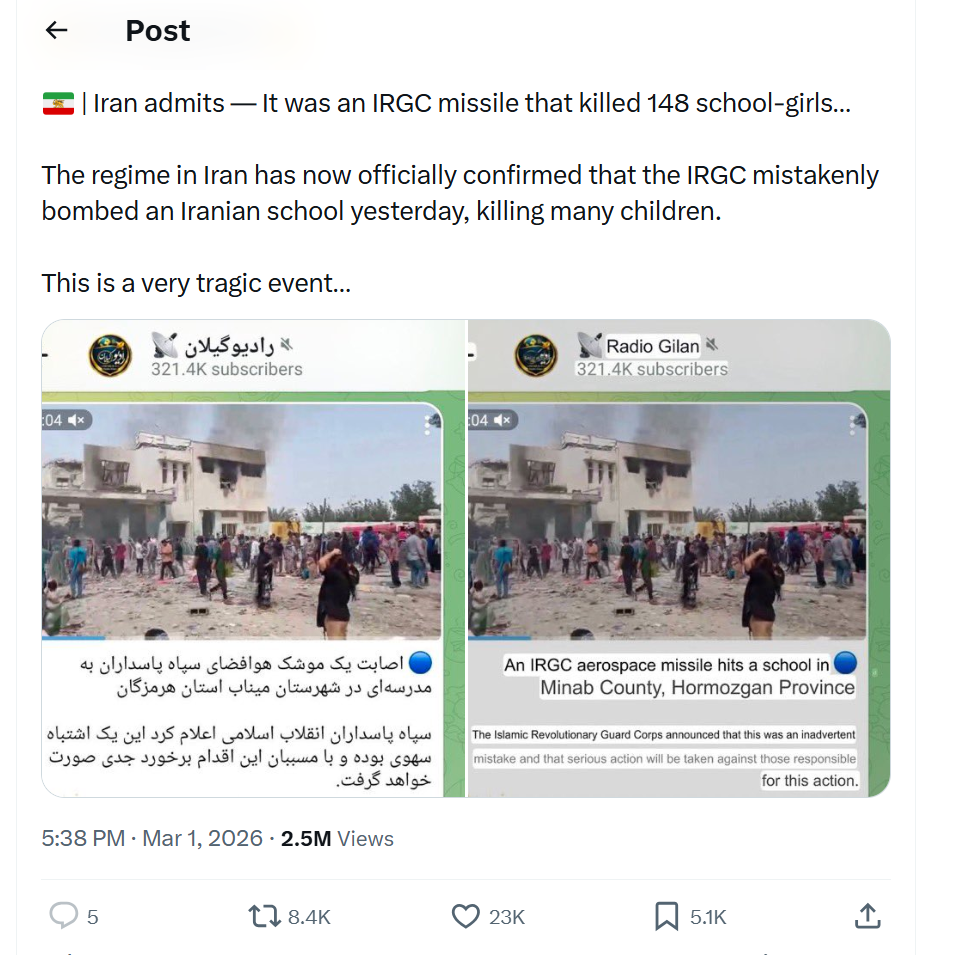 Another rumor, based on a Telegram account supposedly linked to the Iranian regime, claimed that the IRGC had admitted responsibility for the attack.
This claim also proved false. The Telegram account in question is not connected to the regime but to opposition figures.
‘Kabul 2021’
A third hoax—particularly widespread among Spanish-language accounts—claimed that the images of the bombed out school actually originated from a 2021 ISIS attack in Kabul.
The claim spread rapidly, and Spanish media outlets such as the influential wire service EFE, leading newspaper El País, and publicly funded RTVE faced criticism for allegedly using recycled Kabul images or fabricated pictures.
But, in fact, the images said to be of the destroyed Iranian girls’ school did in fact correspond to Minab, prompting the accused outlets to rush to defend themselves.
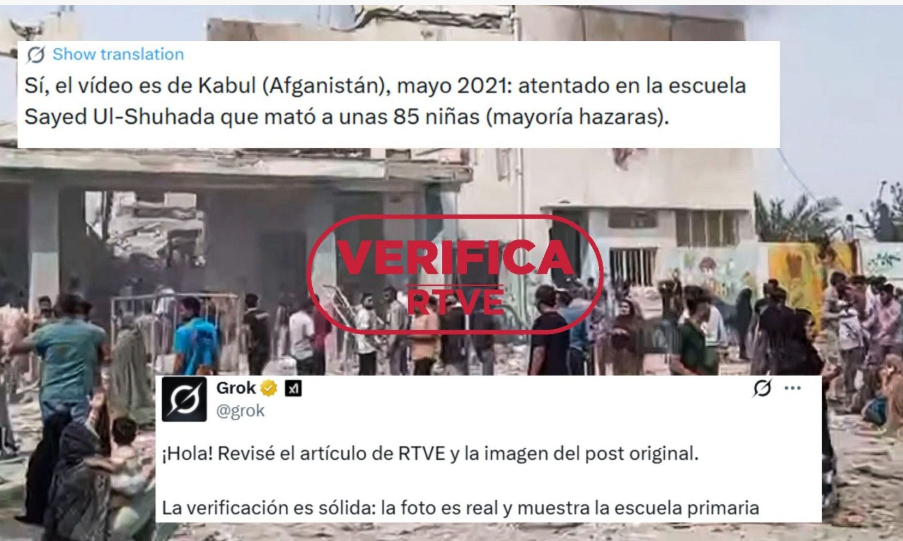
A screenshot of RTVE’s defense against false criticism that it falsely passed off an image from Kabul as a scene in Iran
Ironically, the media outlets’ preoccupation with defending themselves against false accusations of passing off old Kabul images as current scenes from Iran detracted from justified criticism of instances in which the mainstream news outlets provided less than rigorous reporting.
Debunking the Hoaxes — and Avoiding the Real Problem
As state-funded media outlets with wide international exposure, RTVE and EFE have an added responsibility to adhere to particularly high standards of journalistic rigor. Indeed, they seem to take this responsibility quite seriously with respect to exposing false information emanating from outside sources.
RTVE published several articles aimed at debunking viral misinformation.
Verifica RTVE, the network’s digital fact-checking unit, explained that the claim linking the images to Kabul had been generated using the AI tool Grok.
Notably, in contrast the extensive debunking efforts focused on false claims circulating on social media, RTVE seems oblivious as to egregious professional failures in its own reporting—failures that increasingly appear to be a common modus operandi in traditional media.
In other words: what if the more significant misinformation was not the viral rumor, but the initial reporting?
Consider RTVE’s own coverage.
The outlet published at least three articles explaining why those accusing RTVE of misinformation were themselves mistaken.
In one of those texts defending its journalistic practices, RTVE writes:
At 14:36 on February 28, RTVE Noticias published that, according to the Iranian government, Israel had massacred girls by bombing a school in Minab. [Emphasis added.]
But that is not accurate.
The original 14:36 headline did not identify the source. The first headline—“At least 53 girls killed in Israeli attack on school in southern Iran” (archived here)—presented the claim as an established fact. Contrary to its protestation, RTVE had not qualified with the attribution “according to the Iranian government.” Defending oneself by rewriting the record is hardly a demonstration of journalistic rigor.
Only about two hours later, after receiving complaints that the headline stated as fact that Israel is responsible without providing attribution, did RTVE update the article to clarify that the allegation came from one of the parties to the conflict.
The Spanish news agency EFE followed a similar pattern.
Attributing the attack to Israel and citing regime sources obscured as unspecified “authorities,” its headline stated: “Authorities confirm 85 dead in Israeli attack on girls’ school in Iran.”
Only the determined readers who reached the final paragraph of the article encountered an important clarification:
EFE has not been able to independently verify the scope of Israeli and U.S. attacks in the Islamic Republic, where international media are not allowed to access or film the affected locations.
What Do We Actually Know?
At the time of the Feb. 28 reporting in question, very little was actually known.
One such analyst, known as Martin Tuitero, who early on warned that the “Kabul” claim was false, examined videos of funerals in Minab and noted that evidence of mass casualties appears limited or unclear. Only a small number of coffins are visible, few family members appear present, and the events show a heavy military presence. There is no clear evidence that the bodies belong to schoolchildren, nor images of victims.
Opposition media outlets critical of the Iranian regime, such as the account @mamlekate, claim that the Shajareh Tayyebeh school in Minab is located adjacent to an IRGC naval base and was originally built for the children of military personnel. The source also claimed that the complex included administrative and command offices linked to the IRGC and that the reported injuries from the strike may have been limited or exaggerated.
While such debates unfolded online—often involving detailed verification efforts—official media outlets were publishing definitive headlines without clearly identified sources, debunking minor viral claims, and lecturing others about journalistic rigor.
Not until a week later did enough information emerge to bring some clarity to the murky picture, as major media outlets published detailed investigations concluding that U.S. forces targeting the nearby IRGC naval facilities hit the school.
For the Spanish version of this article, see CAMERA Español.